Last updated
AI Startup Financial Model: GPU Costs and Margins (2026)
An AI startup financial model is a dynamic framework that projects revenue, compute costs, and gross margin for a business where GPU infrastructure is the primary cost of goods sold. It differs from traditional SaaS models because cost scales non-linearly with usage, inference costs dominate the P&L, and gross margin depends on hardware efficiency rather than software delivery costs alone.
By Tim Kozin
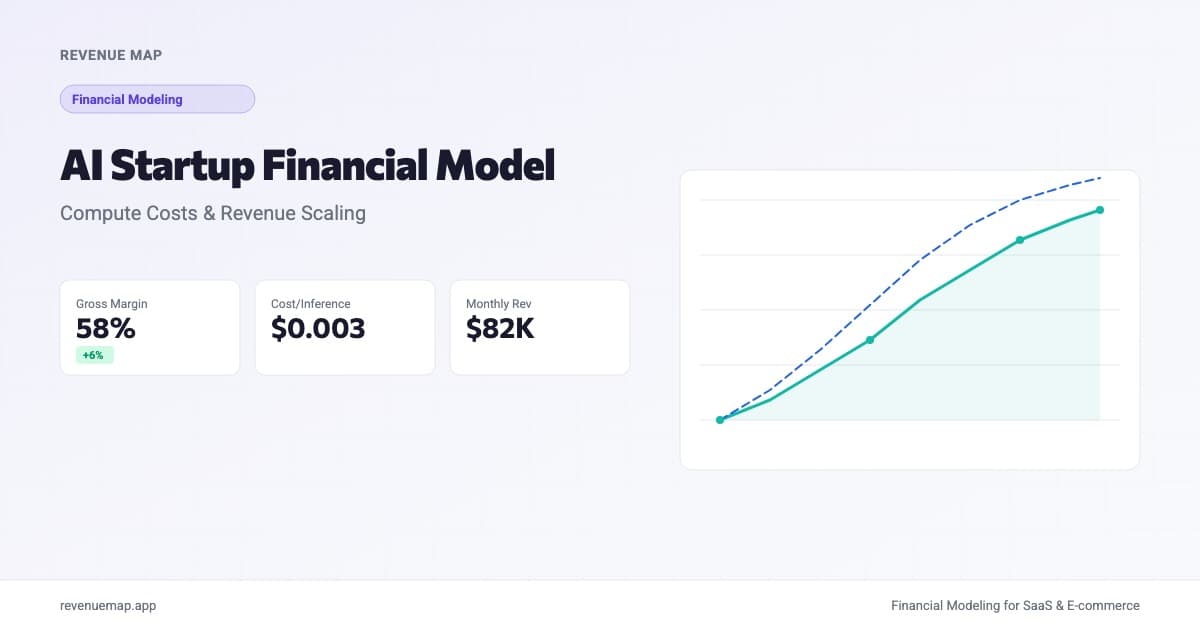
An AI startup financial model is a structured framework for projecting how your AI business generates revenue, consumes compute resources, and converts inference volume into profit, built around the reality that GPU costs, not headcount or hosting, are your dominant cost of goods sold. If you are searching for how to build a financial model for an AI startup, the answer starts with one principle: your unit economics are measured in cost per inference, not cost per seat.
Traditional SaaS financial models assume near-zero marginal cost per user. AI businesses don't have that luxury. Every API call consumes GPU cycles. Every inference request has a real, measurable cost. And that cost doesn't scale linearly, it scales with model complexity, context window size, batch efficiency, and hardware utilization rates. A financial model that doesn't capture these dynamics will systematically misrepresent your margins, your runway, and your path to profitability.
What Makes AI Financial Models Different?
AI financial models differ from SaaS models in one fundamental way: the primary cost of goods sold is GPU compute, not software delivery infrastructure, and that cost scales non-linearly with usage.
In a traditional SaaS business, adding the next 1,000 users costs almost nothing in incremental infrastructure. Server costs exist, but they're a rounding error on the P&L. In an AI business, adding the next 1,000 users means adding the inference volume those users generate, and every inference request burns GPU hours that cost real money.
Three structural differences define AI financial modeling.
GPU costs as primary COGS. For most AI startups, compute represents 30-60% of revenue, compared to 5-15% for traditional SaaS hosting costs. This means your gross margin is a direct function of hardware efficiency, not just pricing power. A 10% improvement in inference speed translates directly to margin expansion in a way that has no equivalent in subscription software.
Inference vs. training cost separation. Training a model is a large, periodic capital expenditure. Running inference is an ongoing, variable operating cost. Your financial model must separate these two cost categories because they have entirely different scaling characteristics and budget cycles. Training costs are lumpy and front-loaded. Inference costs grow with every user you add and every request they make. Conflating the two makes both your cost projections and your capital planning unreliable.
Non-linear scaling dynamics. Doubling your user base doesn't double your compute costs, it might increase them by 2.5x or 3x, depending on whether your batching efficiency degrades, whether you hit GPU memory limits that force you to more expensive hardware, or whether peak-to-average load ratios worsen with scale. AI cost curves have inflection points that linear models don't capture.
Revenue Models in AI
AI startups monetize through four primary revenue models, each with different margin profiles, scaling characteristics, and financial modeling requirements.
API Usage-Based Pricing
The most direct model: charge per API call, per token, or per compute unit consumed. Revenue scales linearly with usage. The financial modeling challenge is that costs also scale with usage, so gross margin depends entirely on the spread between your price per call and your cost per inference. This model offers the clearest unit economics but requires the most granular cost tracking.
SaaS Wrapper
Package AI capabilities into a subscription product with a familiar per-seat or per-tier pricing model. Users pay a flat monthly fee; you absorb the variable compute costs. The modeling challenge here is that heavy users subsidize light users, and if your usage distribution shifts toward power users, gross margin deteriorates without any change in revenue. Your model needs a usage distribution assumption, not just an average.
Embedded AI
License your AI capabilities to other software products that integrate them into their own user experience. Revenue comes through licensing fees, revenue shares, or per-call charges to the integrating partner. The financial model must account for volume commitments, SLA-driven infrastructure provisioning, and the fact that a single enterprise partner can represent 20-40% of total inference volume.
Model-as-a-Service
Offer fine-tuned or specialized models that customers deploy in their own infrastructure or access through dedicated endpoints. Revenue is typically contract-based with minimum commitments. The cost structure differs because you may be providing model weights rather than running inference, shifting the compute cost to the customer while your costs focus on training and model maintenance.
| Company | Revenue Model | Pricing Structure | Implied Cost Structure |
|---|---|---|---|
| OpenAI | API usage-based | $0.50-$60 per 1M tokens (varies by model) | High inference cost, offset by massive scale |
| Jasper | SaaS wrapper | $39-$125/mo per seat | Absorbs variable API costs within flat subscription |
| Midjourney | Usage-based subscription | $10-$120/mo with generation limits | GPU-hours per image, batched rendering |
| Anthropic | API usage-based | $0.25-$75 per 1M tokens (varies by model) | Training amortization + per-inference GPU cost |
| Runway | Usage-based credits | $12-$76/mo with credit system | Video generation GPU cost per second of output |
Five Metrics That Define AI Startup Viability
Traditional SaaS metrics, MRR, churn rate, NRR, still matter for AI startups. But they're insufficient. AI businesses need five additional metrics that capture the compute economics unique to inference-heavy products.
1. Cost per Inference
Total GPU compute cost divided by total inference requests served. This is the foundational unit economic of your AI business. Track it weekly, segment it by model version and request type, and benchmark it against your revenue per inference. If cost per inference is rising while revenue per inference is flat, your margins are compressing with every new user you add.
Benchmark: LLM API calls typically cost $0.001-$0.02 per request. Image generation runs $0.01-$0.05. Video generation can exceed $0.10 per request. Know your number precisely, not approximately.
2. Gross Margin After Compute
Revenue minus all compute costs (inference GPU, model serving infrastructure, data transfer), divided by revenue. This is the AI-specific gross margin, and it's the number that determines whether your business has SaaS-like economics or hardware-like economics.
Benchmark: Target 50-70%. Below 40% signals that your pricing doesn't adequately cover your compute costs, your model is too expensive to run at current efficiency, or both.
3. Revenue per API Call
Total revenue divided by total API calls served. For usage-based models, this is your price. For subscription models, it's your implied revenue per call, monthly subscription revenue divided by actual calls consumed. The gap between revenue per call and cost per inference is your gross profit per unit. If that gap is negative, you lose money on every request and cannot make it up on volume.
4. Inference-to-Revenue Ratio
Total inference requests divided by total revenue. This metric tells you how many inferences you need to run to generate one dollar of revenue. A lower ratio is better, it means each inference is more valuable. Track this over time to detect usage pattern shifts that degrade economics. If users are making more calls without generating proportionally more revenue, your ratio is worsening.
5. Compute Efficiency Over Time
Cost per inference plotted month over month. This metric captures the combined effect of model optimization (quantization, distillation, pruning), infrastructure improvements (better GPU utilization, smarter batching), and hardware cost changes (new GPU generations, pricing shifts from cloud providers). A well-run AI operation should show 15-30% annual improvement in compute efficiency. If your cost per inference is flat or rising, your model serving stack needs attention.
These compute economics show up with extra weight in regulated, high-stakes applications. AI-powered diagnostics and clinical decision support tools layered into a healthtech financial model carry the same non-linear compute cost curve described above, plus the added compliance and validation overhead of deploying inference in a clinical setting, a combination that founders modeling AI-in-healthcare businesses need to plan for on both axes at once.
How to Build an AI Revenue Forecast
Build your AI revenue forecast bottom-up from inference economics, starting with users, scaling through usage patterns, and netting out compute costs to arrive at gross profit.
Step 1, Estimate monthly active users and calls per user. Start with your current user base. Multiply by average API calls per user per month. Be precise about usage patterns: a code assistant user might generate 500+ inference requests per day; a document summarization user might generate 15. Segment by user type if your product serves multiple use cases, a blended average will mask the economics of each segment.
Step 2, Calculate revenue per call. For usage-based pricing, this is your published rate. For subscription models, divide monthly revenue per user by average calls per user. This gives you implied revenue per inference, the number you'll compare against cost per inference to determine unit-level profitability.
Step 3, Model compute costs from GPU hours. Total inference requests multiplied by average compute time per request gives you total GPU-seconds required. Convert to GPU-hours. Multiply by your blended cost per GPU hour, which should account for your mix of reserved capacity (cheaper, committed), spot instances (cheapest, interruptible), and on-demand overflow (most expensive, flexible). Add 10-20% for model retraining and fine-tuning cycles.
Step 4, Calculate gross profit. Gross revenue minus total compute costs equals gross profit. Express as a percentage for gross margin. This is the number that tells you whether your AI business is economically viable at its current scale, and whether scaling improves or degrades that viability.
Worked example, InferenceAI Corp: 5,000 monthly active users. Average 300 API calls per user per month = 1,500,000 monthly inference requests. Revenue per call: $0.008. Monthly gross revenue: $12,000. Average compute time per inference: 0.8 seconds. Total GPU-seconds: 1,200,000 = 333 GPU-hours. Cost per GPU-hour (blended): $2.50. Monthly compute cost: $833. Model retraining (15%): $125. Total compute COGS: $958. Gross profit: $11,042. Gross margin: 92%.
Now stress-test: double users to 10,000 but assume batching efficiency drops 20% at scale. GPU-hours increase from 666 to 799 (not a linear 666). Compute cost rises to $2,123 including retraining. Revenue doubles to $24,000. Gross margin shifts to 91.1%, still healthy, but the non-linear cost increase is visible. At 50,000 users, if batching efficiency degrades further, the margin compression accelerates.
AI Gross Margin Calculator
Enter your monthly revenue, GPU hours consumed, and cost per GPU hour to calculate your AI gross margin percentage after compute costs.
Benchmarks by AI Model Type
Different AI product categories operate at fundamentally different cost structures. Your financial model should benchmark against the category that matches your product, not against a generic "AI company" average that blends unlike economics.
| AI Model Type | Cost per Inference | Target Gross Margin | Typical ARPU (Monthly) | Scaling Curve |
|---|---|---|---|---|
| LLM API | $0.001 – $0.02 | 40 – 60% | $200 – $5,000 (developer) | Sub-linear, batching and caching improve with scale |
| Image Generation | $0.01 – $0.05 | 50 – 65% | $20 – $120 (consumer/prosumer) | Linear to slightly super-linear, each generation is independent |
| Code Assistant | $0.002 – $0.01 | 60 – 75% | $10 – $40 (per seat) | Sub-linear, high cache hit rates on common patterns |
| Data Analytics AI | $0.005 – $0.03 | 55 – 70% | $500 – $10,000 (enterprise) | Sub-linear, query optimization and result caching reduce marginal cost |
How to read this table. Cost per inference is your COGS floor, the minimum you spend to serve one request. Target gross margin is where well-optimized companies in the category operate; if you're below the range, your serving stack or pricing needs work. ARPU determines how much inference volume you can afford per user before margins compress. The scaling curve tells you whether adding users makes your economics better (sub-linear) or worse (super-linear).
LLM APIs benefit most from scale because KV-caching, prompt caching, and batched inference amortize fixed GPU costs across more requests. Image generation scales less favorably because each generation is relatively independent, there's less shared computation to amortize. Code assistants sit in a favorable position because common code patterns create high cache hit rates that reduce effective cost per inference significantly at scale.
Common Mistakes in AI Financial Modeling
1. Not modeling inference cost scaling separately from user growth. The most dangerous mistake in AI financial modeling is assuming compute costs scale linearly with users. They don't. Batching efficiency, GPU memory limits, peak load ratios, and model complexity all create non-linear cost dynamics. A model that projects compute costs as a fixed percentage of revenue will understate costs at scale, sometimes dramatically. Build your cost model from GPU-hours up, not from a percentage down.
2. Ignoring model retraining costs. Inference costs get all the attention. But models degrade over time, data drift, user behavior changes, and competitive pressure all require periodic retraining or fine-tuning. Retraining a large model can cost $50,000-$500,000+ depending on size and data requirements. If your financial model doesn't include a retraining budget, typically 10-20% of total compute spend, on a quarterly or semi-annual cycle, your cost projections are systematically low and your gross margin is overstated.
3. Assuming constant GPU prices. GPU costs are not stable. Cloud provider pricing changes with supply constraints, new hardware generations, and competitive dynamics. NVIDIA's pricing power, hyperscaler capacity buildout, and the emergence of alternative chips (AMD, custom ASICs) all affect your cost per GPU-hour over a 12-24 month horizon. Build your model with a GPU cost assumption that can be varied by scenario, not a single fixed rate. The conservative case should assume 10-20% price increases; the aggressive case can model 15-25% decreases from efficiency gains and hardware competition.
4. Tracking vanity user metrics without connecting them to revenue. An AI product with 100,000 registered users sounds impressive. But if only 8,000 are active, average calls per user is 50 per month, and revenue per call is $0.003, that's $1,200 in monthly revenue from 400,000 inference requests, which might cost $800 in compute. The financial model needs to decompose users into active users, active users into inference volume, and inference volume into revenue and cost. Headline user counts disconnected from usage economics are vanity metrics that obscure whether the business works.
Key Takeaways
- GPU compute is your primary COGS, not a line item, AI gross margins are determined by inference efficiency and hardware costs, making cost per inference the fundamental unit economic that every other metric depends on
- Separate training costs from inference costs in your model, training is a periodic capital expenditure; inference is a variable operating cost that scales with every user and every request; conflating them makes both your cost projections and capital planning unreliable
- Target 50-70% gross margin after compute, below 40% signals pricing or efficiency problems that will compress valuation multiples; track margin monthly because it shifts with usage patterns, model changes, and GPU pricing dynamics
- Model non-linear scaling explicitly, compute costs don't double when users double; batching efficiency, memory limits, and peak load ratios create inflection points that linear projections miss, and missing them means underestimating costs at exactly the scale where capital efficiency matters most
AI financial modeling requires a fundamentally different approach than a traditional startup financial model for SaaS. Your costs are variable, your margins depend on hardware efficiency, and your unit economics are measured in inference requests, not seats or subscriptions. Start by tracking cost per inference with the same rigor you'd apply to MRR in a SaaS business, and build every projection from that foundation upward. Revenue Map's AI/ML financial model supports this workflow: define your AI cost structure, model inference scaling across scenarios, and track actual compute costs against projections each month so your model gets smarter as your business grows. Calculate the metrics that drive it: gross margin, NRR, burn rate, and runway.
Related industry models
Building a model for a different sector? These sibling guides cover the economics unique to each vertical.
- FinTech Financial Model: Transaction Revenue, Compliance Costs, and Growth ProjectionsLearn how to build a fintech financial model that accounts for transaction-based revenue, regulatory compliance costs, and multi-vertical growth projections. Covers payments, lending, neobanking, and insurtech.
- HealthTech Financial Model: Patient Acquisition, Retention Metrics, and Revenue ProjectionsLearn how to build a financial model for a healthtech startup. This guide covers patient acquisition costs, clinical retention metrics, payer mix modeling, and revenue projections across telehealth, digital therapeutics, and health SaaS.
- EdTech Financial Model: Forecasting and Unit EconomicsBuild an EdTech financial model from student acquisition through completion to revenue. Free framework for subscription, per-course, cohort, and B2B pricing.
- GameTech Financial Model: Player LTV, Monetization Metrics, and UA EconomicsBuild a GameTech financial model from player-level unit economics. Learn how to forecast DAU, ARPDAU, player LTV, and UA payback across casual, mid-core, hyper-casual, and RPG game types.
Related Articles
Usage-Based Pricing Model: How to Forecast Consumption Revenue
Learn how to build a usage-based pricing model for API, AI, and infrastructure startups. Includes formulas, benchmarks, and a revenue calculator.
Cash Flow Projection Template for Small Business
Build a 12-month cash flow projection your lender will trust. Includes formulas, a free calculator, and line-by-line examples for restaurants, coffee shops, and more.
SaaS Revenue Model Template for Startups
Build a SaaS revenue model from scratch with MRR components, pricing tier math, and expansion revenue. Includes a free calculator and benchmarks.