Last updated
EdTech Financial Model: Forecasting and Unit Economics
An EdTech financial model projects revenue by mapping the student journey from acquisition through enrollment, completion, and retention. The key differentiator from standard SaaS models is completion rate, the percentage of enrolled students who finish a course or program, which directly drives retention, referrals, and lifetime value. MOOC completion rates average 5-15%, while cohort-based programs reach 40-70%.
By Tim Kozin
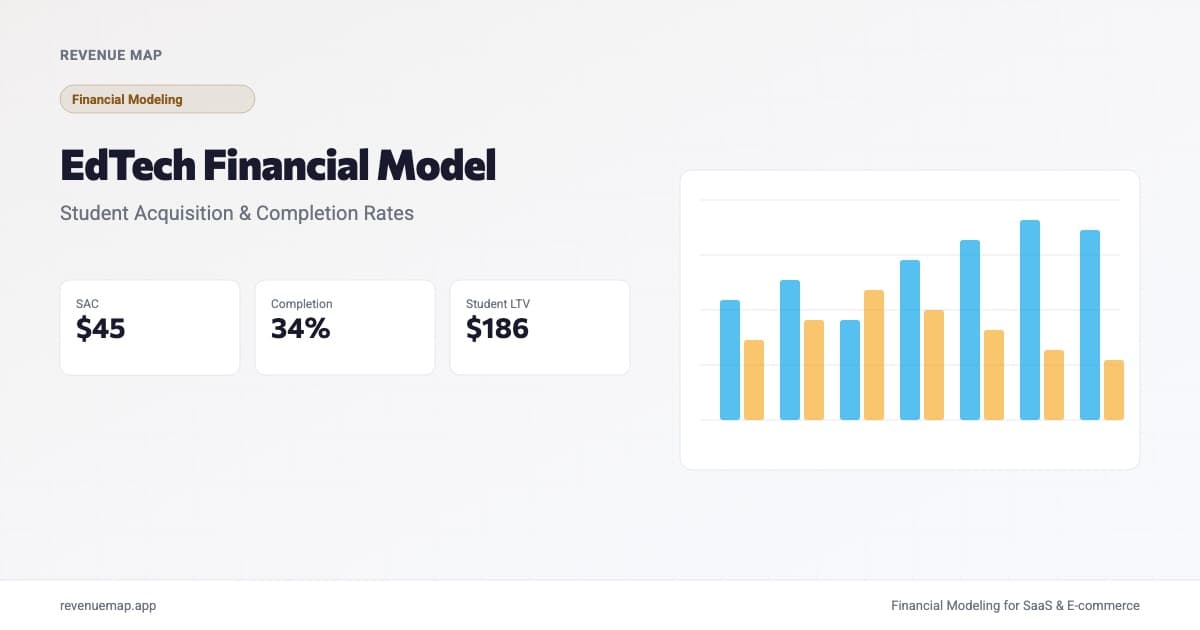
To build a financial model for an EdTech platform, map the full student journey, from traffic and signup through enrollment, completion, and retention, then layer your pricing model on top. The critical difference between EdTech and standard SaaS financial modeling is that completion rate, not just signup volume, determines whether your unit economics work. A platform with high enrollment and low completion will bleed revenue through churn, refund requests, and negative word-of-mouth. A platform with moderate enrollment and high completion will compound through retention and referrals.
This guide walks through the frameworks, metrics, and benchmarks you need to build an EdTech revenue forecast that reflects how education businesses actually generate and retain revenue.
What Is an EdTech Financial Model?
An EdTech financial model is a quantitative projection of how an online education business acquires students, delivers learning outcomes, and converts those outcomes into sustainable revenue.
Unlike a standard SaaS model where the product delivers value continuously upon login, EdTech has a unique challenge: the value proposition is an outcome. Students sign up to learn a skill, earn a credential, or advance their career. If they don't complete the course, they didn't receive the value, regardless of how many features you shipped or how polished your UI is.
This means your financial model must account for a layer that most SaaS models ignore entirely: the delivery of the core value proposition as a measurable event. Completion rate becomes the hinge that connects your acquisition spend to your revenue durability. Students who complete a course retain at 3-5x the rate of those who don't. They refer others. They buy the next course. They upgrade to premium tiers.
A well-built EdTech financial model captures five stages:
- Acquisition, traffic sources, cost per visitor, signup conversion
- Enrollment, free-to-paid conversion, course selection, initial payment
- Engagement, lesson progress, assignment completion, time-on-platform
- Completion, certificate earned, final assessment passed, program finished
- Expansion, retention, upsell to next course, referral, B2B licensing
Skip any of these stages and your projections will diverge from reality within two quarters.
Why Completion Rate Is Your North Star
Completion rate is the single most predictive metric for EdTech revenue durability, it drives retention, referral volume, pricing power, and ultimately lifetime value.
The industry data is stark. Self-paced MOOCs average 5-15% completion rates. Cohort-based courses with deadlines and peer accountability reach 40-70%. Bootcamps with intensive mentorship hit 70-90%. These aren't just pedagogical differences, they're unit economics differences.
Here's why completion rate cascades through your entire model:
Retention. Students who complete a course renew their subscription or purchase the next course at 3-5x the rate of non-completers. If your completion rate is 10%, you're losing 90% of your revenue base before they ever reach a renewal decision. No amount of win-back emails fixes that.
Referrals. Completers are the only students who generate organic referrals at scale. A student who dropped out of your course at lesson 3 isn't recommending you to colleagues. A student who earned a certificate and landed a promotion is. Your viral coefficient is a function of completion rate, not enrollment rate.
Pricing power. Platforms with high completion rates can charge more, because they can demonstrate outcomes. A coding bootcamp with 85% completion and 78% job placement can justify $15,000 tuition. A self-paced platform with 8% completion cannot justify $500, regardless of content quality.
Refund reduction. Low completion rates correlate with high refund request rates, particularly in higher-priced programs. Modeling a 10-15% refund rate on a low-completion product versus 2-3% on a high-completion product changes your effective revenue per enrollment significantly.
When you build your financial model, treat completion rate as an input variable and stress-test your projections at different levels. A 10-percentage-point improvement in completion often generates more incremental revenue than a 30% increase in marketing spend.
Four Revenue Models in EdTech
EdTech companies monetize through four primary models, each with distinct unit economics and forecasting requirements.
| Model | How It Works | Typical ARPU | Retention Driver | Best For |
|---|---|---|---|---|
| Subscription | Monthly/annual access to a content library | $15–$50/mo | Content freshness, habit formation | Broad skill platforms, language learning |
| Per-Course | One-time payment per course or certification | $50–$500 per course | Course quality, credential value | Professional certifications, niche skills |
| Cohort-Based | Fixed-date programs with live instruction | $500–$5,000 per cohort | Completion rate, peer community | Career transition, executive education |
| B2B (Institutional) | Licenses sold to companies or schools | $5,000–$500,000/yr per contract | ROI reporting, admin tooling | Corporate training, K-12 supplements |
Most EdTech companies blend two or more of these. A platform might offer a $29/month subscription for self-paced content and a $1,200 cohort-based bootcamp as an upsell. Your financial model needs to capture each revenue stream separately, because they have different acquisition funnels, conversion rates, and retention characteristics.
Subscription models are the easiest to forecast, they behave like SaaS with predictable MRR dynamics. The risk is low engagement leading to high churn.
Per-course models have lumpy revenue but lower churn anxiety. The challenge is repeat purchase rate, what percentage of students buy a second course?
Cohort-based models have the highest completion rates and strongest unit economics, but they require significant instructor investment and don't scale linearly.
B2B models have the highest contract values but longer sales cycles and more complex procurement. Model a 3-6 month sales cycle and plan for pilot-to-full-deployment conversion rates of 40-60%.
Five Metrics for EdTech Unit Economics
1. Student Acquisition Cost (SAC)
Total sales and marketing spend divided by new paying students acquired. This is your CAC equivalent. For B2C self-serve, target $20-$80. For cohort-based programs, $200-$600 is typical. B2B institutional sales often exceed $5,000 per contract, justified by the contract value.
Include everything: paid ads, content marketing salaries, affiliate commissions, free trial costs, and the portion of your sales team devoted to new business. Exclude customer success and onboarding, those are delivery costs, not acquisition costs.
2. Revenue per Student
Average revenue generated per student over a defined period. For subscription models, this is ARPU (average revenue per user per month). For per-course models, calculate average transaction value plus repeat purchase revenue over 12 months. For cohort programs, it's tuition minus refunds.
3. Completion Rate
Students who finish a course or program divided by students who enrolled, expressed as a percentage. Segment this by course, cohort, and acquisition channel. Students acquired through organic search complete at higher rates than those from paid social, because intent is different. Your financial model should reflect this.
4. Net Promoter Score and Viral Coefficient
NPS among completers predicts your organic growth rate. EdTech platforms with NPS above 50 among completers typically see a viral coefficient of 0.3-0.5, meaning every 10 completers refer 3-5 new students. At a 60% completion rate, that's 1.8-3.0 referrals per 10 enrollments. At a 10% completion rate, it's 0.3-0.5. The difference in your acquisition model is enormous.
5. Student Lifetime Value (LTV)
For subscription: monthly price multiplied by average retention in months. For per-course: average first purchase plus (repeat purchase rate multiplied by average repeat purchase value). For cohort-based: tuition minus refund rate, plus upsell revenue from advanced programs.
The LTV-to-SAC ratio should exceed 3:1 for a sustainable EdTech business. Below 2:1, you're subsidizing growth with capital. Above 5:1, you're likely under-investing in acquisition.
How to Build an EdTech Revenue Forecast
Follow this six-step funnel to project revenue from first principles.
Step 1, Traffic. Estimate monthly visitors by channel: organic search, paid ads, social media, partnerships, and referrals. Apply historical or benchmark conversion rates for each. Organic search traffic for EdTech keywords typically converts to signup at 3-6%. Paid social converts at 1-3%.
Step 2, Signup. Multiply traffic by signup conversion rate to get new registered users per month. Not all signups become paying students, many will remain on free tiers or abandon during onboarding.
Step 3, Enrollment. Apply your free-to-paid conversion rate. For freemium EdTech models, this typically ranges from 2-5%. For free-trial models with a time limit, 10-20%. For direct-purchase models with no free tier, this step merges with signup.
Step 4, Completion. Multiply paying enrollments by your completion rate to project how many students receive the full value proposition. This is the step most EdTech models skip, and it's the step that determines whether your retention assumptions are realistic.
Step 5, Retention and Referral. Model two retention rates: one for completers (typically 60-80% annual retention for subscriptions) and one for non-completers (typically 10-25%). Apply your viral coefficient to completers to project organic referral enrollments, which feed back into Step 3.
Step 6, Revenue. Multiply retained students by price to get recurring revenue. Add new enrollment revenue. Subtract refunds and failed payments. This gives you net revenue per month, which you can project forward with growth assumptions on traffic, conversion, and retention.
EdTech LTV Calculator
Enter your monthly subscription price and average retention duration to estimate student lifetime value.
Benchmarks by EdTech Model
Use these benchmarks to pressure-test your assumptions. If your model projects metrics significantly better than these ranges, challenge whether your inputs are realistic.
| Metric | MOOC Platform | Bootcamp | K-12 Supplement | Corporate Training |
|---|---|---|---|---|
| Student Acquisition Cost | $15–$40 | $300–$800 | $50–$150 (per school) | $2,000–$10,000 (per contract) |
| Completion Rate | 5–15% | 70–90% | 50–70% | 30–50% |
| Avg Revenue per Student | $120–$300/yr | $8,000–$18,000 | $5–$15/student/mo | $30–$100/seat/yr |
| Monthly Churn (Subscription) | 6–10% | N/A (cohort) | 3–5% | 1–3% (annual contracts) |
| LTV:SAC Ratio | 3:1–5:1 | 8:1–15:1 | 4:1–8:1 | 5:1–20:1 |
Bootcamps show the strongest unit economics because high completion rates drive high LTV, and the premium price point absorbs acquisition costs. MOOCs have the weakest per-student economics but compensate with volume, a 5% completion rate across 500,000 enrollments still produces 25,000 completers.
Corporate training benefits from low churn on annual contracts and high expansion revenue as companies roll out to additional departments. The challenge is the long sales cycle and the need for enterprise-grade reporting features that increase your development costs.
Common Mistakes in EdTech Financial Modeling
1. Using signup count as your growth metric. Signups are a vanity metric in EdTech. A platform with 50,000 signups and 2% enrollment conversion has 1,000 paying students. A platform with 10,000 signups and 15% conversion has 1,500. Report enrolled, paying students, not registered accounts. Your board deck should lead with active enrolled students, not total signups.
2. Not modeling content production costs. Unlike SaaS where the product is built once and distributed at near-zero marginal cost, EdTech requires ongoing content development. New courses, updated curricula, instructor compensation for cohort programs, video production, these are not one-time costs. Model content production as a recurring expense that scales with your catalog. A typical EdTech platform spends 15-25% of revenue on content development and maintenance.
3. Ignoring seasonality. EdTech enrollment is highly seasonal. B2C platforms see spikes in January (New Year's resolutions), September (back to school), and after major industry layoffs. K-12 follows the academic calendar. Corporate training budgets typically open in Q1 and have a use-it-or-lose-it spike in Q4. A monthly revenue model that assumes flat enrollment growth will be wrong every single month, even if the annual total is close.
4. Treating all students as one cohort. A student who finds you through an organic Google search for "learn Python" has fundamentally different intent, completion probability, and LTV than a student who clicked a Facebook ad offering a free mini-course. Segment your model by acquisition channel at minimum, and by program type if you offer multiple products. Blended averages hide the fact that one channel may have a 5:1 LTV:SAC while another is below 1:1.
Key Takeaways
- Completion rate is the defining metric, it drives retention, referrals, pricing power, and LTV in ways that signup volume never will. Model it explicitly and stress-test your projections at different completion levels.
- Segment your financial model by revenue type and acquisition channel, blended averages across subscription, per-course, cohort, and B2B revenue streams will produce forecasts that match none of them. Each stream has different conversion rates, retention curves, and cost structures.
- EdTech unit economics depend on the delivery model, bootcamps with 80% completion can sustain $800 SAC; MOOCs with 8% completion need SAC under $40. Your pricing and acquisition strategy must align with your completion rate reality.
- Model content production as a recurring cost, not a one-time investment, unlike pure SaaS, EdTech platforms must continuously invest in curriculum development, instructor compensation, and content updates. Budget 15-25% of revenue for content operations.
If you want to model how different completion rates and pricing structures affect your EdTech platform's long-term revenue, Revenue Map's EdTech financial model lets you set your student acquisition assumptions, retention curves, and revenue model in one place, then run scenarios to see which levers move the needle most. Calculate the core metrics directly: churn rate, LTV, CAC, and ARPU.
Related industry models
Building a model for a different sector? These sibling guides cover the economics unique to each vertical.
- Mobile App Financial Model: Free Template (2026)Build a mobile app financial model with MAU-to-MRR projections, unit economics, and real category benchmarks. Free LTV calculator and worked examples included.
- HealthTech Financial Model: Patient Acquisition, Retention Metrics, and Revenue ProjectionsLearn how to build a financial model for a healthtech startup. This guide covers patient acquisition costs, clinical retention metrics, payer mix modeling, and revenue projections across telehealth, digital therapeutics, and health SaaS.
- GameTech Financial Model: Player LTV, Monetization Metrics, and UA EconomicsBuild a GameTech financial model from player-level unit economics. Learn how to forecast DAU, ARPDAU, player LTV, and UA payback across casual, mid-core, hyper-casual, and RPG game types.
- AI Startup Financial Model: GPU Costs and Margins (2026)Build your AI startup financial model with GPU compute costs, inference pricing, and 2026 gross margin benchmarks. The numbers investors actually check.
Related Articles
Cash Flow Projection Template for Small Business
Build a 12-month cash flow projection your lender will trust. Includes formulas, a free calculator, and line-by-line examples for restaurants, coffee shops, and more.
SaaS Revenue Model Template for Startups
Build a SaaS revenue model from scratch with MRR components, pricing tier math, and expansion revenue. Includes a free calculator and benchmarks.
Budget vs Forecast vs Projection for Startups
Budgets, forecasts, and projections serve different purposes. Learn when to use each and how they connect in your startup financial plan.