HealthTech Financial Model: Patient Acquisition, Retention Metrics, and Revenue Projections
A healthtech financial model projects patient acquisition, clinical retention, and revenue across multiple payer channels for a digital health business. Unlike standard SaaS models, it must account for regulatory compliance costs, insurance reimbursement variability, and clinical validation timelines. Build it bottom-up from patient unit economics, acquisition cost, visit frequency, revenue per visit, and retention years, and stress-test against payer mix shifts.
By Tim Kozin
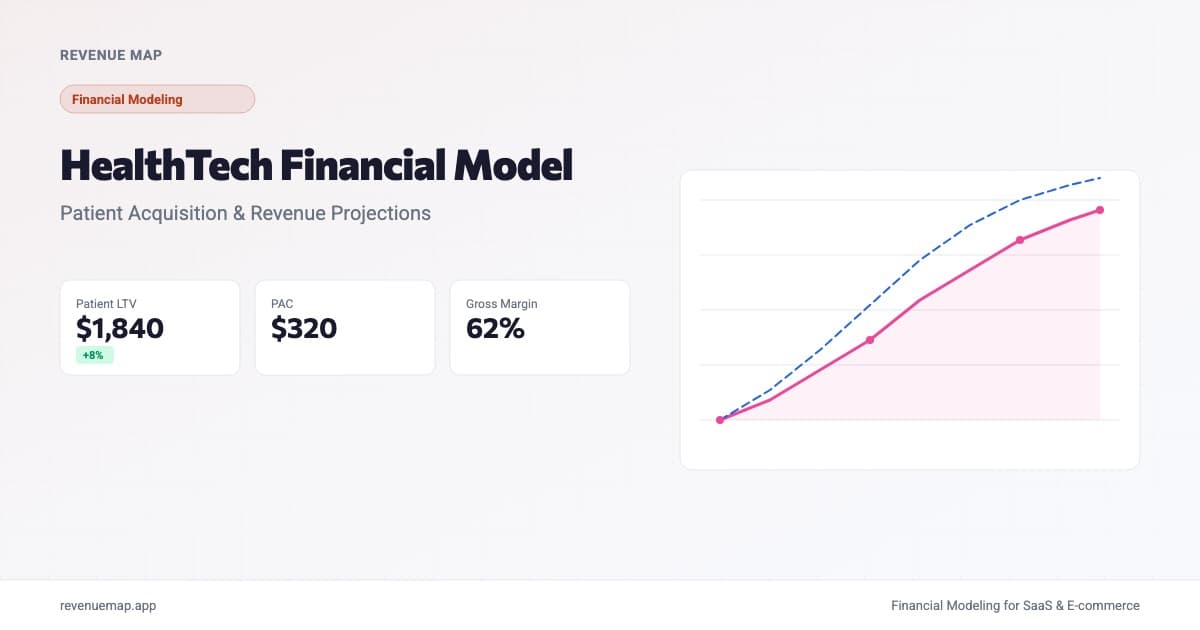
A healthtech financial model is a structured projection of how a digital health business acquires patients, generates revenue across multiple payer channels, and manages the cost structure unique to regulated healthcare, built to support operational decisions, fundraising, and clinical program investment. If you're asking how to build a financial model for a healthtech startup, the answer starts with patient unit economics, not a TAM slide. You need five numbers: patient acquisition cost, average revenue per visit, visit frequency, average retention period, and gross margin after compliance overhead. Everything else in the model is derived from those inputs, and the model is only useful if it accounts for the regulatory, reimbursement, and clinical dynamics that make healthtech fundamentally different from general-purpose SaaS.
What Makes HealthTech Financial Modeling Unique?
HealthTech financial modeling is defined by four structural forces that don't exist in standard SaaS: regulatory compliance costs, longer sales cycles, insurance and payer dynamics, and clinical validation requirements.
These aren't edge cases or footnotes. They reshape every assumption in the model, from gross margin to customer acquisition cost to revenue recognition timing. A SaaS financial model template applied to a digital health business will be wrong in predictable and dangerous ways.
Regulatory compliance is a fixed cost floor, not a variable expense. HIPAA compliance alone requires dedicated infrastructure, encrypted data storage, audit logging, BAA agreements with every vendor, annual risk assessments, and staff training. For early-stage healthtech companies, HIPAA compliance costs run $50,000–$150,000 annually before a single patient is seen. If your product requires FDA clearance (digital therapeutics, clinical decision support, remote monitoring devices), add $500,000–$2,000,000 and 12–24 months to your timeline. These costs don't scale down. They're table stakes.
Sales cycles in B2B healthtech are measured in quarters, not weeks. Selling to health systems, payers, or self-insured employers involves procurement committees, clinical validation reviews, IT security assessments, and legal review of BAAs. A typical enterprise healthtech sales cycle runs 6–18 months from first meeting to signed contract. Your model must reflect this: if you close your first enterprise deal in Q3, your revenue model shouldn't show enterprise revenue starting in Q1. The cash gap between sales investment and revenue realization is where healthtech startups run out of money.
Insurance and payer dynamics create revenue uncertainty that SaaS businesses don't face. When a patient uses your platform, the revenue you receive depends on who pays: the patient (self-pay), a commercial insurer, Medicare, or Medicaid. Reimbursement rates for the same service can vary by 40–60% across payer types. Commercial insurance might reimburse a telehealth visit at $120; Medicare at $75; Medicaid at $40. And reimbursement isn't guaranteed, claim denials, prior authorization requirements, and coding errors mean that collected revenue is typically 60–80% of billed charges. Your model must account for this gap.
Clinical validation is a prerequisite for growth, not a nice-to-have. Payers and health systems increasingly require clinical evidence before contracting with digital health companies. This means investing in outcomes studies, peer-reviewed publications, and real-world evidence, investments that cost $200,000–$1,000,000 and take 6–18 months to produce results. Model these as upfront investments with delayed revenue impact, not as ongoing operating expenses.
Three Revenue Models in Digital Health
Digital health companies operate under one of three revenue models, B2C, B2B, or B2B2C, and the choice reshapes every financial assumption from acquisition cost to gross margin.
Choosing the wrong revenue model, or failing to model payer mix accurately, is the most common structural error in healthtech financial models. Each model has different unit economics, different sales cycles, and different margin profiles.
B2C (Direct-to-Consumer Telehealth). The patient pays directly, either per visit or via a subscription. Think Hims, Cerebral, or Talkiatry. Acquisition is through paid digital channels (social, search, content). Revenue is predictable but per-patient value is constrained by willingness to pay out of pocket. Gross margins are high (65–80%) because there's no insurance billing overhead, but patient acquisition costs are also high and retention is volatile because switching costs are low.
B2B (Employer and Payer Contracts). The company sells to employers, health plans, or health systems, who then offer the product to their covered population. Revenue comes as a per-employee-per-month (PEPM) or per-member-per-month (PMPM) fee. Sales cycles are long (6–18 months) but contracts are large ($200K–$2M+ annually) and retention is high (85–95% annual) because switching costs are significant. Gross margins are moderate (55–70%) due to implementation, integration, and customer success costs.
B2B2C (Hybrid). The company contracts with an enterprise buyer but the end user is a patient or member who must be individually activated and engaged. Revenue depends on both closing the enterprise deal and achieving sufficient patient adoption within the covered population. This is the most complex model to forecast because revenue is a function of two conversion rates: enterprise close rate and patient activation rate.
| Dimension | B2C (DTC) | B2B (Enterprise) | B2B2C (Hybrid) |
|---|---|---|---|
| Who pays | Patient | Employer / Payer | Enterprise contract, patient uses |
| Typical deal size | $50–$300/patient/year | $200K–$2M/year | $100K–$1M/year + per-activation fee |
| Sales cycle | Days to weeks | 6–18 months | 3–12 months |
| Patient acquisition | Paid digital, SEO, referral | Enterprise sales team | Enterprise close + patient activation |
| Gross margin | 65–80% | 55–70% | 50–65% |
| Retention driver | Product experience | Contract terms, integration depth | Clinical outcomes, engagement |
| Key risk | High CAC, low switching cost | Long sales cycle, cash gap | Low activation rates post-contract |
Five Metrics That Define HealthTech Viability
A healthtech financial model must output five metrics that together determine whether the business has sustainable, scalable economics, and each metric carries nuances specific to healthcare.
1. Patient Acquisition Cost (PAC)
PAC is the total cost of acquiring a new patient, marketing spend, sales costs, clinical onboarding, and credentialing overhead divided by new patients acquired. In B2C telehealth, PAC typically runs $30–$80. In B2B, the relevant metric is cost per enterprise contract ($15,000–$50,000) divided across covered lives. The benchmark: PAC should be recovered within the first 6–9 months of the patient relationship. If payback exceeds 12 months, your unit economics require either higher retention, higher revenue per visit, or lower acquisition spend.
2. Patient Lifetime Value (LTV)
Patient LTV is the total net revenue a patient generates over their entire relationship with your platform. The formula: Revenue Per Visit x Visits Per Year x Average Retention Years. A telehealth patient generating $85 per visit, visiting 4 times per year, retained for 2.5 years has an LTV of $850. The LTV-to-PAC ratio should be at least 3:1, below that, growth consumes more capital than it creates.
3. Clinical Outcome Rate
Clinical Outcome Rate measures the percentage of patients who achieve a defined clinical improvement, symptom reduction, biometric improvement, or care plan adherence. This metric matters financially because it directly drives retention (patients who get better stay longer), payer contract renewals (payers require outcomes data), and referral rates (clinical success generates organic acquisition). Target: 60–80% depending on condition severity and intervention type.
4. Net Revenue Per Visit
Net Revenue Per Visit is the actual collected amount per clinical encounter after insurance adjustments, claim denials, and patient copay collection. It is not the billed amount. If you bill $150 for a telehealth visit but average collection is $95 after payer adjustments and a 12% denial rate, your Net Revenue Per Visit is $95. Model this number, not the charge amount, the gap between billed and collected revenue is where healthtech revenue projections go wrong.
5. Gross Margin After Compliance
Standard gross margin (revenue minus COGS) understates the true cost of delivering healthcare. Healthtech gross margin must include HIPAA infrastructure costs, clinical licensing and credentialing, malpractice insurance, quality assurance, and regulatory reporting. These costs are partially fixed and partially variable, and they don't disappear at scale. A healthtech company reporting 75% gross margin that hasn't allocated compliance costs is overstating margin by 10–20 percentage points. True healthtech gross margins after full compliance allocation typically run 45–65%.
How to Forecast HealthTech Revenue
Forecast healthtech revenue bottom-up through the patient funnel, from acquisition to visit frequency to revenue per visit to retention, not top-down from addressable market size.
Step 1, Model your patient acquisition funnel. Start with your monthly marketing spend and conversion rates by channel. If you spend $20,000/month on paid acquisition with a 3% landing-page-to-appointment conversion rate and 70% appointment completion rate, you acquire approximately 420 new patients per month. In B2B, model enterprise pipeline separately: deals in pipeline x close rate x average covered lives per deal x activation rate.
Step 2, Establish visit frequency by patient segment. Not all patients visit at the same rate. Segment by condition, acuity, and care plan. Mental health patients might average 3–4 visits per month; chronic condition management might average 1–2 per month; acute episodic care might average 1–2 per year. Weight your revenue projection by the mix of patient segments you serve.
Step 3, Apply net revenue per visit by payer type. Multiply visit volume by net revenue per visit, segmented by payer mix. If your payer mix is 40% commercial ($110/visit), 25% Medicare ($72/visit), 15% Medicaid ($38/visit), and 20% self-pay ($95/visit), your blended net revenue per visit is $84.90. Model payer mix shifts over time, as you add enterprise contracts or Medicare Advantage plans, the blend changes.
Step 4, Model retention curves, not flat rates. Patient retention in healthtech is not linear. Attrition is highest in months 1–3 (30–40% of patients drop off), stabilizes in months 4–12, and patients who remain past 12 months have significantly higher lifetime retention. Model a retention curve, not a flat monthly churn rate, it produces materially different LTV calculations.
Step 5, Calculate Patient LTV and validate against PAC. With visit frequency, net revenue per visit, and retention modeled, calculate LTV per patient segment. Validate that LTV exceeds PAC by at least 3x across all segments. If any segment falls below 2x, that segment is value-destructive at current economics, either improve retention, increase visit frequency, or reduce acquisition cost for that segment.
Patient LTV Calculator
Enter your average revenue per visit, visits per year, and average patient retention period to calculate Patient Lifetime Value.
Want to model this over 36 months with scenarios? Try Revenue Map free →
Benchmarks by HealthTech Segment
Use segment-specific benchmarks to validate your model assumptions, a telehealth company and a digital therapeutics company have fundamentally different unit economics.
| Metric | Telehealth (DTC) | Digital Therapeutics | Health SaaS (B2B) | Remote Patient Monitoring |
|---|---|---|---|---|
| Patient Acquisition Cost | $30–$80 | $150–$400 | $5K–$25K per contract | $80–$200 |
| Revenue / Patient / Month | $40–$120 | $100–$300 | $2–$10 PEPM | $50–$150 |
| Gross Margin (after compliance) | 50–65% | 55–70% | 60–75% | 40–55% |
| Annual Patient Retention | 30–50% | 40–60% | 85–95% (contract) | 50–70% |
| Time to Revenue | Immediate | 12–24 months (FDA + payer) | 6–18 months (sales cycle) | 3–6 months |
| Primary Payer | Self-pay / Insurance | Insurance / Employer | Employer / Health System | Insurance / Medicare |
These benchmarks reflect current market data for venture-backed digital health companies at Series A through Series C stage. Early-stage companies will typically see higher PAC, lower retention, and lower gross margins, the model should account for improvement trajectories as the business matures.
Common Mistakes in HealthTech Financial Modeling
1. Ignoring reimbursement variability. Modeling revenue at the billed charge amount, rather than the collected amount after payer adjustments and denials, systematically overstates revenue by 20–40%. A telehealth company billing $150 per visit that models revenue at $150 will be wrong by Q2. Model net revenue per visit by payer type, include a denial rate assumption (8–15% is typical), and track the billed-to-collected ratio monthly. This single correction changes your unit economics, your LTV calculation, and your runway projection.
2. Underestimating compliance costs. First-time healthtech founders consistently model HIPAA and regulatory costs at 30–50% of actual levels. The costs aren't just the initial audit and infrastructure, they're ongoing: annual risk assessments, penetration testing, staff training refreshers, BAA management, incident response readiness, and the engineering overhead of maintaining compliant data handling as you ship features. Budget 15–25% of operating costs for compliance in year one, declining to 10–15% at scale as fixed costs amortize across a larger revenue base.
3. Using wrong patient lifetime assumptions. Applying a SaaS-style 24–36 month average lifetime to healthtech patients produces wildly optimistic LTV projections. Real patient retention depends on condition type, clinical outcomes, and whether the patient's need is chronic or episodic. Mental health platforms see median patient lifetimes of 4–8 months. Chronic condition management platforms see 12–24 months. Episodic telehealth (urgent care, dermatology) sees 1–3 visits total with no ongoing relationship. Model retention by patient segment using actual cohort data, not a blended average borrowed from SaaS financial modeling.
4. Not modeling payer mix. A healthtech revenue model that treats all revenue as coming from a single source, whether self-pay, commercial insurance, or enterprise contracts, will break the moment your payer mix shifts. And payer mix always shifts as you grow: adding a Medicare Advantage contract, onboarding an employer group, or launching a self-pay tier each change the blended revenue per visit, the billing cost structure, and the collection timeline. Model each payer channel separately with its own revenue per visit, denial rate, and collection lag, then blend at the summary level. Track payer mix monthly alongside churn rate as a core model input.
Key Takeaways
- HealthTech financial models must account for four forces that standard SaaS models ignore: regulatory compliance costs, longer sales cycles, payer mix variability, and clinical validation investment, omitting any one of them will produce projections that are structurally wrong
- Patient LTV is a function of revenue per visit, visit frequency, and retention period, and retention in healthtech is segment-specific, not a flat monthly rate; model retention curves by patient cohort, not blended averages
- Net revenue per visit is the number that matters, not billed charges, the gap between what you bill and what you collect after payer adjustments and denials is 20–40%, and failing to model this gap is the single most common source of revenue overstatement in healthtech
- Choose your revenue model (B2C, B2B, B2B2C) deliberately and model its specific economics, each has different acquisition costs, margin profiles, sales cycles, and retention dynamics, and hybrid models require forecasting two conversion rates instead of one
A healthtech financial model isn't a SaaS template with medical terminology. It's a purpose-built framework that reflects the regulatory, clinical, and payer dynamics unique to healthcare, and it's only useful if you update it monthly with actual collection data, real retention cohorts, and current payer mix. Start with your patient unit economics, validate against the segment benchmarks above, and use scenario planning to stress-test what happens when reimbursement rates shift or a payer contract takes six months longer than planned. Revenue Map's HealthTech financial model supports this workflow: build your model from patient-level inputs, run multiple scenarios, and compare projections against actuals every month so the model gets smarter as your business grows. Calculate the underlying metrics directly: CAC, LTV, NRR, and CAC payback.
Related industry models
Building a model for a different sector? These sibling guides cover the economics unique to each vertical.
- FinTech Financial Model: Transaction Revenue, Compliance Costs, and Growth ProjectionsLearn how to build a fintech financial model that accounts for transaction-based revenue, regulatory compliance costs, and multi-vertical growth projections. Covers payments, lending, neobanking, and insurtech.
- EdTech Financial Model: Forecasting and Unit EconomicsBuild an EdTech financial model from student acquisition through completion to revenue. Free framework for subscription, per-course, cohort, and B2B pricing.
- AI Startup Financial Model: GPU Costs and Margins (2026)Build your AI startup financial model with GPU compute costs, inference pricing, and 2026 gross margin benchmarks. The numbers investors actually check.
- PropTech Financial Model: Deal Economics, Listing-to-Close Metrics, and Revenue ProjectionsBuild a PropTech financial model grounded in deal economics. Learn how to forecast listing-to-close conversion, revenue per transaction, and cost per deal across brokerage, property management, and iBuyer platforms.
Related Articles
Cash Flow Projection Template for Small Business
Build a 12-month cash flow projection your lender will trust. Includes formulas, a free calculator, and line-by-line examples for restaurants, coffee shops, and more.
SaaS Revenue Model Template for Startups
Build a SaaS revenue model from scratch with MRR components, pricing tier math, and expansion revenue. Includes a free calculator and benchmarks.
Budget vs Forecast vs Projection for Startups
Budgets, forecasts, and projections serve different purposes. Learn when to use each and how they connect in your startup financial plan.