FinTech Financial Model: Transaction Revenue, Compliance Costs, and Growth Projections
A fintech financial model is a dynamic framework that projects transaction-based revenue, regulatory compliance costs, and cash flow for a financial technology business. It differs from SaaS models because revenue scales with transaction volume rather than subscriptions, and compliance costs, licensing, audits, fraud prevention, represent a structural expense category that most tech startups never encounter. Build it bottom-up from users, transactions per user, average transaction size, and revenue per transaction.
By Tim Kozin
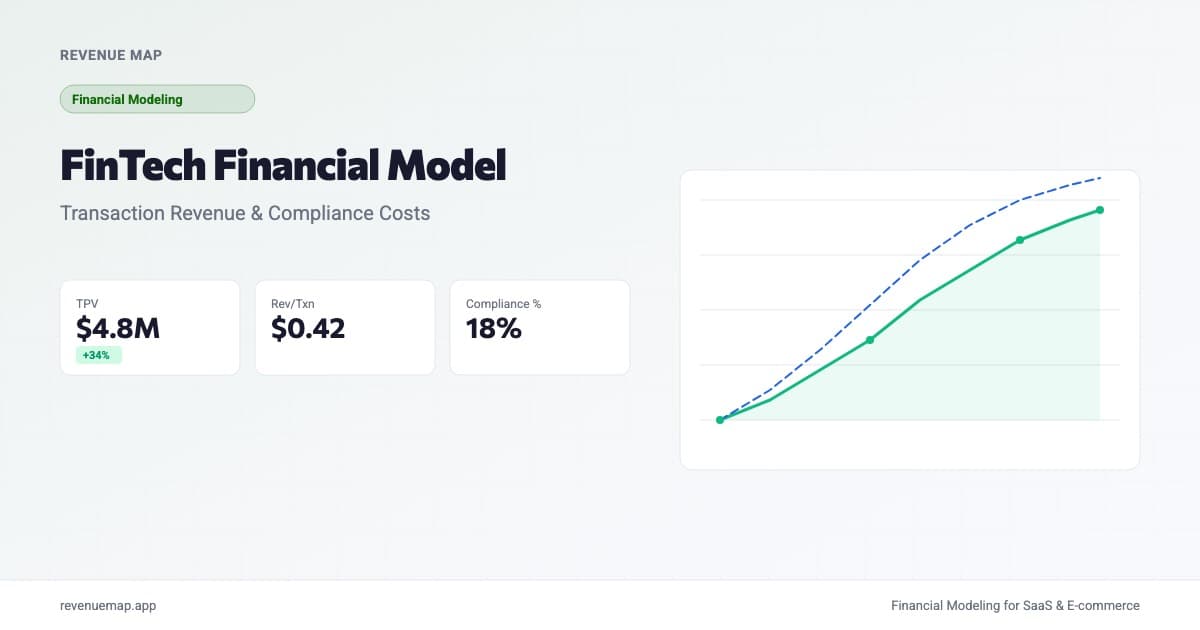
How do you build a financial model for a fintech startup? You start with transaction volume, not subscriptions, not TAM percentages, not annual contracts. A fintech business lives and dies by the number of transactions flowing through its platform, the revenue captured per transaction, and the regulatory and compliance costs required to keep those transactions legal. Every fintech financial model that works is built on this foundation. Every one that fails treats fintech like a SaaS business with different labels.
A fintech financial model is a structured framework that projects transaction-based revenue, compliance costs, and cash flow for a financial technology business, built to support fundraising, operational decisions, and regulatory planning simultaneously. It shares some architecture with SaaS financial models, but the revenue mechanics, cost structure, and risk profile are fundamentally different. This guide covers how to build one that reflects those differences.
What Makes FinTech Financial Modeling Different?
FinTech financial modeling is different because revenue is transaction-driven rather than subscription-driven, compliance is a structural cost category rather than a footnote, and regulatory timelines create hard constraints on market entry and expansion that most tech business models never encounter.
Three differences matter most.
Transaction-based revenue scales with volume, not seat count. In a SaaS business, revenue grows when you add subscribers. In fintech, revenue grows when existing users transact more frequently, when transaction sizes increase, or when you add new users who transact. This creates a three-dimensional growth surface, user count, frequency, and transaction size, rather than the simpler subscriber-times-ARPA math of SaaS. It also means revenue is more volatile: a payments company processing holiday shopping volume in December may see 2-3x the revenue of a typical month, followed by a January drop. Your model needs to account for seasonality that SaaS businesses rarely experience.
Compliance is not an optional line item, it's a structural cost. A SaaS startup's regulatory burden is typically limited to data privacy (GDPR, SOC 2). A fintech startup faces money transmitter licensing in up to 50 states, Bank Secrecy Act compliance, AML/KYC requirements, PCI-DSS certification, and potentially federal banking regulators. These are not one-time costs. They're recurring, audits, examinations, ongoing monitoring, and the legal counsel required to navigate all of it. Early-stage fintech companies commonly spend 8-15% of revenue on compliance. At scale, well-run operations bring this down to 3-5%, but the absolute dollar amount continues to grow.
Regulatory timelines create hard gates on growth. You cannot launch a lending product until you have state licenses. You cannot process payments until you have a payment facilitator registration or a bank partnership. These timelines, often 6-18 months, create constraints that don't exist in SaaS. Your financial model must account for the fact that certain revenue streams have a regulatory lead time before they can begin generating income, and the compliance costs begin accumulating well before the first dollar of revenue arrives.
Revenue Models in FinTech
FinTech revenue models fall into five primary categories, and most successful fintech companies combine two or more to build durable, diversified revenue streams.
| Revenue Model | How It Works | Example | Typical Take Rate |
|---|---|---|---|
| Transaction fees | Percentage of each transaction processed | Stripe: 2.9% + $0.30 per transaction | 1.5–3.0% |
| Interchange revenue | Share of interchange fees earned on card transactions | Chime: ~$0.20–0.50 per debit transaction | $0.15–0.50 per txn |
| Interest spread | Difference between borrowing cost and lending rate | Affirm: 15-30% APR vs. 5-8% funding cost | 7–22% net spread |
| Subscription/SaaS fees | Monthly or annual platform access fees | Plaid: API access pricing per connection | $50–500/mo per client |
| Float income | Interest earned on customer funds held in transit | PayPal: interest on held balances | Varies with fed funds rate |
| Payment for order flow | Revenue from routing trades to market makers | Robinhood: PFOF on equity and options trades | $0.002–0.005 per share |
The critical modeling nuance: most fintech revenue is gross revenue that requires significant pass-through costs before reaching net revenue. A payment processor charging 2.9% typically passes 1.8-2.1% through to the card network and issuing bank as interchange, meaning the actual net revenue is 0.8-1.1% of transaction volume. Models that project gross transaction fees as revenue without deducting interchange will overstate actual revenue by 2-3x. This is the single most common error in fintech financial models.
FinTech isn't the only vertical where compliance reshapes the P&L this way. HealthTech financial models face a similar dynamic, HIPAA compliance, payer reimbursement cycles, and clinical validation costs function as a structural cost category the same way licensing and AML/KYC do for fintech, and founders in both spaces routinely underestimate how much runway that compliance layer consumes before revenue scales.
Five Metrics Investors Want to See
Investors evaluating a fintech financial model are looking for five specific metrics that together reveal whether the business can scale transaction volume profitably while absorbing regulatory costs.
1. Total Payment Volume (TPV)
TPV is the total dollar value of transactions processed through your platform. It's the top-of-funnel metric that drives everything else in the model. Investors want to see TPV, its month-over-month growth rate, and the composition of that growth, is it coming from new users, increased transaction frequency, or larger transaction sizes? The source matters because each growth vector has different durability and cost characteristics.
2. Revenue per Transaction (Take Rate)
Take rate is net revenue divided by TPV, expressed as a percentage. It measures how efficiently you monetize each dollar that flows through your platform. A declining take rate isn't necessarily bad, it may reflect volume pricing or competitive pressure, but it must be declining more slowly than TPV is growing, or total revenue will plateau. Benchmark: payments companies typically operate at 0.5-1.5% net take rate; lending platforms at 3-8%; neobanks at 1.0-2.5% of transaction volume through interchange and fees.
3. Customer Acquisition Cost (CAC)
CAC in fintech has a unique characteristic: the cost of acquiring a user who never transacts is fully wasted. Unlike SaaS where a subscriber generates MRR from day one, fintech CAC only converts to value when the user activates and begins transacting regularly. Your model should track CAC alongside activation rate (percentage of acquired users who complete their first transaction within 30 days) and time-to-activation. A $45 CAC with a 60% activation rate is effectively a $75 CAC for active users.
4. Compliance Cost Ratio
Compliance cost as a percentage of revenue is the metric that separates fintech-native investors from generalist VCs. Generalists see 12% compliance cost and recoil. Fintech-focused investors see 12% at early stage and ask whether you have a credible path to 4-5% at scale. Your model should show compliance costs broken into categories (licensing, AML/KYC, audit, legal, fraud prevention) and project each category's scaling behavior, some are fixed (licensing fees), some scale sub-linearly (audit costs), and some scale linearly with volume (fraud losses).
5. Net Revenue Retention (NRR)
NRR in fintech measures whether existing users are transacting more over time. An NRR above 100% means your existing user base is generating more revenue each period without any new user acquisition, through higher transaction frequency, larger transaction sizes, or adoption of additional products. Best-in-class fintech NRR: 115-130%. Healthy: 100-115%. Below 100%: users are churning or reducing activity, and you're on a treadmill where new acquisition is just replacing lost volume.
How to Build a FinTech Revenue Forecast
Build your fintech revenue forecast bottom-up from user behavior and transaction economics, not top-down from total addressable market.
A top-down model ("We'll process 0.1% of US payment volume within 3 years") is a market sizing assertion, not a financial model. It has no connection to how users are actually acquired, activated, and retained. A bottom-up model starts with what you can observe and measure.
Step 1, Start with active users. Define "active" precisely, for most fintech products, this means users who completed at least one transaction in the trailing 30 days. Use your current active user count as the base. Project growth using your trailing 3-month average acquisition rate for the base case, adjusted for activation rate (not all acquired users become active).
Step 2, Multiply by transactions per user per month. This is the behavioral metric most fintech models underweight. A payments app where the average user transacts 4 times per month has fundamentally different economics than one where users transact 18 times per month. Use your actual trailing data. Model this as stable in the base case, transaction frequency tends to stabilize quickly after user activation.
Step 3, Multiply by average transaction size to get TPV. Active users x transactions per user x average transaction size = Total Payment Volume. This is your gross flow metric. Average transaction size varies enormously by vertical, a P2P payment app might average $85 per transaction while a B2B payments platform averages $12,000.
Step 4, Apply your take rate to derive gross revenue. Gross revenue = TPV x take rate. For a payments company charging 2.9%, gross revenue on $10M TPV is $290,000.
Step 5, Subtract pass-through costs. Deduct interchange fees, network fees, and processing costs. For a payment processor, these typically consume 60-70% of gross revenue. On that $290,000 in gross revenue, pass-through costs might be $185,000, leaving $105,000 in net payment revenue.
Step 6, Subtract compliance costs and fraud losses. Compliance costs (8-15% of revenue at early stage) and fraud/chargeback reserves (0.5-2.0% of TPV, depending on vertical and risk profile) come off net payment revenue to produce your true net revenue.
Worked example, NovaPay (payments startup): 15,000 active users. 8 transactions per user per month. Average transaction: $120. Take rate: 2.5%.
TPV = 15,000 × 8 × $120 = $14,400,000/month
Gross Revenue = $14,400,000 × 0.025 = $360,000/month
Interchange & Processing (65%) = -$234,000
Net Payment Revenue = $126,000/month
Compliance Costs (10%) = -$36,000
Fraud Reserves (0.8% of TPV) = -$115,200
Net Revenue = -$25,200/month
This example illustrates a critical fintech reality: a business processing $14.4M in monthly volume with a 2.5% headline rate can still be negative after interchange and compliance. The path to profitability runs through scale (reducing compliance as a percentage) and fraud optimization (reducing loss rates), not through raising the take rate, which is set by competitive pressure.
FinTech Revenue Calculator
Enter your active users, monthly transactions per user, average transaction size, and revenue percentage to estimate gross monthly revenue before interchange and compliance costs.
Want to model this over 36 months with scenarios? Try Revenue Map free →
Benchmarks by FinTech Vertical
Not all fintech verticals share the same economics. The table below summarizes benchmark ranges for the four major verticals, use these to sanity-check your model assumptions and identify where your projections deviate from industry norms.
| Vertical | Net Revenue / Transaction | Compliance Cost (% of Revenue) | CAC (Active User) | NRR |
|---|---|---|---|---|
| Payments | $0.15–0.45 | 5–10% | $25–60 | 105–120% |
| Lending | 3–8% of loan value | 10–18% | $80–200 | 95–115% |
| Neobank | $0.20–0.55 per txn | 8–14% | $35–90 | 100–125% |
| Insurtech | 15–25% of premium | 12–20% | $50–150 | 90–110% |
Key observations from these benchmarks.
Payments has the thinnest per-transaction margins but the highest transaction frequency and the most predictable volume scaling. Compliance costs are moderate because payments infrastructure is well-understood by regulators. NRR tends to be strong because users who adopt a payment method rarely switch.
Lending captures the highest per-transaction revenue but faces the steepest compliance costs and the most complex regulatory environment. CAC is high because borrower acquisition requires credit underwriting, you're not just acquiring a user, you're underwriting a risk. NRR can dip below 100% if borrowers pay off loans and don't return.
Neobanking sits between payments and lending in both revenue and compliance. The strategic advantage is cross-sell: a neobank user who starts with a debit card can be offered savings, lending, and investment products, each adding incremental revenue without incremental acquisition cost. This is why neobank NRR benchmarks can reach 125%.
Insurtech has strong per-policy revenue but high compliance costs (insurance is regulated at the state level with extensive filing requirements) and lower NRR because insurance customers shop on price annually. The churn dynamic in insurtech is closer to e-commerce than to SaaS.
Common Mistakes in FinTech Financial Models
1. Underestimating regulatory timelines and pre-revenue compliance costs. Founders routinely model revenue starting in month 3 when the licensing process alone takes 6-18 months. Money transmitter licenses require state-by-state applications, surety bonds, and examinations. A lending product requires state lending licenses, and some states have multi-month backlogs. Your model should show zero revenue and full compliance costs for the licensing period, and that period should be researched, not assumed. Building 12 months of compliance spend before the first dollar of revenue is not conservative. In many fintech verticals, it's realistic.
2. Modeling gross revenue without deducting interchange and processing fees. This is the fintech equivalent of modeling SaaS revenue without subtracting hosting costs, except the magnitude is far larger. A payments company with a 2.9% headline rate and 1.8% interchange cost has a true net margin of 1.1%. A model that shows $2.9M revenue on $100M TPV instead of $1.1M is not slightly wrong, it's overstating revenue by 2.6x. Always model net of interchange from the first row of your revenue projection.
3. Ignoring fraud losses and chargeback costs. Fraud is a cost of doing business in fintech, not an edge case. Payment processors typically budget 0.5-1.5% of TPV for fraud and chargebacks. Lending platforms face default rates of 3-8% depending on borrower profile. A model that doesn't include a fraud/loss reserve line is incomplete, and a model that uses the industry average without adjusting for your specific risk profile is lazy. If you're processing higher-risk transaction types (international, card-not-present, high-ticket), your fraud rate will be above average. Model accordingly.
4. Treating compliance costs as flat rather than modeling their scaling behavior. Early-stage compliance costs are disproportionately high relative to revenue because many components are fixed (licensing fees, minimum audit costs, baseline legal counsel). As revenue grows, compliance as a percentage of revenue should decline, but only if you invest in automation (automated AML screening, real-time transaction monitoring, automated regulatory reporting). A model that projects 12% compliance cost at $500K revenue and 12% at $5M revenue is not modeling, it's copy-pasting. Show the path: which costs are fixed, which scale sub-linearly, and what investments drive the ratio down.
Key Takeaways
- FinTech revenue is transaction-driven, not subscription-driven, your model must start with users, transaction frequency, and average transaction size, then apply take rate economics rather than multiplying subscribers by ARPA
- Always model net of interchange and processing fees, a 2.9% headline rate with 1.8% interchange means 1.1% net revenue; modeling gross fees overstates revenue by 2-3x and will not survive investor due diligence
- Compliance is a first-class cost category, not a footnote, budget 8-15% of revenue at early stage, break it into fixed and variable components, and show a credible path to 3-5% at scale through automation and operational maturity
- Regulatory timelines create hard constraints on revenue start dates, model zero revenue and full compliance costs during the licensing period, which ranges from 6-18 months depending on vertical and state coverage
A fintech financial model is more complex than a SaaS financial model, not because the math is harder, but because the cost structure has more moving parts and the regulatory environment imposes constraints that pure software businesses never face. Start with transaction volume, apply realistic take rates net of interchange, layer in compliance costs as a structural expense, and build scenarios around both growth and regulatory timing. Revenue Map's FinTech financial model supports this workflow: define your transaction economics, set compliance assumptions by category, and run scenarios that show how your unit economics evolve as you scale from thousands to millions of transactions per month. Calculate the key inputs on their own: CAC, LTV, NRR, and burn rate.
Related industry models
Building a model for a different sector? These sibling guides cover the economics unique to each vertical.
- Marketplace Financial Model: Take Rates, GMV Projections, and Liquidity MetricsLearn how to build a marketplace financial model with GMV projections, take rate analysis, and liquidity metrics. Includes formulas, benchmarks by marketplace type, and a step-by-step revenue projection framework for two-sided platforms.
- PropTech Financial Model: Deal Economics, Listing-to-Close Metrics, and Revenue ProjectionsBuild a PropTech financial model grounded in deal economics. Learn how to forecast listing-to-close conversion, revenue per transaction, and cost per deal across brokerage, property management, and iBuyer platforms.
- HealthTech Financial Model: Patient Acquisition, Retention Metrics, and Revenue ProjectionsLearn how to build a financial model for a healthtech startup. This guide covers patient acquisition costs, clinical retention metrics, payer mix modeling, and revenue projections across telehealth, digital therapeutics, and health SaaS.
- AI Startup Financial Model: GPU Costs and Margins (2026)Build your AI startup financial model with GPU compute costs, inference pricing, and 2026 gross margin benchmarks. The numbers investors actually check.
Related Articles
Cash Flow Projection Template for Small Business
Build a 12-month cash flow projection your lender will trust. Includes formulas, a free calculator, and line-by-line examples for restaurants, coffee shops, and more.
SaaS Revenue Model Template for Startups
Build a SaaS revenue model from scratch with MRR components, pricing tier math, and expansion revenue. Includes a free calculator and benchmarks.
Budget vs Forecast vs Projection for Startups
Budgets, forecasts, and projections serve different purposes. Learn when to use each and how they connect in your startup financial plan.