AI Business Plan in 2026: What AI Can and Cannot Do
AI can write the narrative sections of a business plan well, but chatbots hallucinate financial projections because text generation has no math engine underneath. The reliable approach in 2026 is to use a chatbot for prose and a deterministic modeling engine grounded in industry benchmarks for the financial section.
Type "write me a business plan" into any chatbot and you will get one: ten tidy sections, confident tone, delivered in thirty seconds. In 2026 this is how a large share of first-time founders start. The prose half of that output is genuinely useful. The financial half is fiction, and it is the half investors read first.
This guide draws an honest line between the two: what AI can do in a business plan today, where it fails, and how to build the financial section with a real engine instead of a text generator.
What AI does well: the narrative half
Chatbots are strong at exactly what language models are built for: structured prose. In a business plan that covers most of the document by page count:
- Executive summary and company description. Feed a chatbot your positioning and it will draft clean, well-organized copy faster than you would.
- Market and competitor descriptions. Good first drafts, provided you verify every cited figure yourself.
- Go-to-market narrative. Channel descriptions, messaging, launch sequencing: solid starting points that you edit for specifics.
- Formatting and tone. Turning your rough notes into investor-readable structure is a genuine time-saver.
Here's the thing: none of these sections make or break diligence. Investors skim the narrative and go straight to the numbers. And the numbers are where chatbots quietly fail.
What AI cannot do: the financial half
A language model predicts plausible text. It does not compute. When a chatbot writes "Year 1 revenue: $340,000," that figure was not derived from your pricing, conversion, and churn. It is a statistically typical number for the sentence it sits in.
Three failure modes follow directly from that:
- Nothing reconciles. Revenue, costs, and cash flow are generated as separate sentences, so nothing forces revenue minus costs to equal profit, or makes month 12 follow from month 11. Ask for a monthly breakdown and the columns rarely sum to the stated totals.
- The numbers are not reproducible. Run the same prompt twice and get two different projections. A model you cannot regenerate is not a model, it is an anecdote.
- Assumptions are invisible. When an investor asks "what churn rate does this assume?", there is no answer, because the projection was never computed from a churn rate at all.
This is not a prompt-engineering problem. It is architectural. The financial section needs a calculation engine, the same way the narrative section needs a language model.
Building the financial half with a real engine
The workable 2026 stack is a split: chatbot for prose, deterministic engine for numbers. Here is what the engine half looks like in practice, using Revenue Map's AI financial model generator.
Step 1: describe the business, not the spreadsheet. You answer 6 questions: what you sell, who buys, how you charge, expected price point, team size, starting cash. The AI part of the tool handles this intake and routes you to one of four computation engines, each with its own revenue logic (MRR and churn cohorts for SaaS, AOV and repeat purchases for e-commerce, GMV and take rate for marketplaces, capacity and utilization plus rent, staff and loan amortisation for a physical location).
Step 2: benchmarks fill what you have not measured. A pre-launch founder does not know their churn or CAC yet, and that is fine. The engine pre-fills those assumptions from benchmark bands for the business type, and this is where the difference from a chatbot becomes concrete. A few of the bands Revenue Map's models actually use:
- SMB SaaS monthly churn: 3% to 5% is average, under 3% is good, above 5% flags a problem.
- E-commerce CAC: $45 to $120 is the average band, under $45 is good.
- Failed payments (involuntary churn) typically account for 20% to 40% of total churn, which is why the model separates it from cancellations.
Every default is visible and editable, so your plan can state "we assume 4% monthly churn, the midpoint of the SMB SaaS band" instead of an unsourced number.
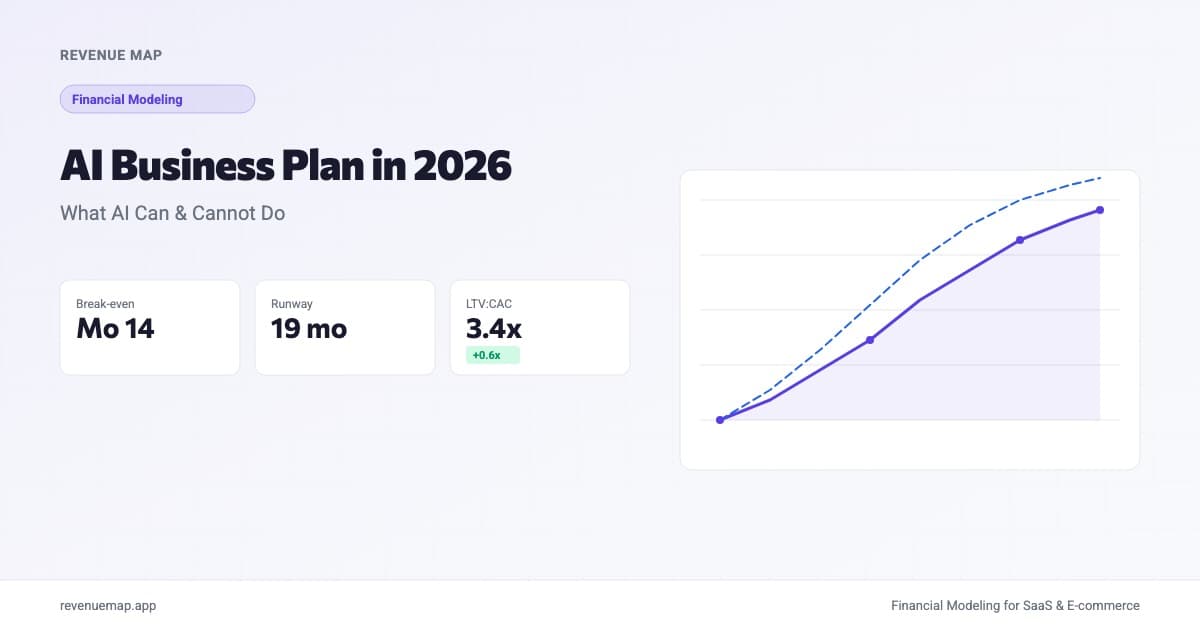
Step 3: the engine computes, you interrogate. The output is a monthly model: revenue projections, cost structure, break-even month, runway, and LTV/CAC, each recalculated live when you change an input. Because the math is deterministic, the same inputs always produce the same model, and every line traces back to a formula you can inspect.
Step 4: take the scenario spread, not the point estimate. The model ships with base, optimistic, and pessimistic scenarios. That spread is the honest answer to "how much will you make": if the plan only works in the optimistic case, you have learned the most valuable thing a business plan can teach, before spending a year building.
One caveat: an engine grounds your assumptions, it does not validate your market. If nobody wants the product, a beautifully reconciled model projects a well-organized failure. Benchmarks keep you realistic; only customers make you right.
The practical workflow
For a plan you would actually show an investor in 2026:
- Draft the narrative sections with a chatbot, then rewrite the claims you cannot personally defend.
- Generate the financial model with a computation engine, adjusting benchmark defaults where you have real data.
- Paste the engine's outputs (break-even month, runway, LTV/CAC, scenario table) into the plan, with assumptions stated next to each.
- Export the investor report and attach it. When someone asks where a number came from, you have an answer.
AI did not make business planning obsolete. It made the prose cheap and left the numbers as the whole game. Spend your effort where the diligence happens. If you want deeper background on the modeling itself, the SaaS financial modeling guide covers the mechanics end to end.
Related Articles
Financial Forecasting for Startups: A Practical Guide
Learn how to build and maintain startup financial forecasts. Covers five proven methods, re-forecasting cadence, accuracy benchmarks, and a free calculator.
Revenue Forecast Template for Startups (2026)
Build a revenue forecast from scratch. Grab our template with MRR growth formulas, churn adjustments, and expansion revenue built in.
Financial Projections Template: What to Include
Build a financial projections template with revenue forecasts, cost structure, cash flow, and scenario analysis. Includes formulas, benchmarks, and a free calculator.