Churn Rate Calculation: Formulas, Benchmarks, and How to Reduce It
Churn rate is the percentage of customers or revenue a subscription business loses in a given period. Calculate it by dividing customers lost by customers at the start of the period, then multiplying by 100. For SMB SaaS, a monthly churn rate under 2% is acceptable and under 1.5% is excellent.
By Tim Kozin

Churn rate measures the percentage of customers or revenue your business loses in a given period. The basic formula is: customers lost divided by customers at the start of the period, multiplied by 100. If you're running a subscription business and you're not tracking this number monthly, you're flying blind, because churn compounds quietly until it becomes a crisis.
What Is Churn Rate?
Churn rate is defined as the percentage of customers or revenue that leaves your business within a specific time period, typically one month.
It's the inverse of retention. A 5% monthly churn rate means you're retaining 95% of customers each month. That sounds fine until you run the math: 5% monthly churn compounds to a ~46% annual loss. Half your customer base. Gone. Every year.
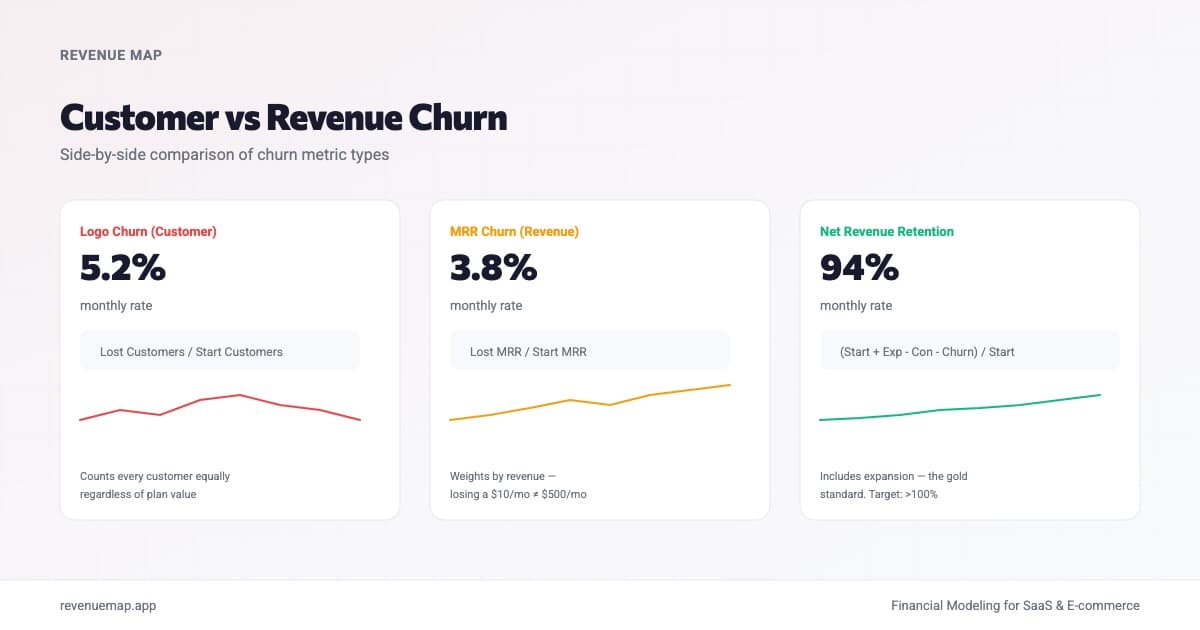
There are two distinct types: customer churn (how many accounts you lose) and revenue churn (how much MRR disappears). Conflating them is one of the most expensive mistakes a SaaS founder can make, a plan downgrade shows up as revenue churn but not customer churn, and that distinction changes how you diagnose and respond. If you need a refresher on how MRR itself is calculated before diving into churn's effect on it, see our guide on how to calculate and track monthly recurring revenue.
Why Churn Rate Is the Most Dangerous Metric You're Ignoring
Most founders underestimate churn because they focus on new customer acquisition, a number that trends up and to the right, while churn silently erodes the base.
Here's the uncomfortable math. Suppose you have 500 customers at $100 ARPA and you're adding 25 new customers per month. With 2% monthly churn, you lose 10 customers per month, net gain of 15. Manageable. Raise that churn to 5% and you're losing 25 per month. Net growth: zero. You're running to stand still, burning acquisition budget to replace customers you're already losing.
The LTV damage is even more severe. At 2% monthly churn, average customer lifetime is 50 months. At 5%, it drops to 20 months. Your LTV just fell 60%, without a single pricing change, without losing a single sales rep. That compression flows directly into your LTV:CAC ratio, your payback period, and ultimately your unit economics story to investors.
Churn isn't a retention problem. It's a business model problem.
Types of Churn: Customer vs. Revenue Churn
Customer (Logo) Churn
Customer churn, sometimes called logo churn, counts the number of accounts that cancel in a period. It's the bluntest measure of product-market fit and customer satisfaction.
Customer Churn Rate = (Customers Lost in Period / Customers at Start of Period) × 100
If you start January with 400 customers and lose 12, your monthly customer churn rate is 3%.
Revenue (MRR) Churn
Revenue churn measures the MRR lost from cancellations and downgrades, independent of how many accounts churned. A single enterprise account canceling can produce more MRR churn than 20 SMB cancellations combined.
MRR Churn Rate = (MRR Lost in Period / MRR at Start of Period) × 100
Track both. They tell different stories. High logo churn with low MRR churn suggests you're losing small accounts while retaining large ones, a very different problem than the reverse.
Negative Churn: and Why It Changes Everything
Negative net revenue churn occurs when expansion MRR from upgrades and upsells exceeds churn MRR in the same period. If you lost $2,000 in MRR from cancellations but gained $3,500 in expansion, your net revenue churn is -$1,500. Negative.
This is the unlock that makes SaaS economics genuinely special. A company with negative churn grows revenue even with zero new customer acquisition. It's why investors pay a premium for SaaS businesses with strong NRR, the revenue base is self-compounding.
How to Calculate Churn Rate (Step-by-Step)
Calculate churn rate by dividing customers (or MRR) lost in a period by the starting count, then multiplying by 100.
Use this three-step process.
Step 1, Define your cohort window. Churn rate is only meaningful within a consistent time frame. Monthly is standard for most SaaS businesses. Annual churn works for enterprise with long contracts, but monthly gives you a faster feedback loop.
Step 2, Count only customers who were active at the start of the period. New customers acquired mid-period who cancel within the same month should not be counted in churn, that's a failed conversion, not a churn event. This is the most common measurement error in early-stage SaaS.
Step 3, Apply the formula.
Monthly Customer Churn Rate = (Customers Lost in Month / Customers at Start of Month) × 100
Monthly MRR Churn Rate = (MRR Lost in Month / MRR at Start of Month) × 100
Worked example, Acme SaaS: Acme starts March with 320 customers generating $48,000 MRR. During March, 11 customers cancel (total $2,200 MRR lost). Two customers downgrade, losing another $400 MRR. No new customers acquired in March.
- Customer churn rate: (11 / 320) × 100 = 3.4%
- MRR churn rate: (($2,200 + $400) / $48,000) × 100 = 5.4%
The gap between 3.4% and 5.4% tells you something important: the customers leaving are higher-value than your average. That's a segmentation problem worth investigating immediately.
Monthly Churn Rate Calculator
Enter your starting customer count and customers lost to calculate your monthly churn rate instantly.
Churn Rate Benchmarks by Segment
A good monthly churn rate for SMB SaaS is under 2%. Anything above 3% is a signal that something structural is broken in your product or onboarding.
Based on Revenue Map modeling data across 500+ financial models, here are the benchmarks by segment:
| Segment | Excellent | Acceptable | Warning |
|---|---|---|---|
| SMB SaaS (< $500 ACV) | < 1.5% | 1.5–3% | > 3% |
| Mid-Market SaaS ($500–$5K ACV) | < 1% | 1–2% | > 2% |
| Enterprise SaaS (> $5K ACV) | < 0.5% | 0.5–1% | > 1% |
| E-commerce subscriptions | < 5% | 5–8% | > 10% |
| Consumer subscription apps | < 3% | 3–7% | > 8% |
Two things worth noting. First, enterprise benchmarks look low because enterprise contracts are annual, the monthly equivalent of a 10% annual churn rate is under 1% monthly. Second, e-commerce subscriptions tolerate higher churn because of higher reactivation rates and lower CAC for returning customers.
Annual churn equivalents for context:
| Monthly Churn | Annual Equivalent |
|---|---|
| 1% | ~11.4% |
| 2% | ~21.5% |
| 5% | ~46.0% |
5 Common Churn Calculation Mistakes
1. Counting free trials or freemium users as customers. If a user never paid you, their departure is not churn, it's a conversion failure. Only paid, active accounts belong in your churn denominator. Mixing in free users artificially inflates your customer count and understates your churn rate.
2. Including mid-period new customers in the denominator. A customer who signs up on March 15 and cancels on March 28 didn't churn, they never onboarded. Add them to the starting count and you misrepresent your retention. Use only customers active on day 1 of the measurement period.
3. Measuring churn annually when your billing cycle is monthly. Annual churn smooths over seasonal spikes and hides deteriorating cohorts. Monthly tracking catches problems 11 months earlier. Even for annual contracts, model the monthly equivalent so your financial model stays comparable to benchmarks.
4. Ignoring revenue churn entirely. Logo churn is visible. Revenue churn is actionable. If your highest-value accounts churn first, a common pattern when product-market fit is weak in a specific segment, your business is in more trouble than the headline number suggests.
5. Cherry-picking your measurement window. Calculating churn only in your best months is the financial modeling equivalent of only weighing yourself after a diet. Pick a 12-month rolling average and report it consistently. Investors will ask for trailing 12-month churn. Have it ready before they do.
Proven Strategies to Reduce Churn
Fix Onboarding First
The highest-leverage churn reduction intervention is early. Most churn is decided in the first 14-30 days, customers who don't reach their first "aha moment" rarely stick around to month 3. Audit your activation rate: what percentage of new signups complete your core onboarding flow and hit at least one meaningful value moment in the first week?
If that number is below 40%, you don't have a churn problem. You have an onboarding problem. Fix activation before you invest in any win-back or retention campaign.
Metric to watch: Time-to-first-value (TTFV). Target under 7 days for SMB, under 30 for enterprise.
Identify At-Risk Accounts Early
Churn is rarely a surprise at the account level, it's a surprise at the operations level. Build a basic health score from login frequency, feature adoption, and support ticket volume. Customers who haven't logged in for 21 days, haven't adopted more than 1 feature, or have opened 3+ support tickets in 30 days are flagging risk.
Automated check-ins triggered by behavioral signals outperform calendar-based QBRs for SMB. A single "we noticed you haven't done X yet, here's how" email at day 14 can recover accounts that would otherwise silently cancel.
Metric to watch: 30-day login rate by cohort. Drop-offs correlate with the following month's churn.
Price and Plan Structure as a Retention Tool
Annual billing is the most underused retention tool in SaaS. Customers on annual plans churn at 3-5× lower rates than monthly, not because they're more loyal, but because the cancellation decision is made once a year instead of every 30 days. Offering a 2-month discount for annual upfront ($239/year vs. $29/month) is often revenue-positive even before accounting for reduced churn.
Seat-based or usage-based pricing also reduces churn risk by aligning cost with value delivered. When customers pay proportionally to how much they use your product, the mental accounting shifts from "is this worth $X/month?" to "I'm expanding because I'm getting more value."
Metric to watch: Annual vs. monthly billing mix. Target > 40% of revenue on annual plans within 12 months of launch.
Key Takeaways
- Churn rate formula: (Customers Lost ÷ Customers at Start) × 100, measure it monthly, every month, without exception
- 5% monthly churn = 46% annual loss, the compounding effect is why "low" churn still destroys businesses at scale
- SMB SaaS benchmark: under 2% monthly is acceptable; under 1.5% is excellent; above 3% requires immediate investigation
- Customer churn and MRR churn are different metrics, track both, because the gap between them reveals which customer segments are churning
- The highest-ROI churn reduction is onboarding, most cancellation decisions are made in the first 30 days, not at renewal
- Annual billing reduces churn 3-5× vs. monthly, restructuring your pricing can cut churn before you change a single line of product code
If you want to model how different churn rates affect your long-term MRR and LTV, see how monthly recurring revenue compounds over time when you pair low churn with consistent acquisition. Revenue Map's financial modeling platform lets you set your churn rate, ARPA, and acquisition assumptions in one place and run scenarios against your actual monthly numbers, so you stop guessing and start managing.
Sources
The churn benchmarks in this guide, acceptable monthly churn ranges by segment, the annual-vs-monthly billing effect, and the onboarding-window framing, reflect figures published in the following sources. Treat specific churn percentages as representative industry ranges that vary by segment (SMB vs. enterprise) and pricing model.
- ChartMogul SaaS Retention Benchmarks, customer and revenue churn benchmarks from anonymized subscription data
- Recurly Research, Subscription Churn Benchmarks, churn rates by industry and billing model
- Paddle / ProfitWell Churn Research, retention and churn analysis across subscription businesses
Related Articles
How to Segment Churn Rate and Find Hidden Patterns
Learn how to segment your churn rate by plan, cohort, and customer type to uncover retention patterns that aggregate numbers hide.

Monthly Recurring Revenue (MRR): How to Calculate and Track It
Learn what monthly recurring revenue is, how to calculate MRR correctly, avoid common mistakes, and use it to forecast growth. Includes a free MRR calculator.
Net Revenue Retention (NRR): How to Calculate and Improve It
Learn how to calculate net revenue retention, see 2026 NRR benchmarks by company stage, and find strategies to push your NRR above 110%.