Last updated
Monthly Recurring Revenue (MRR): How to Calculate and Track It
Monthly recurring revenue is the predictable, normalized revenue a subscription business expects to collect every month from active paying customers. Calculate it by multiplying active subscribers by average revenue per account. Normalize all annual contracts to their monthly value before calculating.
By Tim Kozin

Monthly recurring revenue is the normalized, predictable revenue your subscription business generates each month. The formula is: active subscribers multiplied by average revenue per account (ARPA). MRR is the single most important number in a subscription business, every other metric you track, from churn to LTV to runway, is either derived from it or measured against it.
What Is Monthly Recurring Revenue (MRR)?
Monthly recurring revenue is defined as the predictable, normalized revenue a subscription business expects to collect every month from its active paying customers.
It is not total revenue. It is not cash collected. It's a snapshot of your recurring revenue engine at a point in time, stripped of one-time fees, setup charges, and the distortion of annual contracts paid upfront.
That last point matters more than most founders realize. If a customer pays you $1,200 upfront for an annual plan, your MRR from that account is $100, not $1,200. Recognizing the full payment in month one inflates your MRR, skews every downstream metric, and produces a financial model that falls apart under investor scrutiny.
MRR answers one question: if nothing changes, how much recurring revenue will you collect next month? For an interactive calculator and quick-reference benchmarks, see the MRR entry in our knowledge base.
Why MRR Is the Heartbeat of Your Subscription Business
MRR matters because it is the foundation every other SaaS metric is built on, and because its compound growth rate determines the trajectory of your entire business.
Pull on any metric that matters to investors and you'll find MRR underneath it. LTV is ARPA divided by churn rate, both derived from MRR. CAC payback period is CAC divided by MRR per customer times gross margin. Runway is cash balance divided by net burn, which is operating costs minus MRR. You cannot accurately model any of these without clean MRR data.
The compounding math is the other reason MRR deserves your full attention. A business at $10,000 MRR growing 10% month-over-month reaches $31,384 MRR in 12 months. At 15% MoM growth, that same business reaches $53,502. The difference between 10% and 15% monthly growth isn't 50% more revenue, it's 70% more revenue, compounding every month. Small improvements in MRR growth rate produce enormous differences in outcomes over 24-36 months.
Investors understand this math intuitively. It's why the first question in almost every early-stage investor meeting is "what's your current MRR?", not revenue, not ARR, not GMV. MRR.
The 5 Types of MRR You Need to Track
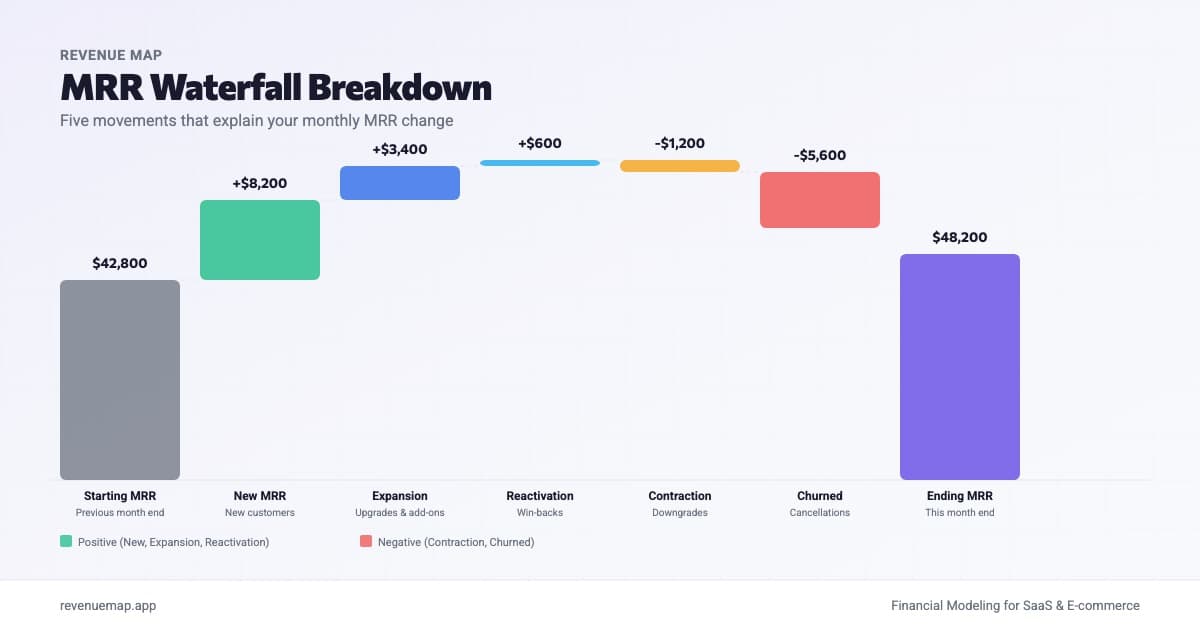
Most articles on MRR cover the headline number and stop there. That's where the analysis should start. Your MRR is not a single stream, it's the net result of five distinct movements happening simultaneously every month. If you only track the total, you're missing the signals that tell you why it's moving.
New MRR
New MRR is revenue generated from customers who were not paying you in the previous month. It's the most visible MRR movement and the one most founders track first.
New MRR = Sum of MRR from all new customers acquired this month
Expansion MRR
Expansion MRR is additional revenue from existing customers, plan upgrades, seat additions, usage overages, or upsells to higher tiers. High expansion MRR is one of the strongest signals of product-market fit: your existing customers are finding more value over time, not less.
Expansion MRR = MRR gained from existing customers via upgrades or upsells
Contraction MRR
Contraction MRR is revenue lost from existing customers who downgrade, but don't cancel. It reduces your MRR without showing up in customer churn, which is why tracking logo churn alone misses this signal entirely.
Contraction MRR = MRR lost from existing customers via downgrades
Churned MRR
Churned MRR is revenue lost from customers who cancel entirely. Together with contraction MRR, it forms your gross revenue churn, the total MRR your business lost from existing customers this month.
Churned MRR = MRR lost from customer cancellations
Reactivation MRR
Reactivation MRR is revenue from previously churned customers who return and start paying again. It's undertracked and undervalued, reactivations typically convert at higher rates and churn less than cold acquisition.
Reactivation MRR = MRR from previously churned customers who resubscribe
Net New MRR: The Number That Ties It Together
Net New MRR = New MRR + Expansion MRR + Reactivation MRR - Contraction MRR - Churned MRR
This is the waterfall. If your Net New MRR is positive, your revenue base is growing. If it's negative, you're shrinking, regardless of what your new customer acquisition numbers look like.
How to Calculate MRR (Step-by-Step)
Calculate MRR by multiplying active subscribers by average revenue per account, or by summing the normalized monthly value of every active contract.
There are two methods depending on how your billing is structured.
Method 1, Subscriber × ARPA (best for simple, uniform pricing)
MRR = Active Subscribers × Average Revenue Per Account (ARPA)
If you have 200 customers all paying $49/month, your MRR is $9,800. Clean and fast.
Method 2, Sum of contracts (best for mixed billing cycles and variable pricing)
List every active paying customer, normalize their contract to a monthly value, and sum.
MRR = Sum of (Contract Value / Contract Length in Months) for all active customers
Annual contract normalization: a customer paying $1,188/year contributes $99/month to MRR, not $1,188, not $0 in months 2-12.
Worked example, Acme SaaS: Acme has three plan tiers:
- 80 customers on the $49/month Starter plan
- 55 customers on the $99/month Pro plan
- 15 customers on the $299/month Business plan
- 8 customers on annual Business plans at $2,988/year ($249/month normalized)
MRR calculation:
- Starter: 80 × $49 = $3,920
- Pro: 55 × $99 = $5,445
- Business monthly: 15 × $299 = $4,485
- Business annual: 8 × $249 = $1,992
Total MRR: $15,842
The 8 annual customers contribute $1,992/month to MRR, not $23,904 in month one and $0 thereafter. That normalization is non-negotiable for a clean model.
MRR Calculator
Enter your active subscriber count and average revenue per account to calculate your monthly recurring revenue instantly.
Want to model this over 36 months with scenarios? Try Revenue Map free →
MRR Benchmarks and Growth Rates
A healthy MoM MRR growth rate for early-stage SaaS is 10–15%. Below 5% at the pre-$10K MRR stage is a signal the growth engine isn't working yet.
Growth rate benchmarks shift significantly by stage and by whether you're VC-backed or bootstrapped. Applying the wrong benchmark to your business produces either false panic or dangerous complacency.
| Stage | MRR Range | Healthy MoM Growth | Warning |
|---|---|---|---|
| Pre-revenue / Launch | $0–$1K | Any positive growth | Flat after 3 months |
| Early traction | $1K–$10K | 15–20% | < 10% |
| Growth | $10K–$100K | 10–15% | < 7% |
| Scale | $100K–$500K | 5–10% | < 5% |
| Mature | $500K+ | 3–7% | < 3% |
VC-backed context: Investors often reference the "T2D3" framework, triple ARR for two consecutive years, then double for three, as the benchmark for Series A+ SaaS. That translates to roughly 10–13% MoM growth sustained over five years.
Bootstrapped context: A bootstrapped SaaS business at 5–7% consistent MoM growth is building a healthy, valuable business. The VC growth curve is a specific financing strategy, not a universal standard.
Common MRR Calculation Mistakes
1. Including one-time fees in MRR. Setup fees, implementation charges, and professional services revenue are not recurring. Adding them to MRR inflates the number in month one, creates a false growth signal, and produces misleading churn calculations. Keep one-time revenue in a separate line item.
2. Double-counting annual contracts. Recognizing the full value of an annual contract in the month it's signed is the most common MRR inflation error. Normalize every annual and multi-year contract to its monthly value. A $12,000 annual deal is $1,000 MRR, not $12,000 MRR in January and a growth cliff in February.
3. Mixing cash accounting with MRR. MRR is an accrual concept, it represents earned recurring revenue, not cash received. If you track MRR as cash collected, your monthly numbers will be lumpy, front-loaded on annual renewals, and incomparable month-over-month. Keep your MRR model on accrual logic regardless of your accounting method.
4. Ignoring contraction MRR. A customer who downgrades from $299/month to $49/month didn't churn, but your MRR just fell $250 from that account. If you only track cancellations, you're measuring less than half the revenue erosion. Contraction MRR is a product signal: customers are finding less value, or your pricing ladder has a misaligned tier.
How to Use MRR to Run Your Business
MRR as a Forecasting Input
MRR is not just a reporting metric, it's the primary input for your forward-looking financial model. Feed your current MRR, expected growth rate, and churn rate into a monthly model and you can project your revenue 12–24 months forward with scenario branches. A conservative, base, and aggressive case built on different MRR growth rate assumptions gives you a range of outcomes rather than a single point forecast that will almost certainly be wrong.
MRR vs ARR: When to Use Each
ARR (annual recurring revenue) is simply MRR × 12. Use MRR when you're managing operations month-to-month, running cohort analysis, or monitoring growth rate. Use ARR when you're talking to investors, benchmarking against industry databases, or comparing your business to VC-backed SaaS companies that report annually. The underlying math is identical, it's a communication convention, not a different measurement.
ARR = MRR × 12
A business at $15,842 MRR has $190,104 ARR. Both numbers are accurate. The context determines which to lead with.
Plan vs Actual MRR Tracking
The most underused application of MRR tracking is the monthly plan vs. actual comparison. Set your MRR target at the start of each month. At month-end, compare actual MRR to plan, and break down the variance by MRR type. Did you hit plan but with lower New MRR offset by surprise Expansion MRR? That's a different business signal than hitting plan purely on acquisition. The waterfall tells the story; the headline number hides it.
Key Takeaways
- MRR formula: Active Subscribers × ARPA, normalize all annual contracts to monthly value before calculating
- Net New MRR = New + Expansion + Reactivation - Contraction - Churned, the waterfall is more useful than the headline number
- 10–15% MoM growth is the benchmark for the early-growth SaaS stage ($1K–$10K MRR); expectations shift significantly at scale
- Annual contracts contribute MRR monthly, not upfront, recognizing full contract value in month one is the single most common MRR inflation error
- ARR = MRR × 12, use MRR for operations, ARR for investor conversations; they measure the same thing at different time scales
- Plan vs. actual MRR tracking turns a reporting metric into a management tool, compare monthly and break down variance by MRR movement type
MRR doesn't mean much in isolation. Its value comes from tracking it consistently, breaking it into its five components, and pairing it with your churn rate to understand the true health of your revenue base. See how churn rate compounds against MRR growth to understand why even modest churn has an outsized effect on your long-term trajectory. Revenue Map lets you set your MRR, growth rate, and churn assumptions together, and run plan vs. actual comparisons every month so your model stays connected to reality.
Sources
The MRR growth benchmarks and MRR-movement framing in this guide reflect figures published in the following sources. Growth-rate figures should be read as stage-dependent industry ranges rather than fixed targets.
- ChartMogul SaaS Metrics & Benchmarks, MRR movement, expansion, and retention benchmarks from anonymized subscription data
- Paddle / ProfitWell Retention & Pricing Research, MRR, expansion, and churn analysis across subscription businesses
- OpenView SaaS Benchmarks Report, private-SaaS growth-rate benchmarks by revenue stage
Related Articles

Churn Rate Calculation: Formulas, Benchmarks, and How to Reduce It
Learn how to calculate SaaS churn rate with the right formula, compare your numbers to industry benchmarks, and apply proven strategies to reduce customer loss.
SaaS Revenue Per Employee: 2026 Benchmarks
How much ARR should each employee generate? See 2026 SaaS revenue per employee benchmarks by stage and growth rate, with formulas and a free calculator.
SaaS Gross Margin: How to Calculate and Benchmark It
Learn how to calculate SaaS gross margin, what counts as COGS, and 2026 benchmarks by company stage. Includes a free calculator.