Food Truck Business Plan: Costs, Revenue, Profit
A food truck business plan should include startup costs of $50,000 to $200,000, revenue projections built from daily customers times average ticket, and a 12-month cash flow forecast. Lenders expect a debt service coverage ratio of 1.25x or higher.
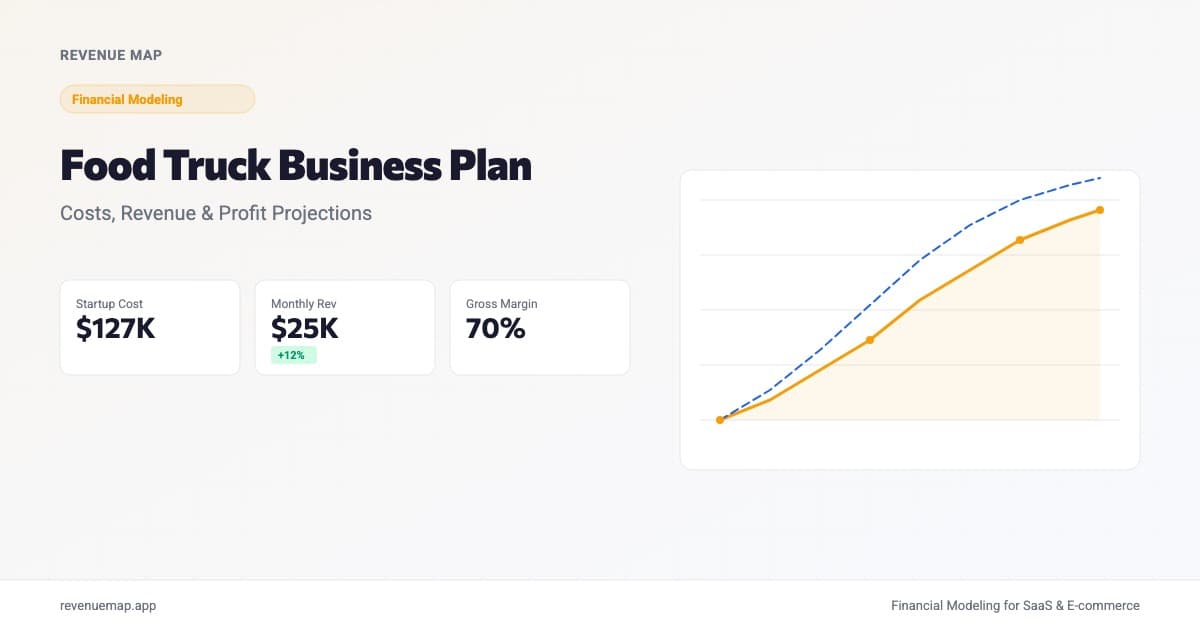
A food truck business plan needs real financial projections, not just a menu concept and a logo. Lenders and investors evaluate food truck plans on three numbers: how much it costs to launch, how much revenue is realistic per day, and whether the cash flow covers debt payments during the ramp-up months. Get those right and the rest of the plan supports them. Get them wrong and even a great concept gets declined.
The food truck industry now includes over 92,000 businesses in the United States, generating a combined $2.8 billion annually according to IBISWorld. While recent coverage of non-restaurant franchise opportunities highlights the appeal of lower-overhead business models, food trucks offer something most franchises don't: you skip the franchise fee entirely, control your menu from day one, and can test multiple locations before committing to a permanent spot.
Here is the financial section of a food truck business plan, built with the actual numbers lenders expect to see.
How Much Does It Cost to Start a Food Truck?
Startup costs for a food truck range from roughly $50,000 for a used truck with basic equipment to $200,000 for a new custom build with a full commercial kitchen. Most first-time operators land somewhere in the $75,000 to $130,000 range.
Here is a realistic breakdown for a street food truck:
| Category | Low Estimate | Mid Estimate | High Estimate |
|---|---|---|---|
| Truck (used vs. new) | $25,000 | $65,000 | $130,000 |
| Kitchen equipment | $15,000 | $28,000 | $45,000 |
| Permits and licenses | $2,000 | $5,000 | $10,000 |
| Wraps and branding | $2,500 | $4,500 | $8,000 |
| Initial inventory (30 days) | $2,000 | $3,500 | $6,000 |
| Insurance (first year) | $3,000 | $4,500 | $7,000 |
| POS system and tech | $500 | $1,500 | $3,000 |
| Working capital (3 months) | $8,000 | $15,000 | $25,000 |
| Total | $58,000 | $127,000 | $234,000 |
The working capital line matters more than most founders realize. You will have slow days, permit delays, and equipment repairs in the first 90 days. A plan with zero cash reserve after buildout is a red flag for lenders. For a deeper look at estimating these figures for your specific setup, the startup cost calculator lets you adjust by business type and location.
A coffee and drinks truck, for comparison, typically launches at around $85,000 in total capital expenditure because the equipment list is simpler (no fryers, no hood ventilation). That lower entry point means a smaller loan, often around $60,000, which makes the approval math easier.
How to Project Food Truck Revenue
Revenue projections for a food truck are straightforward to build but easy to inflate. The formula is simple:
Monthly Revenue = Daily Customers × Average Ticket × Days Open per Month
The hard part is choosing honest inputs. Here is what the numbers actually look like across different food truck niches, based on industry benchmarks:
| Niche | Avg Ticket | Daily Customers | Days/Month | Monthly Revenue |
|---|---|---|---|---|
| Street food (tacos, bowls) | $12 | 95 | 22 | $25,080 |
| Coffee and drinks | $6.50 | 140 | 22 | $20,020 |
| Dessert truck | $8 | 110 | 22 | $19,360 |
| Office park lunch | $14 | 100 | 21 | $29,400 |
| Events and festivals | $15 | 140 | 14 | $29,400 |
| Catering truck | $26 | 45 | 16 | $18,720 |
A few things to notice. The events and festivals niche has high daily volume but fewer operating days per month because events are concentrated on weekends and seasonal calendars. The catering truck has the highest ticket but the fewest customers per day. Both can produce strong annual revenue, but the cash flow patterns are completely different, and that matters when a lender evaluates your plan.
For your first year, project conservatively: assume 60% of the daily customer numbers above in months one through three, ramping to 85% by month six, and reaching full capacity around month nine. Lenders prefer realistic ramp-ups over optimistic day-one projections. If you have already built revenue projections for a different business type, our guide on financial projections templates covers the general framework.
Calculate Your Food Truck Revenue
Food Truck Revenue Calculator
Estimate your monthly and annual food truck revenue
Food Truck Gross Margin and COGS
Food cost is the biggest variable expense in a food truck operation. Gross margin for most food trucks falls between 60% and 74%, depending on the menu and sourcing.
| Niche | Typical COGS % | Gross Margin % |
|---|---|---|
| Street food | 28-32% | 68-72% |
| Coffee and drinks | 24-28% | 72-76% |
| Dessert truck | 25-29% | 71-75% |
| Catering | 30-35% | 65-70% |
These margins are meaningfully better than a sit-down restaurant, where labor and rent eat into the spread. A food truck with no dining room, a crew of two or three, and a focused menu can maintain gross margins that a full-service restaurant would envy.
That said, COGS creep is real. If your food cost drifts from 28% to 35% over six months because you didn't renegotiate with suppliers or your portions drifted, you just lost a third of your gross profit. Track it weekly, not monthly.
Monthly Cash Flow for Year One
The cash flow forecast is what separates a plan that gets funded from one that gets filed. Here is a simplified 12-month cash flow for a street food truck with $127,000 in startup costs, a $90,000 SBA loan, and $37,000 in owner equity.
| Month | Revenue | COGS (30%) | Operating Expenses | Loan Payment | Net Cash Flow | Cumulative Cash |
|---|---|---|---|---|---|---|
| 1 | $15,048 | $4,514 | $7,200 | $1,050 | $2,284 | $17,284 |
| 2 | $17,556 | $5,267 | $7,200 | $1,050 | $4,039 | $21,323 |
| 3 | $20,064 | $6,019 | $7,200 | $1,050 | $5,795 | $27,118 |
| 6 | $25,080 | $7,524 | $7,800 | $1,050 | $8,706 | $52,500 |
| 9 | $25,080 | $7,524 | $8,000 | $1,050 | $8,506 | $78,018 |
| 12 | $25,080 | $7,524 | $8,200 | $1,050 | $8,306 | $103,336 |
Operating expenses include fuel, commissary fees, permits, insurance, payroll for one helper, and marketing. The loan payment assumes a 7-year SBA 7(a) loan at 10.5% interest.
Notice the cumulative cash position never goes negative after funding. That is exactly what a lender wants to see. If your projection shows a negative cumulative position in any month, you either need more working capital, a smaller truck, or a phased launch.
Monitor your actual burn rate against this plan monthly. The first three months are where most food truck owners discover their projections were too optimistic, and catching the gap early is the difference between adjusting and running out of cash.
What Lenders Check in a Food Truck Business Plan
If you are applying for an SBA loan or a conventional small business loan, the lender evaluates your food truck plan differently than a venture investor would. They care about repayment, not growth trajectory.
The five things that carry the most weight:
-
Debt service coverage ratio (DSCR). Can the truck generate enough income to cover loan payments with a cushion? Lenders want 1.25x or higher. Using the year-one numbers above: net operating income of roughly $10,500/month against a $1,050 monthly payment gives a DSCR of 10x at stabilization. Even in month one, the DSCR is above 2x. That is a strong application.
-
Use of funds. Where every dollar of the loan goes. Not "truck and equipment" but "2019 Ford F-59 step van ($35,000), commercial griddle and fryer ($8,500), generator ($4,200)." Specificity builds credibility.
-
Owner equity. Most SBA loans require 10-20% owner equity injection. In the example above, $37,000 on a $127,000 total project is 29%, which exceeds the typical minimum.
-
Cash flow during ramp-up. The lender will stress your first six months. If the cash flow goes negative before the truck reaches steady-state revenue, the plan needs a larger working capital reserve.
-
Comparable data. Reference the $2.8 billion US food truck market (IBISWorld) and per-truck averages. Anchor every assumption in a number a loan officer can verify.
Our full guide on writing a business plan for a loan covers the broader framework, including DSCR calculations, break-even analysis, and the narrative sections that lenders expect alongside the numbers.
Common Mistakes in Food Truck Financial Plans
-
Projecting full capacity on day one. No food truck serves 95 customers on its first Tuesday. Build in a 3-6 month ramp. Lenders know this and will discount your projections if you don't.
-
Forgetting commissary and parking fees. Many cities require food trucks to prep at a licensed commissary kitchen ($500-$1,500/month) and charge for vending permits at specific locations. These are recurring costs that often get left out of first drafts.
-
Ignoring seasonality. A food truck in Chicago will see a 40-60% revenue drop from December through February. Your cash flow needs to survive the slow season, and your plan should show it explicitly.
-
Underestimating repairs. Trucks break down. Budget $200-$400/month for maintenance and keep a $3,000-$5,000 emergency fund. A truck that is off the road for a week can cost you $5,000 in lost revenue.
Key Takeaways
- Food truck startup costs range from $50,000 to $200,000 depending on whether you buy new or used and how extensive your kitchen setup is. Budget 20% of total costs for working capital.
- Build revenue projections from daily customers, average ticket, and days open per month. A street food truck averaging 95 customers at $12 per ticket generates about $25,000 monthly at full capacity.
- Gross margins of 65-75% are achievable, but only if you track food costs weekly and keep COGS below 30%.
- Your 12-month cash flow forecast should show a cumulative cash position that never goes negative after funding. This is the single most scrutinized section in a loan application.
- Lenders want a DSCR of 1.25x or higher. Most well-planned food trucks exceed this comfortably because the loan amounts are relatively modest compared to operating income.
Ready to build the financial model behind your food truck business plan? Start with Revenue Map, select "Food Truck" as your business type, and get a three-year projection you can hand to a lender. Free, two minutes.
Related Articles
Beauty Supply Store Business Plan: Costs and Projections
Build the financial section of your beauty supply store business plan with real startup costs, revenue projections, and the cash flow forecast lenders require.
Salon Suite Business Plan: Costs and Projections
Build the financial section of your salon suite business plan with startup costs, rental revenue projections, and the cash flow lenders check.
Hot Dog Cart Business Plan: Costs and Projections
Build the financial section of your hot dog cart or food cart business plan with startup costs, revenue projections, and the cash flow lenders check.