Business Plan for a Business Loan: What to Include
A business plan for a business loan should include five financial sections: an executive summary, a use-of-funds breakdown, three-year revenue projections, monthly cash flow forecasts, and a debt service coverage ratio above 1.25x. Lenders use these to decide whether your business can repay the loan.
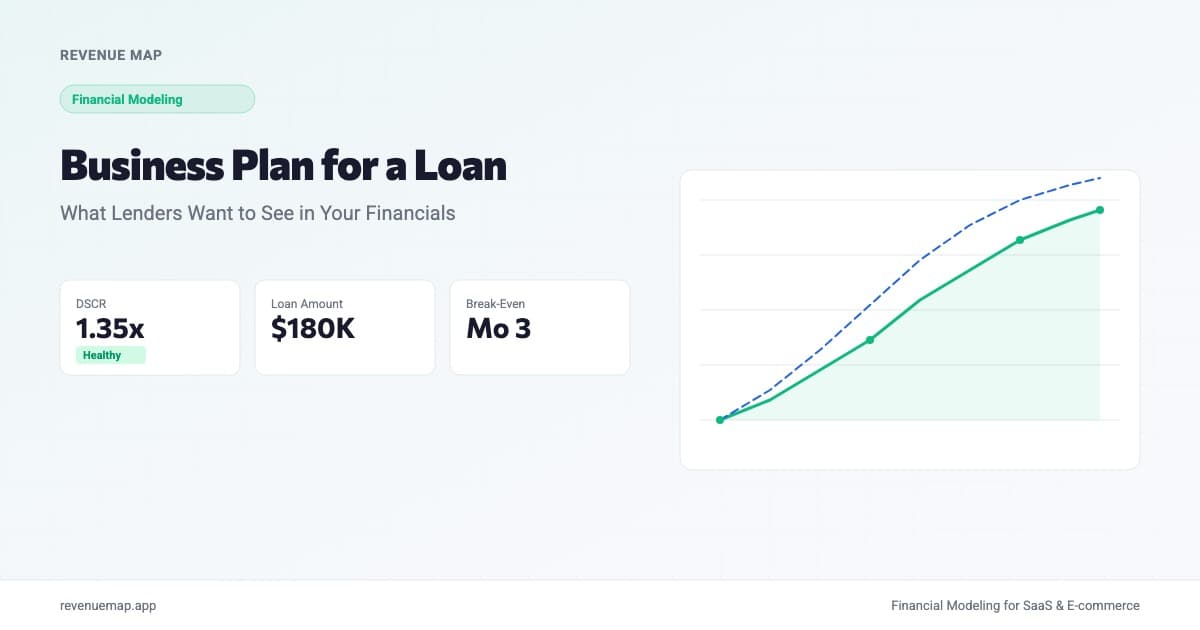
A business plan for a business loan needs to answer one question above everything else: can this business repay what it borrows? Lenders care about your vision, but they approve loans based on projected cash flow, collateral, and your ability to service debt. The financial sections of your plan carry the decision.
This matters more than usual right now. The SBA recently proposed a major overhaul of small business size standards, potentially expanding eligibility for thousands of businesses that previously didn't qualify for SBA-backed loans. If you're opening a restaurant, launching a food truck, or expanding a service business, the financing window may be wider than it was six months ago. But a wider door still requires a solid plan to walk through it.
What Do Lenders Actually Look For?
Bank loan officers and SBA reviewers evaluate business plans differently than venture investors. A VC wants to see a path to 10x returns. A lender wants to see a path to steady repayment. That difference changes everything about how you write the plan.
Here's what carries the most weight in a loan decision:
- Debt service coverage ratio (DSCR): Can the business generate enough income to cover loan payments with a margin of safety? Most lenders require 1.25x or higher.
- Use of funds: Exactly where the money goes. Lenders want specificity, not "general working capital."
- Cash flow projections: Monthly projections for year one, annual for years two and three. This is the section that kills most applications when it's missing or unrealistic.
- Owner experience and equity injection: Skin in the game matters. Most SBA loans require 10-20% owner equity.
- Collateral: What assets back the loan if the business doesn't perform?
The narrative sections (market analysis, competitive landscape, marketing strategy) provide context, but the numbers close the deal. If you're unsure where a business plan ends and a financial model begins, our breakdown of financial model vs business plan covers the distinction.
Five Financial Sections Every Loan-Ready Plan Needs
1. Use-of-Funds Breakdown
Lenders need to know exactly how you'll spend the loan proceeds. A vague "equipment and buildout" line won't cut it. Break it down to individual categories with dollar amounts.
For a coffee shop seeking a $180,000 SBA loan, that might look like:
| Category | Amount | % of Loan |
|---|---|---|
| Leasehold improvements | $65,000 | 36% |
| Equipment (espresso machine, grinders, POS) | $42,000 | 23% |
| Initial inventory (90 days) | $12,000 | 7% |
| Working capital (6 months operating reserve) | $38,000 | 21% |
| Permits, licenses, legal | $8,000 | 4% |
| Marketing and signage | $15,000 | 8% |
The working capital line is the one most first-time borrowers underestimate. Lenders actually want to see it. A plan that allocates 100% of funds to buildout with zero operating reserve signals that the borrower hasn't thought through the first six months of cash burn. If you need help estimating these figures, the startup cost calculator can give you a starting framework for your specific business type.
2. Revenue Projections
Revenue projections for a loan application need to be conservative and defensible. The lender will ask where every number comes from, so anchor your assumptions in observable data.
For a physical business, build revenue from the bottom up:
Monthly Revenue = Daily Customers × Average Ticket × Days Open
A restaurant projecting 120 covers per day at a $28 average check, open 26 days per month, generates roughly $87,000 in monthly revenue. That's a number a lender can stress-test: compare it to what similar restaurants in your area report per square foot.
Here's the thing: lenders don't penalize conservative projections. They penalize unrealistic ones. A plan showing 90% month-over-month growth for a brick-and-mortar business will get flagged immediately. Show steady, buildable growth instead. For most physical businesses, modeling 60-70% of full capacity in month one and ramping to 85-90% by month six is credible.
For SaaS or service businesses, the approach differs. Build from customer acquisition costs and conversion rates rather than foot traffic. Our financial projections template guide covers the mechanics of building these models across business types.
3. Monthly Cash Flow Forecast
This is the section that separates approved applications from rejected ones. Revenue projections show potential. Cash flow shows survival.
A cash flow forecast tracks when money actually enters and leaves the business, not when revenue is earned on paper. For a restaurant, you might earn $87,000 in revenue during March, but your food distributor requires payment within 15 days, your rent is due on the first, and payroll runs biweekly. Cash flow timing matters more than total revenue.
Build a 12-month forecast with these rows at minimum:
- Cash in: Sales revenue, other income, owner contributions, loan proceeds
- Cash out: COGS, payroll, rent, utilities, insurance, loan payments, taxes, marketing
- Net cash flow: Monthly surplus or deficit
- Cumulative cash position: Running balance (this is what lenders watch most closely)
The cumulative cash position should never go negative after the loan is funded. If it does, you either need a larger loan, a smaller buildout, or a phased opening plan. Lenders will catch this instantly. Track your projected burn rate against your reserves to make sure the math works before the lender does it for you.
4. Debt Service Coverage Ratio
DSCR is the single most important ratio in a loan application. It measures whether the business generates enough operating income to cover its debt obligations.
DSCR = Net Operating Income / Annual Debt Service
Net operating income is revenue minus operating expenses (before interest and loan payments). Annual debt service is the total of all loan payments for the year, including principal and interest.
| DSCR | What It Means | Lender Reaction |
|---|---|---|
| Below 1.0x | Business can't cover loan payments | Automatic decline |
| 1.0x to 1.15x | Barely covering payments | High risk, likely decline |
| 1.15x to 1.25x | Thin but acceptable for SBA | May approve with conditions |
| 1.25x to 1.5x | Healthy coverage | Standard approval range |
| Above 1.5x | Strong coverage | Favorable terms likely |
Most conventional bank loans require 1.25x minimum. SBA 7(a) loans sometimes accept 1.15x, but that depends on the lender's own overlay requirements.
One thing worth noting: project your DSCR for each of the first three years, not just at stabilization. A business that shows 1.4x DSCR in year three but 0.8x in year one has a problem. The lender needs to know how payments get covered during the ramp-up period, and that's where your working capital reserve justifies itself.
Calculate Your Debt Service Coverage Ratio
DSCR Calculator
Check if your business can cover its loan payments
Want to model this over 36 months with scenarios? Try Revenue Map free →
5. Break-Even Analysis
Lenders want to see when your business stops losing money. Break-even analysis calculates the revenue level where total income equals total costs, including your new loan payments.
Break-Even Revenue = Fixed Costs / Gross Margin %
For a restaurant with $35,000 in monthly fixed costs (rent, salaries, insurance, loan payments) and a 65% gross margin, break-even revenue is roughly $54,000 per month. If your revenue projections show reaching that level by month three, the lender has a concrete timeline for when the business becomes self-sustaining.
Include both a monthly break-even number and a timeline showing when you expect to reach it. Pair this with your cash flow forecast to demonstrate that your working capital reserve covers the gap between opening day and profitability.
Common Mistakes That Get Loan Applications Rejected
-
No owner equity. Showing up with zero personal investment signals low commitment. Most SBA programs require 10-20% equity injection. Even conventional lenders want to see the owner sharing the risk.
-
Hockey-stick revenue projections. Lenders have seen thousands of plans. A food truck projecting $500,000 in month-six revenue when the industry average for a single truck is $250,000 to $300,000 annually will lose credibility fast. Ground every number in comparable data.
-
Missing the cash flow forecast. Roughly half of the business plans we've reviewed skip monthly cash flow entirely, relying on annual income projections instead. That's the difference between a plan that shows you understand operations and one that shows you filled in a template.
-
Ignoring seasonality. A beach town restaurant that projects flat revenue across all twelve months hasn't done the homework. Lenders in seasonal markets expect to see the dip and your plan for surviving it.
Key Takeaways
- Lenders evaluate business plans primarily on financial feasibility, not on the strength of the idea. The DSCR, cash flow forecast, and use-of-funds breakdown carry the decision.
- Target a DSCR of 1.25x or higher. Below 1.0x is an automatic decline at virtually every lender.
- Build revenue projections from the bottom up (daily customers times average ticket) and keep them conservative. Lenders reward realism over optimism.
- Include a 12-month cash flow forecast with a cumulative cash position that never goes negative after funding.
- The SBA's proposed expansion of size standards may qualify more businesses for SBA-backed loans, making this a good time to prepare your plan.
Ready to build the financial projections for your loan application? Start with Revenue Map, pick your business type, and get a three-year model you can hand to a lender. Free, two minutes.
Related Articles
Business Plan Financial Projections: What Lenders Expect
What financial projections belong in a business plan, how to build them, and the numbers bank and SBA lenders check before approving a loan.
SBA Loan Business Plan: What Lenders Require
Learn exactly what SBA lenders need in your business plan. Covers 7(a) vs 504 requirements, projection formats, DSCR thresholds, and common rejection reasons.
Beauty Supply Store Business Plan: Costs and Projections
Build the financial section of your beauty supply store business plan with real startup costs, revenue projections, and the cash flow forecast lenders require.