Budget vs Forecast vs Projection for Startups
A budget allocates what you plan to spend over a fixed period. A forecast predicts what will probably happen based on current trends. A projection models what could happen under different scenarios. Startups need all three for spending discipline, operational planning, and fundraising.
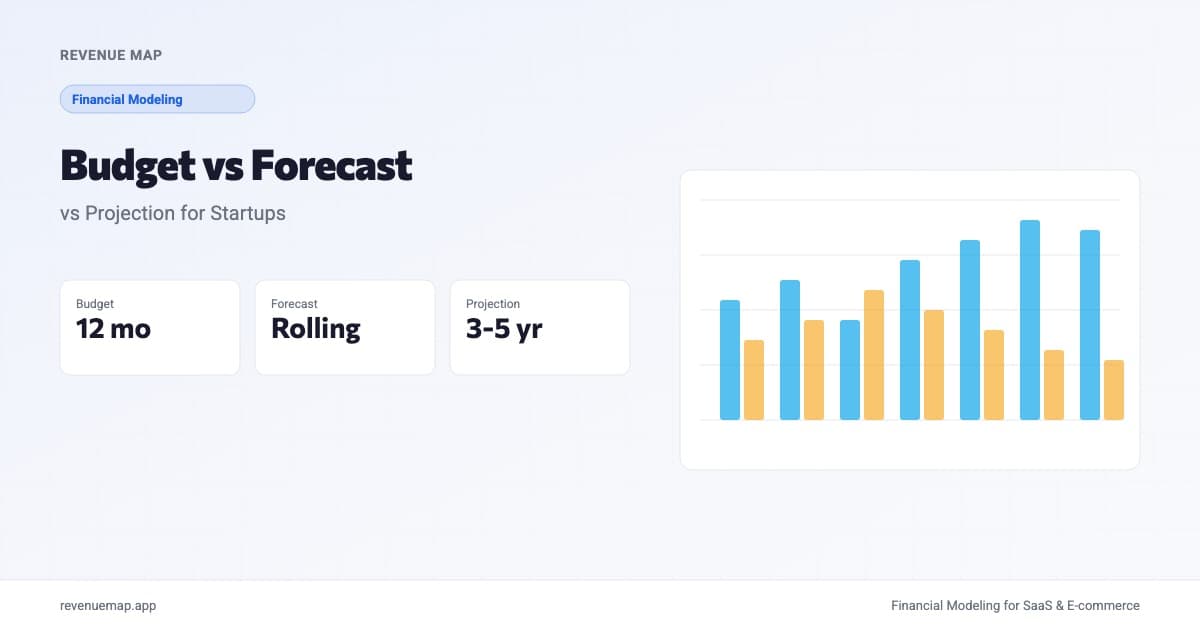
A budget tells you how much you can spend. A forecast tells you what will probably happen. A projection tells you what could happen under different assumptions. Founders mix up all three constantly, and it costs them: wrong numbers in a pitch deck, misleading burn targets for the team, or operational plans built on wishful thinking instead of actual data.
The distinction matters more in fast-moving markets. SaaStr's latest roundup covered AI companies like Clay reaching a $7B valuation and Cognition hitting $46B, numbers that only make sense when investors evaluate projections (multi-scenario models of what could happen) rather than forecasts (what the current run rate predicts). Knowing which document to use, and when, is a basic literacy test for founders raising capital in this environment.
What Is the Difference Between a Budget, Forecast, and Projection?
A budget is a fixed spending plan. It allocates a defined pool of money across departments, line items, and time periods for one fiscal year. The budget answers one question: "Given our expected revenue, who gets to spend what?"
A forecast is a rolling prediction of what will actually happen, updated regularly with real performance data. It combines historical trends, pipeline data, and known variables to produce a best-estimate outcome. The forecast answers: "Based on where we are right now, where will we end up?"
A projection is a scenario model that explores what could happen under a set of hypothetical assumptions. Projections typically include multiple cases (base, optimistic, pessimistic) over 3 to 5 years. The projection answers: "If these assumptions hold, what does the business look like?"
Here is the critical distinction: forecasts start from reality and predict forward. Projections start from assumptions and model outcomes. A forecast might say "we will hit $1.2M ARR by December based on current growth." A projection says "if we double marketing spend and improve conversion by 15%, we could hit $2M ARR by December." Same company, entirely different numbers, both valid for different purposes.
Budget vs Forecast vs Projection: How They Compare
| Dimension | Budget | Forecast | Projection |
|---|---|---|---|
| Time horizon | 1 year (monthly detail) | 1 to 4 quarters (rolling) | 3 to 5 years |
| Starting point | Revenue assumptions | Actual performance data | Hypothetical assumptions |
| Number of scenarios | Single plan | Single best estimate | Multiple (base, up, down) |
| Update frequency | Set annually, reviewed monthly | Monthly or quarterly | When assumptions change |
| Primary audience | Department leads, finance team | Operations, board | Investors, strategic planning |
| Key question answered | "How much can we spend?" | "Where are we headed?" | "What could happen if...?" |
| Relationship to actuals | Compared monthly (variance) | Calibrated by actuals | Independent of current actuals |
When Should Founders Use Each One?
Budget. You need one once you have a team spending money. At the seed stage, a budget might be a single sheet with headcount costs, infrastructure, and marketing spend. By Series A, it should break down by department and month. The budget keeps spending disciplined, and tracking variance against it tells you where your assumptions were wrong.
If you have not built one yet, our startup budget guide walks through the full process with benchmarks by stage.
Forecast. Start building forecasts once you have 3 to 6 months of revenue data to calibrate against. The forecast is your operating compass. It tells the team what to expect, surfaces problems early ("we are trending 20% below plan"), and gives the board a credible picture of near-term performance.
A strong forecast feeds directly from your actuals. Plug in last month's numbers, adjust for known changes like seasonal trends or a large deal closing, and project forward. Our revenue forecast template has the structure you need.
Projection. Every startup that fundraises needs projections. Investors expect a financial model with at least three scenarios over 3 to 5 years. But projections also serve strategic purposes: evaluating a new pricing model, entering a new market, or deciding whether to hire aggressively before hitting profitability.
The honest answer is that most startups begin with projections (because they are raising money), add a forecast once they have data, and add a budget once they have a team. The mistake is treating one document as all three.
How Do the Three Documents Connect?
Here is how they should flow together:
- Projections set the vision. Your multi-year model establishes the growth trajectory and resource requirements. For a deeper guide on building those projections, see our financial forecasting for startups walkthrough.
- The budget translates vision into spending limits. Take the Year 1 assumptions from your projection, ground them in reality, and allocate specific dollars.
- The forecast tracks execution. Each month, compare actuals to both the forecast and the budget. When they diverge, update the forecast (not the budget) to reflect the new trajectory.
Projection (Year 1 revenue target: $1.5M)
    → grounds into
Budget (Q1 marketing: $60K, Engineering: $180K)
    → tracked by
Forecast (actual Q1 revenue: $310K, on pace for $1.3M)
When the forecast shows you falling short of the projection, you face a decision: adjust the budget (spend less), change tactics (improve conversion, raise prices), or revise the projection (tell investors the timeline has shifted). That feedback loop is what separates startups that run on data from ones that run on hope.
What Is Forecast Variance?
Forecast variance measures how far your actual results deviated from what you predicted. It is the simplest health check for your planning process.
Forecast Variance (%) = ((Actual - Forecast) / Forecast) × 100
A positive variance means you outperformed. A negative variance means you missed. Neither is inherently good or bad. Consistently positive variance can signal that your forecasts are too conservative, which wastes resources through under-investment. Consistently negative variance means your assumptions are disconnected from reality.
Track forecast variance monthly on your key metrics: revenue, burn rate, customer acquisition, and runway. If variance exceeds 10 to 15% for three consecutive months, your forecasting inputs need recalibration.
Calculate Your Forecast Variance
Forecast Variance Calculator
Compare actual results against your forecast to measure prediction accuracy
Common Mistakes Founders Make
-
Using projections as forecasts. Projections assume hypothetical scenarios. If you tell your team "we are going to hit $3M ARR this year" based on your upside projection, you are setting targets nobody can track against. Use your base forecast for operational targets and save projections for strategic planning.
-
Never updating the forecast. A forecast built in January and never touched is just a stale projection. Update it monthly with actual data. That is the whole point: the forecast earns its value by staying calibrated to reality.
-
Budgeting without a model. Setting spending limits without a financial model feeding the budget is guessing. The budget should flow from your projection's Year 1 assumptions, grounded by your latest forecast. Without that connection, departments either overspend or underspend because the budget has no strategic context.
-
Presenting the forecast to investors. Investors want to see scenarios, not a single best estimate. Your pitch deck should use projections (base, upside, downside) to show how the business scales under different conditions. Save the forecast for board updates and internal planning.
-
Skipping variance analysis. The budget is only useful if you compare actuals against it every month. Without variance reporting, you discover you overspent in Q4, which is too late to correct course.
Key Takeaways
- A budget allocates spending, a forecast predicts likely outcomes, and a projection models hypothetical scenarios. They are three different documents that serve three different purposes.
- Start with projections for fundraising, add a forecast once you have revenue data, and add a budget once you have a team spending money.
- Connect all three: projections inform the budget, the forecast tracks execution, and variance analysis closes the loop.
- Track forecast variance monthly. If you consistently miss by more than 10 to 15%, recalibrate your inputs.
- Use projections (not forecasts) in your pitch deck, and forecasts (not projections) for day-to-day operational planning.
Building these documents from scratch takes time, but starting from a proven template cuts weeks off the process. Try Revenue Map to generate your first financial model in minutes, then layer on your budget and forecast from there.
Related Articles
Financial Modeling Software for Startups (2026)
Compare the best financial modeling software for startups, from spreadsheets to AI-native tools. Features, pricing, and when to upgrade from Excel.
Financial Forecasting for Startups: A Practical Guide
Learn how to build and maintain startup financial forecasts. Covers five proven methods, re-forecasting cadence, accuracy benchmarks, and a free calculator.
Financial Model vs Budget: When You Need Each
A financial model projects scenarios over 3-5 years. A budget allocates spending for 12 months. Here is when to use each and how to connect them.