FoodTech Unit Economics: Per-Order Profitability, Delivery Costs, and Break-Even Analysis
FoodTech unit economics measure the revenue, cost, and profit generated by a single food delivery order. The core metric is contribution margin per order, what remains after subtracting food cost, packaging, delivery, platform fees, and payment processing from the order total. A cloud kitchen needs a contribution margin of at least 15 to 20 percent per order to reach profitability at scale.
By Tim Kozin
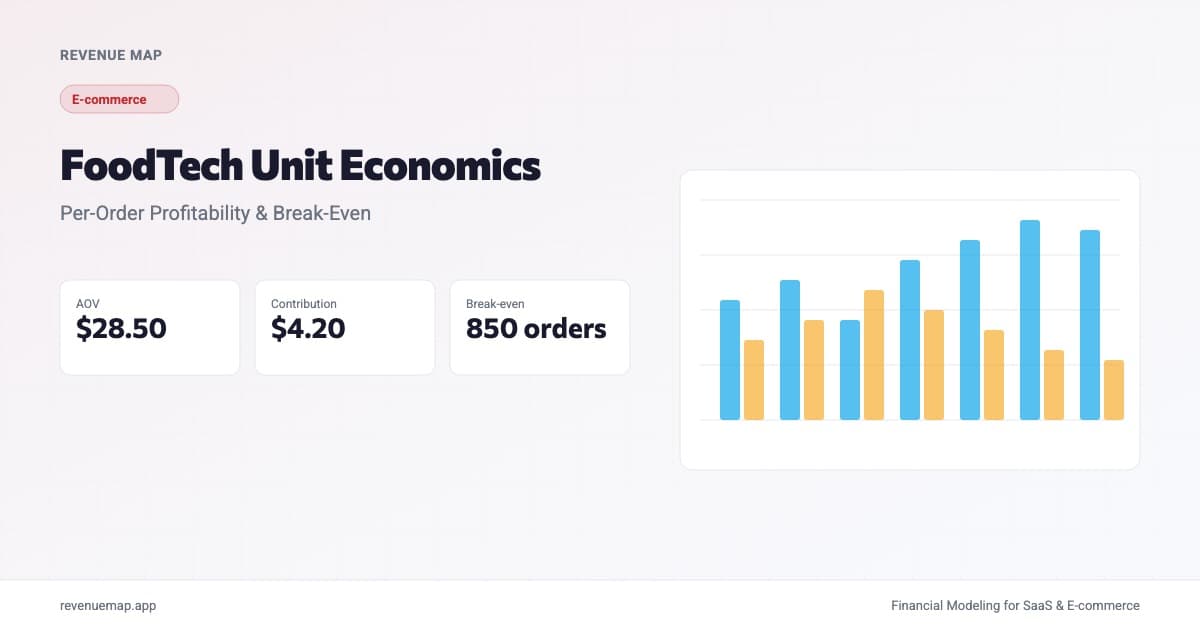
To calculate per-order profitability for a food delivery business, subtract every variable cost from the order total: food cost (COGS), packaging, delivery expense, platform or marketplace fee, and payment processing. The result is your contribution margin per order, the single metric that determines whether scaling your food delivery operation builds a business or accelerates cash burn. If contribution margin is negative, more orders means more losses. No amount of volume fixes that.
What Are FoodTech Unit Economics?
FoodTech unit economics measure the direct revenues and costs associated with fulfilling a single food delivery order, used to determine whether the business model generates profit at the order level before fixed costs are applied.
Unlike traditional e-commerce where lifetime value and acquisition cost dominate the analysis, food delivery economics are fundamentally per-order. Customers have low switching costs, platform loyalty is weak, and repeat behavior is driven by convenience and price rather than brand affinity. The unit is the order, not the customer.
Contribution margin per order is the metric that matters. It answers: after paying for the food, the box, the driver, the platform, and the payment processor, how much is left? That residual, positive or negative, is the atomic building block of your entire financial model. Every projection about break-even, fundraising runway, and long-term profitability is built on top of it.
Why Per-Order Profitability Is the Only Metric That Matters
Volume does not fix negative unit economics, it amplifies them. A food delivery business losing $1.40 per order at 3,000 orders per month will lose $14,000 per month. At 30,000 orders, it loses $140,000.
This is the fundamental trap of food delivery businesses. Gross merchandise value (GMV) looks impressive on pitch decks. Order count growth looks impressive in board meetings. Neither metric tells you whether the business is viable. Only contribution margin per order does.
The food delivery industry has a well-documented history of startups that scaled aggressively on subsidized delivery, achieved market share, and then discovered they could not reach profitability because their per-order economics were structurally negative. The subsidy created demand that evaporated the moment pricing moved to sustainable levels.
The correct sequence is: prove positive contribution margin on a small number of orders first, then scale. If your per-order economics don't work at 500 orders per day, they won't work at 5,000. The cost structure might shift slightly with volume discounts on packaging or food procurement, but delivery cost, the largest variable expense, does not compress linearly with scale.
Anatomy of a Food Delivery Order
A food delivery order has six cost components that determine contribution margin: food cost, packaging, delivery, platform fees, payment processing, and refund/cancellation allowance.
Here is the full breakdown for a typical order:
Average Order Value (AOV): The total charged to the customer, including food items and any delivery fee passed through. FoodTech AOVs range from $18 for quick-service to $45+ for premium meal delivery. The industry median sits around $25-30.
Food Cost (COGS), 28-35% of AOV: The raw ingredient cost of the food in the order. Cloud kitchens operating with optimized menus can hit 28%. Full-menu restaurants on delivery platforms typically run 32-35%. This is the largest single cost component and the one with the most operational leverage, menu engineering, portion control, and supplier negotiation all compress food cost without affecting the customer experience.
Packaging, $0.60-$1.50 per order: Containers, bags, utensils, napkins, stickers, and any insulation for hot/cold items. Packaging cost is often underestimated. A typical delivery order with two containers, a bag, utensils, and napkins runs $0.80-$1.20. Premium or branded packaging can push this above $1.50.
Delivery Cost, $3.50-$7.00 per order: The cost of getting the order from kitchen to customer. This includes driver compensation, fuel or mileage, and any logistics platform fees. For businesses using third-party fleets (DoorDash Drive, Uber Direct), expect $4.50-$6.50 per delivery. In-house delivery teams can reduce this to $3.50-$5.00 in dense urban areas but require fleet management overhead. Delivery cost is the most variable and hardest-to-control line item, it fluctuates with distance, time of day, weather, and driver availability.
Platform/Marketplace Fee, 15-30% of AOV: If orders come through a third-party marketplace (Uber Eats, DoorDash, Grubhub), the platform takes 15-30% of the order value. Direct-to-consumer orders via your own app or website eliminate this fee but require spending on customer acquisition instead. The trade-off is structural: marketplace orders have zero acquisition cost but high per-order fees; direct orders have acquisition cost but near-zero platform fees.
Payment Processing, 2.9% + $0.30 per order: Standard credit card processing. On a $25 order, this is $1.03. On direct orders, you pay this directly. On marketplace orders, it's typically embedded in the platform fee.
How to Calculate Contribution Margin Per Order
Contribution margin per order is calculated by subtracting all variable costs from the average order value. The result, expressed in dollars and as a percentage of AOV, is the profit available to cover fixed costs and generate net income.
Worked example, FreshBowl Kitchen: FreshBowl is a cloud kitchen operating on a mix of marketplace and direct orders. Here are the inputs for a single marketplace order:
- Average order value: $25.00
- Food cost (30% of AOV): $7.50
- Packaging: $0.80
- Delivery cost (third-party fleet): $4.50
- Platform fee (15% of AOV): $3.75
- Payment processing (embedded in platform fee): $0.00
- Refund/cancellation allowance (4% of AOV): $1.00
Step 1, Calculate total variable cost:
Total Variable Cost = $7.50 + $0.80 + $4.50 + $3.75 + $0.00 + $1.00 = $17.55
Step 2, Calculate contribution margin:
Contribution Margin = $25.00 - $17.55 = $7.45
Step 3, Calculate contribution margin percentage:
Contribution Margin % = $7.45 / $25.00 = 29.8%
Step 4, Calculate break-even order volume:
If FreshBowl's monthly fixed costs (rent, staff, equipment, software) are $18,000:
Break-even Orders = $18,000 / $7.45 = 2,416 orders/month (~81 orders/day)
At $7.45 contribution margin per order, FreshBowl needs 2,416 orders per month, roughly 81 per day, to cover fixed costs. Every order beyond that is profit.
Per-Order Profit Calculator
Enter your food delivery order metrics to calculate contribution margin per order. Adjust AOV, food cost percentage, delivery cost, and platform fee to see how each variable affects profitability.
Want to model this over 36 months with scenarios? Try Revenue Map free →
Benchmarks by FoodTech Model
Per-order economics vary significantly by FoodTech model. Cloud kitchens and ghost kitchens achieve the highest contribution margins due to lower food cost and operational efficiency. Delivery apps face the tightest margins because they don't control food cost.
| Model | Typical AOV | Food Cost % | Delivery Cost | Platform Fee | Contribution Margin % |
|---|---|---|---|---|---|
| Cloud Kitchen | $22–28 | 28–32% | $4.00–5.50 | 15–25% | 18–25% |
| Delivery App (marketplace) | $28–38 | 30–35% | $5.00–7.00 | 0% (you are the platform) | 8–15% |
| Meal Kit | $45–65 | 35–42% | $6.00–9.00 | 0% (direct) | 20–30% |
| Ghost Kitchen (multi-brand) | $20–26 | 26–30% | $4.00–5.50 | 15–25% | 20–28% |
Three model-specific notes. Cloud kitchens benefit from simplified menus and no dine-in overhead, but their economics are heavily dependent on order density, fixed kitchen costs require high throughput to amortize. Delivery apps (Uber Eats, DoorDash) don't pay platform fees to themselves, but their margin comes from the fees charged to restaurants, and driver cost is their dominant expense. Meal kits have the highest AOV and no real-time delivery pressure, which allows for batch shipping and lower per-unit logistics cost, but food cost percentage runs higher because ingredient kits include more waste buffer and premium packaging.
Common Mistakes
1. Ignoring last-mile cost variability. Delivery cost is not a fixed number, it varies by distance, time of day, weather, and driver supply. A delivery that costs $4.00 at noon on a Tuesday costs $7.50 during Friday dinner rush in rain. Using a single average delivery cost in your model understates the variance and overstates contribution margin during peak periods when most of your orders occur. Model delivery cost as a range, and stress-test your unit economics at the 75th percentile cost, not the median.
2. Not accounting for refunds and cancellations. Food delivery has a structurally higher refund rate than standard e-commerce, missing items, cold food, late delivery, and incorrect orders generate refund requests on 4-8% of orders. Each refund is a 100% margin loss: you've already paid for food, packaging, and delivery, but you're returning the revenue. A 6% refund rate on a $25 AOV costs $1.50 per order across your entire order base. Omitting this from your unit economics model flatters contribution margin by 5-8%.
3. Subsidizing delivery cost indefinitely. Offering free or discounted delivery to drive adoption is a valid growth tactic, as long as you have a clear timeline for moving to sustainable delivery pricing. The mistake is treating subsidized delivery as a permanent state. If your contribution margin is only positive because you're charging $0 for delivery while paying $5.00 per trip, your true unit economics are negative. Model both the subsidized and unsubsidized scenarios, and know exactly when and how you'll transition.
4. Using the wrong break-even timeline. Food delivery businesses often project break-even based on optimistic order volume ramps. The reality: customer acquisition in food delivery is slow without marketplace distribution, and organic growth in a new market takes 6-12 months to reach meaningful density. If your break-even calculation assumes 200 orders/day by month 3 but you're at 40 orders/day in month 6, your runway calculation is off by 5x. Use conservative volume assumptions and extend your break-even timeline by 50-100% beyond your base case.
Key Takeaways
- Contribution margin per order is the atomic metric for food delivery, subtract food cost, packaging, delivery, platform fee, and payment processing from AOV; if the result is negative, scaling makes the problem worse, not better
- Delivery cost is the largest and most variable expense, model it as a range, not a point estimate, and stress-test at the 75th percentile; a $2.50 swing in delivery cost can flip contribution margin from positive to negative
- Refunds and cancellations cost 4-8% of orders and represent 100% margin loss; include a refund allowance in every per-order calculation or you're overstating contribution margin by 5-8%
- Break-even order volume is the bridge from unit economics to business viability, divide monthly fixed costs by contribution margin per order to find the daily throughput you need, then pressure-test whether your market and channel mix can actually deliver that volume
For a deeper look at how customer-level metrics like LTV and CAC apply to e-commerce and DTC models, including food delivery brands with repeat-order dynamics, see E-commerce Unit Economics: AOV, CAC, and LTV Explained. Revenue Map's FoodTech financial model lets you adjust AOV, food cost, delivery expense, and platform fees in a single scenario, and see exactly how each variable moves your per-order contribution margin and break-even point in real time. Calculate the key inputs directly: AOV, repeat purchase rate, and gross margin.
Related Articles
DTC Financial Model: Revenue, Margins, and CAC
How to build a direct-to-consumer financial model with COGS, blended CAC, and LTV formulas. Includes 2026 DTC benchmarks and a contribution margin calculator.
Subscription Box Financial Model: Costs, Margins, and LTV
Build a subscription box financial model with COGS, fulfillment, and churn formulas. Includes benchmarks and a contribution margin calculator.

Ecommerce Unit Economics: 2026 Benchmarks for AOV, CAC, LTV
Calculate AOV, CAC, and LTV for your online store with step-by-step formulas. Includes 2026 benchmarks by vertical and the 3:1 LTV:CAC profitability rule.