Marketplace Financial Model: Take Rates, GMV Projections, and Liquidity Metrics
A marketplace financial model projects revenue by estimating gross merchandise volume and applying a take rate to derive net revenue. The key distinction is that GMV is not revenue, only the platform's commission is. Viable marketplaces track five core metrics: GMV, take rate, buyer and seller CAC, LTV:CAC per side, and liquidity rate. Modeling both sides of the marketplace independently is essential for accurate projections.
By Tim Kozin
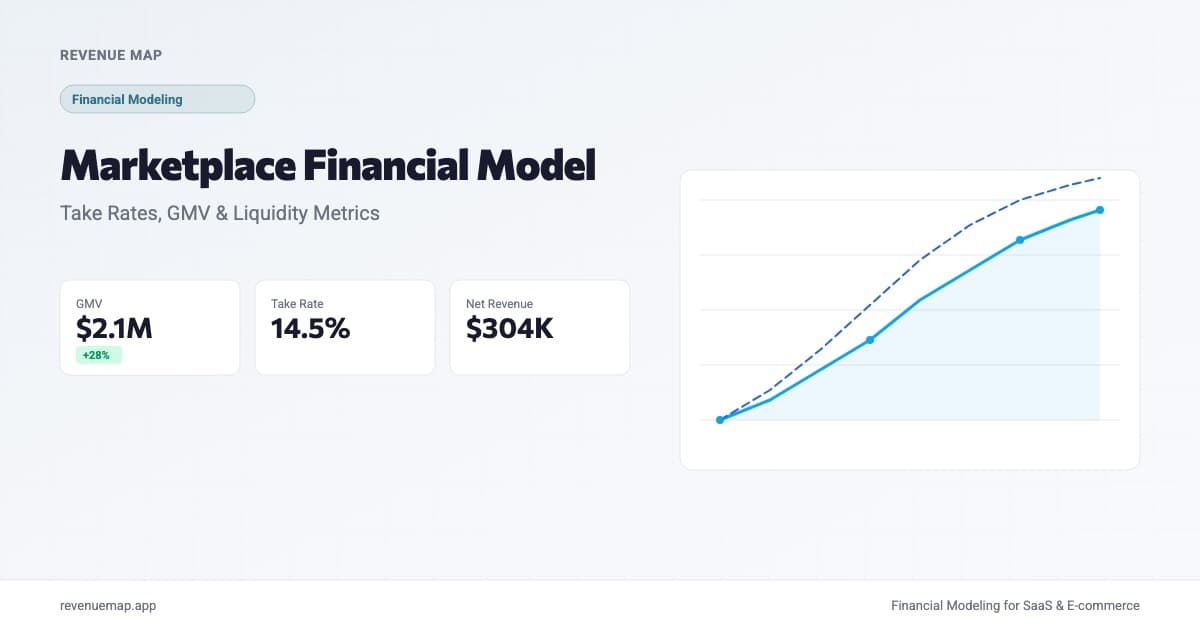
Modeling revenue for a two-sided marketplace requires projecting both sides of the platform independently, supply and demand, then connecting them through liquidity to produce GMV, and applying a take rate to derive net revenue. The fundamental difference between a marketplace model and a traditional e-commerce or SaaS model is that your top line is not the total transaction volume flowing through the platform. It is only the slice you keep. Getting this distinction wrong at the model level cascades into every other number in your projections.
What Is a Marketplace Financial Model?
A marketplace financial model is a revenue projection framework that accounts for the interdependent dynamics of supply, demand, and platform economics in a two-sided business.
In a traditional e-commerce business, you sell products and recognize the full transaction as revenue. In a marketplace, you facilitate transactions between third-party sellers and buyers, and your revenue is the commission or fee you charge for that facilitation. This is the GMV-to-net-revenue distinction, and it changes everything about how the model works.
Gross Merchandise Volume (GMV) is the total dollar value of transactions processed through your platform. Net revenue is the portion you retain.
Net Revenue = GMV × Take Rate
If your marketplace processes $8 million in GMV per quarter at a 14% take rate, your net revenue is $1.12 million, not $8 million. This sounds obvious, but GMV inflation is one of the most persistent problems in marketplace pitch decks and financial models. Investors, lenders, and internal planning teams need to see net revenue, the actual economic value accruing to the platform.
The model must also capture the cost structure on both sides. You have acquisition costs for sellers and acquisition costs for buyers. You have retention dynamics on each side that operate on different timelines. And you have the liquidity layer in between that determines whether supply and demand actually meet. A marketplace financial model that doesn't account for all three layers, supply economics, demand economics, and the liquidity bridge, will produce projections that look plausible in a spreadsheet and fail in reality.
The Chicken-and-Egg Problem in Financial Modeling
Every marketplace faces a cold-start problem: sellers won't join without buyers, buyers won't join without sellers, and your financial model must account for how you break the deadlock.
This isn't just an operational challenge, it's a modeling challenge. In the early months of a marketplace, your supply and demand curves are not independent. They are coupled, and the coupling is non-linear. Adding 100 sellers to a marketplace with zero buyers produces zero transactions. Adding those same 100 sellers after you've reached critical mass on the demand side might produce thousands.
Liquidity is the metric that captures this dynamic. Liquidity rate measures the probability that a listing on your platform results in a completed transaction within a given time window.
Liquidity Rate = Transactions Completed / Active Listings × 100
A marketplace with 10,000 active listings and 1,200 completed transactions per month has a 12% liquidity rate. Whether that's good depends entirely on the category, a services marketplace like Thumbtack might target 30–40% liquidity, while a product marketplace like Etsy might consider 5–8% healthy given the long-tail nature of handmade goods.
The critical mass threshold is the point at which liquidity becomes self-sustaining, where enough supply exists to satisfy demand reliably, and enough demand exists to keep sellers active. Before critical mass, your model should show high CAC on both sides, low conversion rates, and negative unit economics. After critical mass, unit economics should improve rapidly as network effects kick in and organic growth begins to compound.
Modeling the transition from pre-liquidity to post-liquidity is the hardest part of a marketplace financial model, and the part most founders skip. They draw a smooth growth curve from month one to month thirty-six. In reality, marketplace growth looks more like a hockey stick with a long, flat handle. The flat period is the liquidity-building phase, and your burn rate during that period determines whether you survive to see the inflection.
Five Metrics That Define Marketplace Viability
Every marketplace operator tracks dozens of metrics, but five define whether the business model works at a structural level. These are the metrics your financial model must capture, and the ones investors will interrogate first.
1. Gross Merchandise Volume (GMV)
GMV = Number of Transactions × Average Transaction Value
GMV is the total value flowing through your platform. It measures scale and transaction velocity, but it is not revenue. GMV growth with declining take rates can produce flat or declining net revenue, a pattern that looks like progress on a dashboard and like a problem on an income statement.
2. Take Rate
Take Rate = Net Revenue / GMV × 100
Take rate is the percentage of each transaction you retain. Uber's effective take rate is approximately 25%. Airbnb charges roughly 15% (split between host and guest fees). Etsy's take rate is around 6.5% after transaction fees. Your take rate reflects the value you add, managed marketplaces that handle fulfillment, quality assurance, or payment processing command higher rates than listing-only platforms.
3. CAC by Side (Buyer and Seller)
Buyer CAC = Buyer Acquisition Spend / New Buyers Acquired
Seller CAC = Seller Acquisition Spend / New Sellers Acquired
Unlike single-sided businesses, marketplaces must track acquisition cost for each side independently. Seller CAC is often higher than buyer CAC because supply-side acquisition typically requires sales outreach, onboarding support, and quality vetting. A marketplace spending $200 to acquire a seller and $15 to acquire a buyer has a fundamentally different cost structure than one spending $50 on each, and the model must reflect this asymmetry.
4. LTV:CAC Per Side
Seller LTV:CAC = (Revenue per Seller × Seller Lifespan × Margin) / Seller CAC
Buyer LTV:CAC = (Revenue per Buyer × Buyer Lifespan × Margin) / Buyer CAC
The LTV:CAC ratio must be calculated separately for each side of the marketplace. A platform can have a 5:1 ratio on the buyer side and a 1.2:1 ratio on the seller side, meaning seller economics are underwater even though the aggregate number looks healthy. Blending the two hides the problem and delays the intervention. For a deeper look at how LTV:CAC math works in a transactional business, see our breakdown of e-commerce unit economics.
5. Liquidity Rate
Liquidity Rate = Transactions Completed / Active Listings × 100
Liquidity rate is the marketplace-specific metric that has no equivalent in SaaS or e-commerce. It measures whether supply and demand are actually meeting. Declining liquidity, even as GMV grows, signals that one side of the marketplace is outpacing the other, and the imbalance will eventually break retention on the weaker side.
How to Project Marketplace Revenue
Marketplace revenue projection follows a five-step pipeline: supply growth → demand matching → transaction volume → GMV → net revenue.
Building the projection in this order, rather than starting with a top-down revenue target, forces you to make explicit assumptions about each layer. Every assumption becomes testable, and weak spots in the model surface before they become surprises in the P&L.
Step 1, Project supply-side growth. Start with the number of active sellers or providers per month. Model three inputs: new sellers acquired per month (driven by CAC and sales capacity), onboarding conversion rate (percentage of leads that become active sellers), and monthly seller churn rate. Net active sellers = prior month sellers + new sellers − churned sellers. This is the foundation, without supply, no transactions occur.
Step 2, Model demand and liquidity. Estimate buyer growth independently using buyer CAC, organic growth rate, and referral coefficients. Then connect supply and demand through liquidity: given your active listings and active buyers, what percentage of listings convert to completed transactions? Early months will show low liquidity. Your model should show liquidity improving as both sides scale, and you should have a clear assumption about the liquidity rate at steady state.
Step 3, Calculate transaction volume. Multiply active listings by your projected liquidity rate to get the number of completed transactions per period. Alternatively, multiply active buyers by average purchase frequency. Cross-check both methods, if they diverge significantly, your supply-demand assumptions are inconsistent.
Step 4, Calculate GMV. Multiply completed transactions by average transaction value. GMV = Transactions × ATV. Model ATV trends explicitly, most marketplaces see ATV shift over time as the product mix evolves, as the platform moves into new categories, or as power sellers drive a larger share of volume.
Step 5, Apply take rate. Multiply GMV by your take rate to get net revenue. If your take rate is evolving, increasing as you add payment processing, seller tools, or managed services, model the trajectory. A marketplace at 8% take rate in year one and 14% by year three has a fundamentally different revenue profile than one holding flat at 10%.
Marketplace Revenue Calculator
Enter your projected GMV and take rate to calculate net marketplace revenue, the actual top-line number for your P&L.
Benchmarks by Marketplace Type
Take rates, liquidity targets, and CAC payback periods vary significantly by marketplace category. Using benchmarks from the wrong category will distort your entire model.
| Marketplace Type | Avg. Take Rate | Target Liquidity Rate | CAC Payback Target |
|---|---|---|---|
| Services (Uber, TaskRabbit) | 20–30% | 30–50% | < 6 months |
| Product (Etsy, Poshmark) | 6–15% | 5–12% | < 9 months |
| B2B (Faire, Alibaba) | 5–12% | 8–15% | < 12 months |
| Rental (Airbnb, Turo) | 12–20% | 15–30% | < 8 months |
Services marketplaces command the highest take rates because they typically manage more of the transaction, matching, scheduling, payment, dispute resolution, and sometimes quality assurance. The trade-off is higher operational complexity and higher support costs per transaction. Uber's approximately 25% take rate reflects a fully managed experience where the platform handles pricing, routing, payment, and driver-rider matching. That level of management justifies the premium.
Product marketplaces operate at the lowest take rates because sellers have alternatives, they can sell on their own Shopify store, on Amazon, or through wholesale channels. Etsy's 6.5% transaction fee plus listing fees produces a blended take rate that must remain competitive with those alternatives. Product marketplaces compensate with higher GMV per seller and lower support costs per transaction.
B2B marketplaces are still maturing as a category. Take rates are typically lower because order values are higher and buyers have established procurement processes. The payback period is longer because sales cycles on both sides are longer, but LTV per account is often substantially higher than consumer marketplaces, making the economics viable despite the slower ramp.
Rental marketplaces sit in the middle, Airbnb's approximately 15% combined take rate (split between host service fee and guest service fee) reflects a model where the platform provides search, trust/safety, payment, and insurance. Rental marketplaces have natural supply constraints (a property can only be rented to one guest at a time), which limits GMV per supplier but creates pricing power during high-demand periods.
Common Mistakes in Marketplace Financial Modeling
1. Modeling only one side of the marketplace. The most fundamental error is building a demand-side revenue model without explicitly modeling supply growth, supply churn, and supply-side economics. If your model projects 50,000 monthly transactions by month eighteen but doesn't show where the sellers fulfilling those transactions came from, or what it cost to acquire and retain them, the projection is incomplete. Supply constraints are the most common bottleneck in marketplace scaling, and they don't appear in models that only track the demand curve.
2. Reporting GMV as revenue. This mistake appears in pitch decks, board presentations, and internal planning models. A marketplace processing $20 million in GMV at a 10% take rate has $2 million in net revenue, not $20 million. Building an expense structure, hiring plan, or fundraising target against GMV rather than net revenue produces decisions that are off by an order of magnitude. Every line item below the top line, CAC, gross margin, operating expenses, burn rate, must be calculated against net revenue, not GMV.
3. Ignoring seller churn in growth projections. Marketplace models frequently project cumulative seller growth, 100 new sellers per month for 24 months equals 2,400 sellers. In reality, seller churn rates of 5–10% per month are common in early-stage marketplaces, particularly before liquidity reaches critical mass. A marketplace adding 100 sellers per month with 8% monthly churn reaches approximately 1,150 active sellers at month twenty-four, less than half the number a zero-churn model projects. The gap between the two models is the gap between a viable business and a funding shortfall.
4. Assuming a flat take rate across all scenarios. Take rates are not static. They evolve with marketplace maturity, competitive pressure, and value-added services. Many marketplaces launch with a low introductory take rate to attract supply, then increase it as they add payment processing, fulfillment, advertising, and seller tools. Others face take rate compression as competitors enter. Your model should include explicit assumptions about take rate trajectory, and sensitivity analysis showing how a 2–3 percentage point swing in take rate impacts net revenue and unit economics.
Key Takeaways
- GMV is not revenue, net revenue equals GMV multiplied by take rate, and every financial decision from CAC budgets to burn rate must be calculated against net revenue, not gross transaction volume
- Model both sides independently, supply growth, demand growth, and the liquidity rate that connects them are three separate projection layers; collapsing them into a single growth curve hides the structural risks that break marketplaces
- Liquidity rate is the leading indicator, declining liquidity, even with growing GMV, signals a supply-demand imbalance that will eventually destroy retention on the weaker side of the marketplace
- Take rate benchmarks vary by category, services marketplaces (20–30%) command far higher rates than product marketplaces (6–15%); using benchmarks from the wrong category will distort your unit economics and misinform acquisition spending decisions
Revenue Map's marketplace financial model lets you build projections with separate supply and demand curves, adjustable take rates, and liquidity analysis, so you can stress-test your assumptions before committing capital. Calculate the underlying metrics too: CAC, LTV, and gross margin. For transactional businesses that sell directly rather than facilitating third-party sales, our e-commerce unit economics guide covers the AOV, LTV, and CAC framework in detail.
Related industry models
Building a model for a different sector? These sibling guides cover the economics unique to each vertical.
- FinTech Financial Model: Transaction Revenue, Compliance Costs, and Growth ProjectionsLearn how to build a fintech financial model that accounts for transaction-based revenue, regulatory compliance costs, and multi-vertical growth projections. Covers payments, lending, neobanking, and insurtech.
- TravelTech Financial Model: Seasonality, Booking Revenue, and Commission EconomicsBuild a TravelTech financial model that accounts for seasonality, booking volume, commission rates, and cancellation economics. Includes benchmarks for OTAs, hotel platforms, experiences marketplaces, and car rental platforms.
- PropTech Financial Model: Deal Economics, Listing-to-Close Metrics, and Revenue ProjectionsBuild a PropTech financial model grounded in deal economics. Learn how to forecast listing-to-close conversion, revenue per transaction, and cost per deal across brokerage, property management, and iBuyer platforms.
- Mobile App Financial Model: Free Template (2026)Build a mobile app financial model with MAU-to-MRR projections, unit economics, and real category benchmarks. Free LTV calculator and worked examples included.
Related Articles
Break-Even Analysis: How to Calculate for Startups
Learn how to calculate your break-even point with formulas, examples, and benchmarks. Includes a free calculator and tips for SaaS and e-commerce founders.
Robotics Startup Financial Model: Costs, Margins, R&D
Build a financial model for a robotics startup. Covers BOM costs, R&D burn, manufacturing margins, and the unit economics investors need to see.
Construction Tech Financial Model for Startups
Build a construction tech financial model with project revenue, bid win rates, and contractor unit economics. Includes benchmarks and a revenue calculator.