Per-Seat vs Usage-Based Pricing: How to Choose
Per-seat pricing charges a fixed fee for each user on the account, while usage-based pricing charges based on actual consumption like API calls or data processed. Choose per-seat when value scales with team size, and usage-based when value scales with volume.
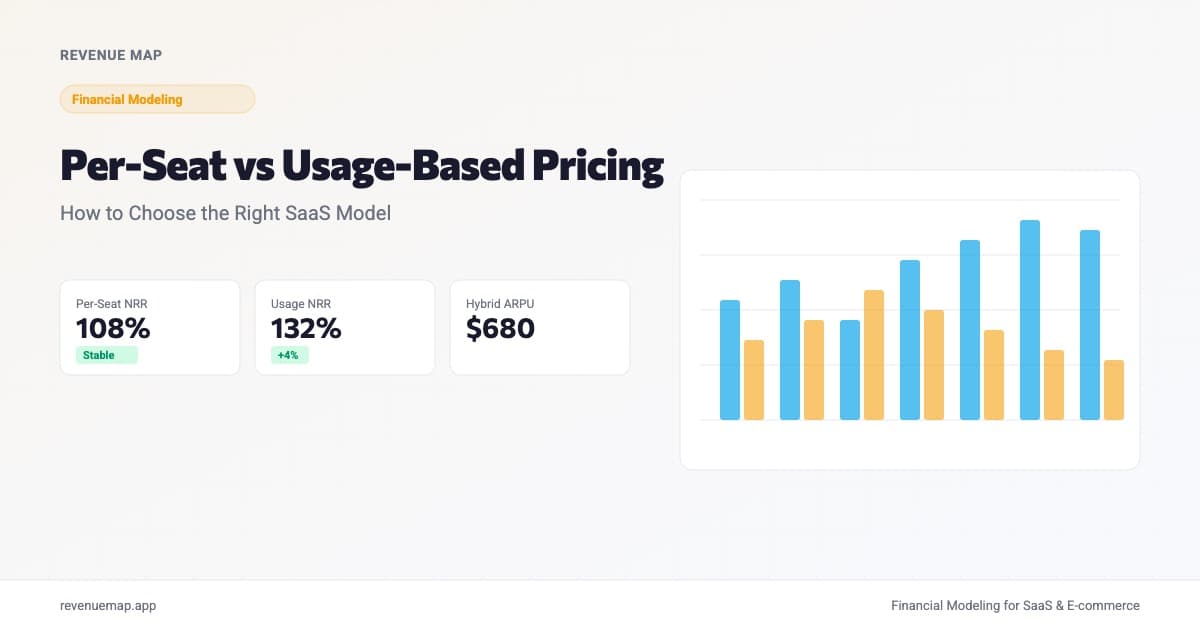
Per-seat pricing charges a fixed rate per user on the account. Usage-based pricing charges per unit consumed (API calls, compute hours, transactions). Choosing between them is one of the highest-leverage decisions a SaaS founder makes, because it determines how your revenue scales, how customers adopt, and how investors value your company. According to SaaStr's July 2026 profile of Willingness to Pay, demand for pricing strategy consulting has surged as B2B and AI companies realize that per-seat models no longer fit products where value is tied to volume, not headcount.
This guide breaks down when each model works, the financial trade-offs, and a decision framework to pick the right one for your startup.
What Is Per-Seat Pricing?
Per-seat pricing (also called per-user or per-license pricing) charges customers a recurring fee for each individual who has access to the product. If a team has 50 users at $20/seat/month, MRR from that account is $1,000 regardless of how much or how little each person uses the software.
This model dominates in categories where the product's value is inherently tied to the number of people collaborating: project management (Asana, Monday), CRM (Salesforce, HubSpot), and design tools (Figma). When every additional user creates value for the rest of the team, per-seat pricing aligns price with perceived value cleanly.
The financial upside: revenue predictability. You can forecast MRR as a function of customer count and seats per account, which simplifies modeling considerably. The downside: expansion is capped by headcount growth, which rarely exceeds 10-15% annually for most customers.
What Is Usage-Based Pricing?
Usage-based pricing (consumption-based or pay-as-you-go) charges customers proportional to how much of the product they actually consume. The billable unit varies: API calls for developer platforms, tokens processed for AI models, gigabytes for data products, transactions for payment infrastructure.
We covered the mechanics of forecasting usage-based revenue in depth here. The critical difference for this comparison: usage-based models unlock uncapped expansion from existing customers. A single account can go from $500/month to $50,000/month as they integrate your product more deeply, without adding a single new user to the account.
Head-to-Head Comparison
Here's how the two models stack up across the dimensions that matter most for financial planning:
| Dimension | Per-Seat | Usage-Based |
|---|---|---|
| Revenue predictability | High (stable seat counts) | Lower (variable consumption) |
| Expansion potential | Capped by hiring pace | Uncapped (scales with volume) |
| Net revenue retention | Typically 105-115% | Typically 115-140%+ |
| Customer acquisition friction | Higher (commit to X seats) | Lower (start small, scale up) |
| Churn visibility | Clear event (cancellation) | Gradual decline (usage fade) |
| Forecasting complexity | Simple (seats x price) | Complex (volume projections) |
| Best for | Collaboration, workflow, CRM | API, AI, data, infrastructure |
| Gross margin profile | 70-85% | 50-70% |
The honest answer is that neither model is universally better. The right choice depends on what you're selling and how customers experience value from it.
The Decision Framework: Three Questions
Question 1: Does Value Scale With Users or Volume?
If adding a 10th person to the account makes the product more valuable for everyone (network effects, collaboration), per-seat wins. If a single user doing 10x more work gets 10x more value, usage-based wins.
Here's the thing: many AI products fail the per-seat test. A company using your AI writing assistant doesn't get more value by giving it to 50 people at 10 queries each versus 5 people at 100 queries each. The value is in the queries, not the headcount. That's why SaaStr reports that AI companies are the fastest-growing segment abandoning per-seat models.
Question 2: Can Customers Predict Their Usage?
Per-seat is easier for buyers to budget. "We have 30 people, so it's $600/month" is simple procurement. Usage-based creates uncertainty ("What if we hit 2 million API calls? What's our bill?"), which can slow enterprise deals.
If your buyers are technical teams comfortable with variable costs (developers, data engineers), usage-based works. If your buyers are non-technical budget holders who need a fixed line item, consider per-seat or a hybrid.
Question 3: What's Your Cost Structure?
Per-seat products typically have near-zero marginal cost per user. One more person logging in costs you almost nothing. Usage-based products have real marginal costs: compute, storage, bandwidth, or API calls to upstream providers.
If serving the marginal unit is expensive, you need usage-based pricing to maintain margins as customers scale. Charging per seat while your infrastructure costs scale with consumption creates a dangerous margin squeeze at your best accounts.
Revenue Impact: Modeling Both Scenarios
Consider a B2B product with 200 customers. Here's how the numbers diverge over 12 months:
Per-Seat Scenario:
- Average seats per account: 12
- Price per seat: $45/month
- Starting MRR: $108,000
- Seat expansion rate: 8% annually
- Month 12 MRR: ~$115,000
Usage-Based Scenario:
- Average consumption: $540/month per account
- Starting MRR: $108,000
- Usage growth rate: 4% monthly per customer
- Month 12 MRR: ~$170,000
Same starting revenue, but the usage-based model reaches 48% more MRR by month 12, driven entirely by organic expansion from existing customers. That expansion compounds, which is why high-NRR companies command premium valuations.
Calculate Your Pricing Model Revenue
Pricing Model Revenue Comparison
Compare 12-month revenue under per-seat vs usage-based pricing
Want to model this over 36 months with scenarios? Try Revenue Map free →
The Hybrid Option
Most companies don't need to commit fully to one model. A hybrid structure captures the predictability of per-seat with the expansion upside of usage-based:
- Platform fee (per seat or flat): covers base access, creates revenue floor
- Usage component: charges for consumption above an included threshold
- Committed-use discounts: reward customers who commit to volume, improving your forecasting
Slack pioneered this with per-seat pricing plus message history and storage limits. Snowflake uses pure consumption but offers committed-use contracts. The hybrid lets you start with per-seat simplicity and layer in usage as your product matures.
For your SaaS financial model, model both components separately. The per-seat base gives you a floor; the usage overage gives you upside. Track ARPU at the blended level, but decompose it into fixed and variable components so you can forecast each accurately.
Common Pricing Model Mistakes
1. Defaulting to per-seat because it's familiar. Per-seat works for tools where value equals access. For products where value equals throughput (AI, APIs, data), it caps your upside and misaligns incentives. Your best customers subsidize your lightest users.
2. Underpricing the usage-based unit. Founders often set per-unit prices too low to minimize adoption friction, then struggle with margins at scale. Price your unit so that gross margins stay above 60% even at high volume. If you can't, you may have a cost structure problem, not a pricing problem.
3. Ignoring buyer psychology. Enterprise procurement teams need predictability. If you go pure usage-based, expect to layer in committed-use contracts or spend caps for larger deals. The pricing model on your website and the pricing model in your enterprise contract can differ.
4. Switching models without modeling the transition. Moving from per-seat to usage-based means some customers pay more and some pay less. Model the revenue impact across your entire customer base before announcing changes. Protect yourself with grandfathering or gradual migration.
Key Takeaways
- Per-seat pricing works when value scales with headcount (collaboration, CRM, workflow tools) and delivers predictable, easy-to-forecast revenue
- Usage-based pricing works when value scales with volume (APIs, AI, data platforms) and unlocks higher NRR through organic expansion
- The deciding question is simple: does your customer get more value from more people using it, or more volume flowing through it?
- Hybrid models let you capture both predictability and expansion, and are increasingly the default for B2B SaaS in 2026
- Model both scenarios in your financial plan to understand the 12-month revenue divergence before committing
Your pricing model shapes every metric downstream: churn rate, NRR, LTV, and ultimately your valuation. Get it right early, and the compounding works in your favor. Build your financial model in Revenue Map to simulate per-seat, usage-based, and hybrid revenue scenarios side by side.
Related Articles
SaaS Pricing Strategy: How to Set, Test, and Scale Prices
Learn how to build a SaaS pricing strategy that avoids pricing gaps, maximizes ARPU, and scales with your product. Frameworks and examples.
Usage-Based Pricing Model: How to Forecast Consumption Revenue
Learn how to build a usage-based pricing model for API, AI, and infrastructure startups. Includes formulas, benchmarks, and a revenue calculator.
Home Bakery Business Plan: Start for Under $20K
Build a home bakery business plan with cottage food costs ($8K to $22K), monthly revenue projections, and the financials lenders check.