PropTech Financial Model: Deal Economics, Listing-to-Close Metrics, and Revenue Projections
A PropTech financial model projects revenue by modeling the listing-to-close funnel, from listings acquired to qualified leads to closed deals, and applying revenue per transaction economics. The key metrics are cost per listing, cost per deal, revenue per transaction, conversion rate, and time-to-close. Healthy brokerage platforms target a cost-per-deal under 15 percent of revenue per transaction.
By Tim Kozin
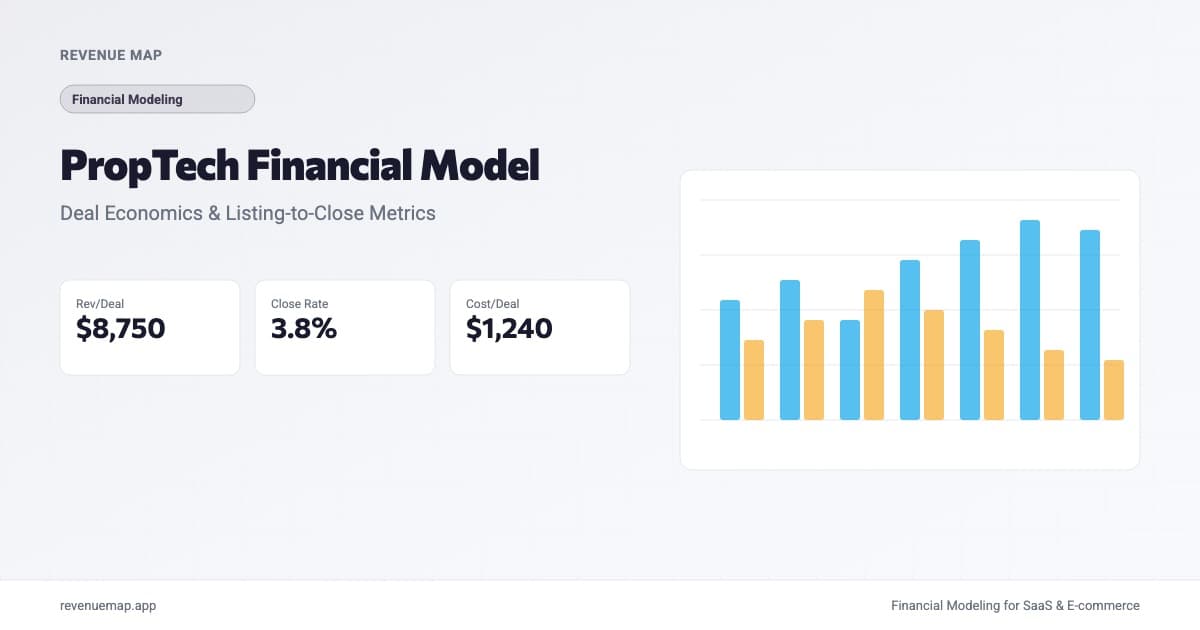
A PropTech financial model projects revenue by tracing a property through the entire listing-to-close funnel, from the moment a listing is acquired to the point a transaction closes and commission or fees are collected. Unlike SaaS businesses with predictable monthly recurring revenue, PropTech economics are transaction-driven: revenue arrives in discrete, often large increments tied to deal closings, and the time between listing and revenue recognition can stretch from weeks to months. The financial model that captures this reality requires a fundamentally different architecture than a subscription-based SaaS model.
Why PropTech Unit Economics Are Different
PropTech unit economics are defined by the listing-to-close funnel, a multi-stage conversion process where each stage has its own cost structure, conversion rate, and time dimension.
This makes PropTech harder to model than e-commerce or SaaS for three specific reasons.
Transaction-driven revenue with long cycle times. A SaaS business recognizes revenue monthly. An e-commerce business recognizes it per order, typically within days. A PropTech business may spend $2,000 acquiring a listing that takes 47 days to close, and if the deal falls through at day 40, the acquisition cost is sunk. Time-to-close is not a vanity metric in PropTech; it is a direct input into cash flow modeling and working capital requirements.
High variance in deal value. A rental marketplace might process transactions ranging from $1,200/year studios to $48,000/year luxury rentals. A brokerage platform sees property values spanning $150,000 to $2,000,000+. This variance means that aggregate conversion rates and average revenue per deal can mask a bimodal distribution, and a model built on averages will systematically misrepresent the business if the deal mix is shifting.
Multi-sided marketplace dynamics. Most PropTech platforms serve both property owners (or sellers) and buyers (or renters). Acquisition costs exist on both sides. A listing without buyer demand is inventory cost with no revenue potential. A model that tracks listing acquisition without modeling demand-side economics is architecturally incomplete.
The Listing-to-Close Funnel
The PropTech revenue funnel has four stages: listings acquired, qualified leads generated, deals initiated, and transactions closed. Revenue is recognized only at the final stage.
Stage 1: Listings Acquired
Listings are the raw inventory of a PropTech platform. For a brokerage, this is properties listed for sale. For a rental marketplace, it is available units. For a property management platform, it is properties under management consideration. The cost of acquiring a listing, through paid marketing, agent outreach, partnerships, or organic channels, is the first unit cost in the model.
Cost per listing varies dramatically by channel: paid search for real estate keywords runs $15-$45 per listing lead, while referral partnerships with real estate agents can produce listings at $5-$15 per listing. The blended cost per listing is a critical input, but like blended CAC in e-commerce, it can hide channel-level performance that matters for capital allocation.
Stage 2: Qualified Leads
Not every listing generates buyer or renter interest sufficient to progress toward a deal. The listing-to-qualified-lead conversion rate filters inventory into actionable pipeline. For brokerage platforms, a qualified lead typically means a showing request or offer received. For rental marketplaces, it means an application submitted.
The conversion from listing to qualified lead is the stage most influenced by platform quality, search functionality, listing presentation, matching algorithms, and response time. Improving this conversion rate by even 2-3 percentage points can have a larger impact on revenue than doubling listing acquisition spend.
Stage 3: Deals Initiated
A qualified lead becomes an initiated deal when both parties enter a transaction process, an accepted offer, a signed letter of intent, or a lease application approval. At this stage, the platform has incurred listing acquisition cost and lead nurturing cost, and the deal still has meaningful fall-through risk.
Fall-through rates at this stage are the hidden cost center in PropTech economics. In residential brokerage, 15-25% of accepted offers fail to close due to inspection issues, financing problems, or buyer withdrawal. Each fallen-through deal carries the fully loaded cost of every preceding stage with zero revenue offset.
Stage 4: Transaction Closed
Revenue is recognized when the transaction completes, closing day for sales, lease signing for rentals, management agreement execution for property management. Revenue per transaction is the product of deal value and the platform's commission or fee rate.
The time from Stage 1 to Stage 4, time-to-close, is the dimension that makes PropTech cash flow modeling distinct. A platform adding 200 listings per month with a 60-day average time-to-close has a permanent 60-day lag between acquisition spend and revenue recognition. That lag must be explicitly modeled or the cash model will be structurally wrong.
Core PropTech Metrics
Cost per Listing
Total acquisition spend (paid marketing, agent incentives, partnership costs) divided by listings acquired in the period. This is the entry point of the cost structure.
Cost per Listing = Total Listing Acquisition Spend / Listings Acquired
Benchmark: $8-$35 for rental marketplaces, $25-$80 for brokerage platforms, $50-$200 for iBuyer platforms (where listing acquisition includes property valuation costs).
Cost per Deal
The fully loaded cost of producing one closed transaction, including listing acquisition, lead nurturing, transaction support, and allocated overhead. This is the PropTech equivalent of CAC.
Cost per Deal = Total Sales & Marketing Cost / Closed Transactions
Cost per deal must be compared against revenue per transaction to determine deal-level profitability. A platform with $1,200 cost per deal and $8,750 revenue per transaction has healthy economics. A platform with $4,500 cost per deal and $5,000 revenue per transaction has a margin problem that scale alone will not fix.
Revenue per Transaction
The commission, fee, or margin earned on a single closed deal.
Revenue per Transaction = Average Property Value x (Commission Rate / 100)
For brokerage platforms, this is typically 2-3% of property value. For property management, it is 8-12% of annual rent. For iBuyers, it is the spread between purchase and resale price minus renovation costs, typically 5-8% of property value but with significantly higher variance and risk.
Listing-to-Close Conversion Rate
The end-to-end conversion from listing acquired to closed transaction. This is the master efficiency metric of the funnel.
Conversion Rate = Closed Transactions / Listings Acquired x 100
A small improvement in this rate leverages every dollar of listing acquisition spend. Moving from 3% to 4.5% conversion on 1,000 monthly listings is 15 additional closed deals per month, at an average revenue per transaction of $8,750, that is $131,250 in incremental monthly revenue with zero additional acquisition cost.
Time-to-Close
Average calendar days from listing acquisition to transaction completion. This metric directly determines working capital requirements and the lag between spend and revenue recognition.
Residential sale: 30-75 days. Commercial lease: 60-120 days. Rental marketplace: 14-30 days. Property management agreement: 21-45 days.
Revenue per Deal Calculator
PropTech Revenue per Deal Calculator
Enter your average property value and commission rate to calculate your expected revenue per closed transaction.
PropTech Benchmarks by Platform Type
Unit economics benchmarks vary significantly across PropTech verticals, a brokerage platform and a rental marketplace operate with fundamentally different deal sizes, conversion rates, and cost structures.
| Metric | Brokerage Platform | Property Management | iBuyer | Rental Marketplace |
|---|---|---|---|---|
| Avg. Property Value | $350,000-$550,000 | $18,000-$36,000/yr rent | $250,000-$400,000 | $15,000-$30,000/yr rent |
| Commission / Fee Rate | 2-3% | 8-12% of annual rent | 5-8% spread | 50-100% of first month rent |
| Revenue per Transaction | $7,000-$16,500 | $1,800-$3,600/yr | $12,500-$32,000 | $1,250-$2,500 |
| Listing-to-Close Conversion | 2-5% | 8-15% | 3-7% | 12-25% |
| Avg. Time-to-Close | 45-75 days | 21-45 days | 30-60 days | 14-30 days |
| Cost per Listing | $25-$80 | $15-$50 | $50-$200 | $8-$35 |
| Cost per Deal | $800-$3,000 | $200-$600 | $2,000-$8,000 | $50-$250 |
| Deal Margin | 65-80% | 55-70% | 25-45% | 70-85% |
Three observations from these benchmarks.
Brokerage platforms have the highest revenue per transaction but the lowest conversion rates. The economics work because deal size compensates for funnel inefficiency, but the long time-to-close and high cost per deal mean that cash flow management is the primary operational challenge, not customer acquisition.
iBuyer platforms carry the most capital-intensive economics. Revenue per transaction is high, but the cost structure includes property acquisition, renovation, holding costs, and resale risk. The 25-45% deal margin is thin relative to the capital deployed per transaction, which is why iBuyer platforms require balance sheet financing that most PropTech models do not.
Rental marketplaces have the most favorable unit economics ratio. Low cost per deal, high conversion rate, and short time-to-close produce fast payback cycles. The challenge is that revenue per transaction is small, making volume and retention the critical growth levers rather than deal optimization.
4 Common PropTech Financial Modeling Mistakes
1. Modeling listings as revenue. Listings are inventory, not revenue. A platform with 50,000 listings and a 2% conversion rate has 1,000 transactions, and 49,000 listings that generated cost but not revenue. Financial models that project revenue as a function of listing volume without explicitly modeling the conversion funnel overstate revenue by a factor proportional to the inverse of the conversion rate. Always model the funnel end-to-end.
2. Ignoring time-to-close in cash flow projections. A PropTech platform spending $150,000 per month on listing acquisition with a 60-day average time-to-close needs $300,000 in working capital just to fund the acquisition-to-revenue lag, before accounting for deals that fall through. Models that recognize revenue in the same period as listing acquisition spend systematically overstate cash position and understate working capital requirements.
3. Using average revenue per deal without segmenting by property type. A brokerage platform processing both $200,000 condos at 2.5% commission ($5,000 revenue) and $800,000 single-family homes at 2.5% commission ($20,000 revenue) has two fundamentally different deal economics. The blended average, $12,500, accurately describes neither segment. If the deal mix shifts toward the lower-value segment, revenue per transaction declines without any change in conversion rate or deal volume. Segment your model by property type.
4. Underestimating fall-through costs. A 20% fall-through rate on initiated deals means that for every 5 deals that reach the offer-accepted stage, one fails to close. The cost of that failed deal, listing acquisition, lead nurturing, transaction support, and opportunity cost, is absorbed entirely by the 4 deals that do close. A model that does not explicitly account for fall-through rate underestimates cost per closed deal by roughly (fall-through rate / (1 - fall-through rate)), at 20% fall-through, that is a 25% understatement of true cost per deal.
Key Takeaways
- PropTech revenue is transaction-driven, not recurring, model the full listing-to-close funnel with explicit conversion rates at each stage rather than projecting revenue from listing volume alone
- Cost per deal, not cost per listing, is the unit cost that determines profitability, include fall-through costs, lead nurturing, and transaction support in the fully loaded number
- Time-to-close is a cash flow variable, not just an operational metric, a 60-day average time-to-close creates a permanent working capital requirement equal to two months of listing acquisition spend
- Revenue per transaction varies 3-5x within most PropTech verticals, segment by property type and model each segment independently to avoid blended averages that mask shifting deal mix
- Listing-to-close conversion rate is the highest-leverage metric, a 1.5 percentage point improvement leverages every dollar of existing acquisition spend without incremental cost
- Fall-through rates at 15-25% on initiated deals are normal in residential brokerage, models that ignore this understate true cost per deal by 20-30%
PropTech financial modeling requires a fundamentally different approach than SaaS revenue forecasting or e-commerce unit economics, the transaction-driven, long-cycle nature of real estate deals means that conversion rates and time-to-close matter as much as deal volume. Revenue Map's PropTech financial model lets you build multi-stage funnel models with configurable conversion rates, deal values, and time-to-close assumptions, so you can see exactly how each lever moves your revenue projection and cash flow timeline before committing acquisition spend. Calculate the key inputs directly: CAC, LTV, gross margin, and runway.
Related industry models
Building a model for a different sector? These sibling guides cover the economics unique to each vertical.
- FinTech Financial Model: Transaction Revenue, Compliance Costs, and Growth ProjectionsLearn how to build a fintech financial model that accounts for transaction-based revenue, regulatory compliance costs, and multi-vertical growth projections. Covers payments, lending, neobanking, and insurtech.
- Marketplace Financial Model: Take Rates, GMV Projections, and Liquidity MetricsLearn how to build a marketplace financial model with GMV projections, take rate analysis, and liquidity metrics. Includes formulas, benchmarks by marketplace type, and a step-by-step revenue projection framework for two-sided platforms.
- TravelTech Financial Model: Seasonality, Booking Revenue, and Commission EconomicsBuild a TravelTech financial model that accounts for seasonality, booking volume, commission rates, and cancellation economics. Includes benchmarks for OTAs, hotel platforms, experiences marketplaces, and car rental platforms.
- HealthTech Financial Model: Patient Acquisition, Retention Metrics, and Revenue ProjectionsLearn how to build a financial model for a healthtech startup. This guide covers patient acquisition costs, clinical retention metrics, payer mix modeling, and revenue projections across telehealth, digital therapeutics, and health SaaS.
Related Articles
Cash Flow Projection Template for Small Business
Build a 12-month cash flow projection your lender will trust. Includes formulas, a free calculator, and line-by-line examples for restaurants, coffee shops, and more.
SaaS Revenue Model Template for Startups
Build a SaaS revenue model from scratch with MRR components, pricing tier math, and expansion revenue. Includes a free calculator and benchmarks.
Budget vs Forecast vs Projection for Startups
Budgets, forecasts, and projections serve different purposes. Learn when to use each and how they connect in your startup financial plan.