Gym Business Plan: Costs, Revenue, Projections
A gym business plan should include startup costs of $50,000 to $500,000 depending on format, revenue projections built from member count times average monthly dues, and a 12-month cash flow forecast. Most lenders require a debt service coverage ratio of 1.25x or higher.
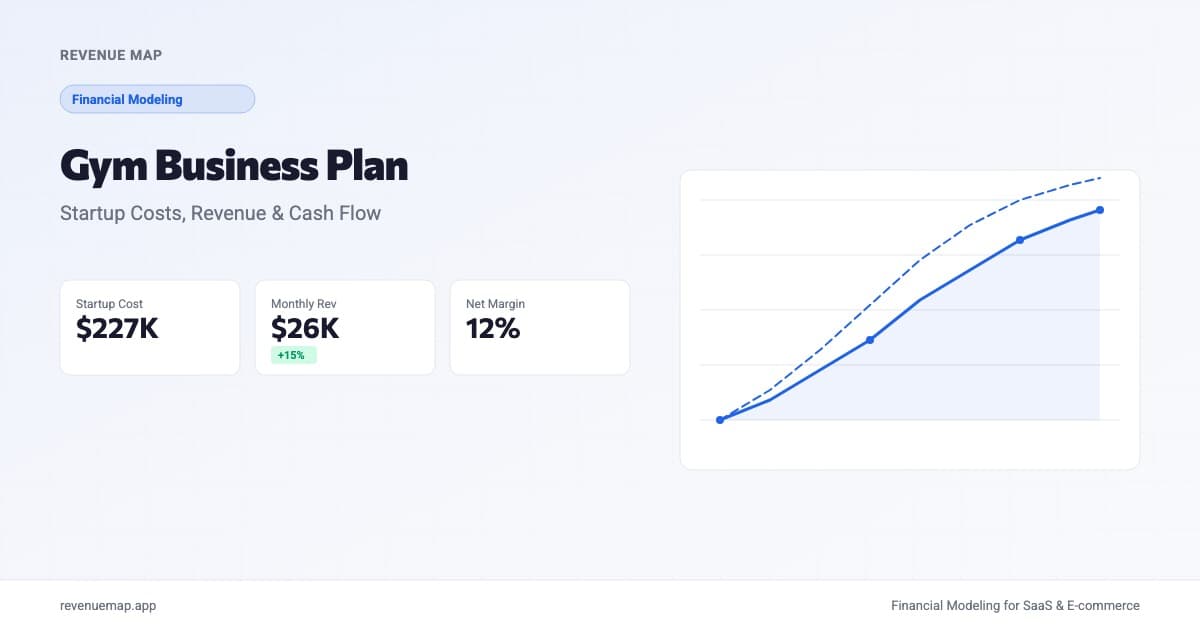
A gym business plan needs a financial section built on real equipment costs, membership pricing, and capacity constraints. Lenders approve gym loans based on projected membership growth, a startup cost breakdown they can verify, and proof the facility can cover its debt payments during the ramp-up months. The concept and the programming matter, but the numbers close the deal.
That's worth keeping in mind as the fitness industry competes for the same first-time operators who once defaulted to food service. Small Business Trends recently profiled the top small restaurant franchises for first-time investors, noting that franchise models attract newcomers because they reduce financial guesswork. An independent gym doesn't come with a corporate playbook, which means the financial plan you write is the playbook. Get it right and you have a fundable business. Get it wrong and the lender sees a hobby with expensive equipment.
Here is how to build the financial section of your gym business plan with the numbers lenders expect.
How Much Does It Cost to Open a Gym?
Startup costs for a gym range from about $50,000 for a small personal training studio to $500,000 or more for a full-service facility with cardio equipment, free weights, group fitness rooms, showers, and locker rooms. Most independent gyms land in the $150,000 to $300,000 range.
Here is a realistic breakdown for a 3,000-square-foot independent gym:
| Category | Low Estimate | Mid Estimate | High Estimate |
|---|---|---|---|
| Leasehold improvements (flooring, mirrors, HVAC) | $25,000 | $60,000 | $120,000 |
| Cardio equipment (treadmills, bikes, rowers) | $15,000 | $35,000 | $80,000 |
| Strength equipment (racks, benches, dumbbells, plates) | $10,000 | $30,000 | $70,000 |
| Locker rooms, showers, plumbing | $5,000 | $20,000 | $50,000 |
| Sound system, TVs, facility tech | $2,000 | $6,000 | $15,000 |
| POS, member management software, access control | $2,000 | $5,000 | $12,000 |
| Permits, licenses, insurance (first year) | $3,000 | $8,000 | $18,000 |
| Marketing, signage, branding | $3,000 | $8,000 | $20,000 |
| Working capital (6 months) | $30,000 | $55,000 | $115,000 |
| Total | $95,000 | $227,000 | $500,000 |
Equipment is the single largest line item, and it's also the one with the most flexibility. Buying used commercial-grade cardio equipment (Precor, Life Fitness) can cut your cardio budget by 40% to 60% without sacrificing member experience. Strength equipment holds value better and is worth buying new when budget allows.
Working capital is just as critical for a gym as it is for a restaurant or bakery. Gyms burn through cash in the first months while building membership. A plan that spends everything on equipment and opens with an empty reserve is the scenario that leads to closure. Use the startup cost calculator to adjust these numbers for your market.
How to Project Gym Revenue
Revenue for a gym is driven primarily by membership dues, with secondary streams from personal training, group classes, and retail. The core formula:
Monthly Revenue = (Active Members x Avg Monthly Dues) + PT Revenue + Class Packs + Retail
Here is what industry benchmarks look like across different gym formats:
| Format | Avg Monthly Dues | Target Members | Monthly Membership Revenue |
|---|---|---|---|
| Budget/value gym (24/7 access) | $25 | 600 | $15,000 |
| Mid-range independent gym | $50 | 400 | $20,000 |
| Boutique fitness studio (CrossFit, cycling, yoga) | $150 | 150 | $22,500 |
| Personal training studio | $250 | 80 | $20,000 |
The boutique model generates the highest revenue per member because it packages coaching and community into the price. The trade-off is a smaller addressable market and higher instructor costs per class.
For year one, assume 20% of your target membership by month one (pre-sale members who signed up before opening), ramping to 50% by month six and 80% by month twelve. Lenders will flag any plan showing full capacity on day one. Our financial projections template guide covers the framework for building these ramp-up models.
Personal training is the most valuable ancillary stream. A gym with four trainers each delivering 20 sessions per week at $60 per session generates $19,200 per month, of which the gym keeps 40% to 50% after trainer pay. Build PT revenue as a separate line item because it scales independently of membership count.
Calculate Your Gym Revenue
Gym Revenue Calculator
Estimate your monthly and annual gym revenue
Want to model this over 36 months with scenarios? Try Revenue Map free →
Gym Margins and Cost Benchmarks
Gyms earn their gross margin from the spread between membership revenue and the cost of keeping the facility open. The challenge is that most costs are fixed: rent, equipment financing, and utilities don't scale with member count, which means utilization rate determines profitability.
| Category | % of Revenue | Monthly (at $25K rev) |
|---|---|---|
| Rent and occupancy | 20-30% | $5,000-$7,500 |
| Staff (front desk, trainers, cleaners, manager) | 25-35% | $6,250-$8,750 |
| Equipment financing/depreciation | 8-12% | $2,000-$3,000 |
| Utilities (electricity, water, HVAC) | 5-8% | $1,250-$2,000 |
| Insurance | 2-4% | $500-$1,000 |
| Software, payment processing, marketing | 5-8% | $1,250-$2,000 |
| Net profit | 10-15% | $2,500-$3,750 |
Here's the thing: a gym with 250 members paying $50 each looks identical on paper to one with 500 members paying $25. But the second gym needs more equipment, more cleaning, more wear and tear, and more front-desk coverage. Revenue per square foot is the metric that separates sustainable gyms from treadmill warehouses. A well-run independent gym targets $30 to $50 in revenue per square foot per year.
Rent is the cost to negotiate hardest on. Gym tenants sign long leases and invest heavily in buildout, which gives you leverage. Negotiate 3 to 6 months of free rent during construction and ramp-up. Utilities also catch first-time owners off guard: HVAC, showers, and laundry can run $1,500 to $2,500 per month depending on climate.
12-Month Cash Flow for a New Gym
The cash flow forecast is the section that gets the loan funded. Here is a simplified 12-month projection for a mid-range independent gym with $227,000 in startup costs, a $160,000 SBA loan, and $67,000 in owner equity.
| Month | Members | Revenue | Rent + Utilities | Staff | Other OpEx | Loan Payment | Net Cash Flow | Cumulative Cash |
|---|---|---|---|---|---|---|---|---|
| 1 | 80 | $6,000 | $6,500 | $5,000 | $2,000 | $1,770 | -$9,270 | $47,730 |
| 2 | 120 | $8,500 | $6,500 | $5,200 | $2,000 | $1,770 | -$6,970 | $40,760 |
| 3 | 160 | $11,000 | $6,500 | $5,500 | $2,100 | $1,770 | -$4,870 | $35,890 |
| 6 | 250 | $17,500 | $6,500 | $6,500 | $2,300 | $1,770 | $430 | $25,120 |
| 9 | 320 | $22,000 | $6,800 | $7,200 | $2,500 | $1,770 | $3,730 | $35,510 |
| 12 | 380 | $26,000 | $7,000 | $7,800 | $2,600 | $1,770 | $6,830 | $55,900 |
Revenue includes membership dues ($50 average) plus personal training and class revenue starting at $2,000/month in month 1 and growing to $7,000/month by month 12 as the trainer roster builds. The loan payment assumes a 10-year SBA 7(a) loan at 10.5% interest.
The first three months show negative cash flow. That is normal and exactly why the working capital reserve exists. Notice the cumulative cash position stays positive throughout. If your projection shows cumulative cash going negative in any month, you need more working capital, a lower rent, or a stronger pre-sale campaign.
Track your actual burn rate against this plan weekly. The gap between projected and actual costs shows up first in membership sign-up velocity and staff scheduling.
What Do Lenders Check in a Gym Business Plan?
The financial section carries the lending decision. Our full guide on writing a business plan for a business loan covers the broader framework, but here are the items gym lenders focus on:
-
Debt service coverage ratio (DSCR). Can the gym generate enough cash to cover loan payments with room to spare? Most lenders require 1.25x or higher. In the year-one example above, stabilized net operating income of roughly $8,600 per month against a $1,770 payment gives a DSCR of 4.9x.
-
Use of funds. Every dollar needs a specific destination. Not "equipment" but "Life Fitness Integrity Series treadmills x6 ($24,000), Rogue RML-490 power racks x4 ($8,000), rubber flooring 3,000 sq ft ($6,000)." Specificity signals preparation.
-
Owner equity. SBA loans typically require 10% to 20% owner injection. The example above shows $67,000 on a $227,000 project (30%), comfortably exceeding the minimum.
-
Pre-sale membership count. Lenders love seeing signed members before opening day. A pre-sale campaign that signs 80 to 120 founding members at a discounted rate demonstrates demand and de-risks the first few months of cash flow. Include the pre-sale plan and any signed commitments in your application.
-
Lease terms. A 5-year lease with two 5-year options and a buildout allowance tells lenders the landlord is invested in your success. Compare how the coffee shop business plan handles similar lease strategies.
Common Mistakes in Gym Financial Plans
-
Overestimating day-one membership. The most common error. A gym that assumes 200 members on opening day with no pre-sale history is projecting a fantasy. Budget for 60 to 100 pre-sale members and a realistic ramp over 12 months.
-
Underestimating equipment maintenance. Treadmills need belt replacements ($200-$400), cable machines need cable swaps ($150-$300), and everything needs regular servicing. Budget $500 to $1,000 per month for maintenance once you're past month six.
-
Ignoring seasonality. January is the best month for sign-ups (New Year's resolutions), and June through August often see a dip in attendance and new sign-ups. Model revenue monthly, not as a flat annual average.
-
No equipment replacement reserve. Commercial gym equipment has a useful life of 7 to 10 years for cardio and 15 to 20 years for strength equipment. A gym that spends $80,000 on cardio equipment needs to set aside $8,000 to $11,000 per year for replacement. Start the reserve from month one.
Key Takeaways
- Gym startup costs range from $50,000 for a personal training studio to $500,000 for a full-service facility. Always include 6 months of working capital in the total.
- Build revenue projections from member count times average monthly dues, plus personal training and ancillary revenue. A mid-range gym with 380 members at $50 average dues generates about $26,000 per month at stabilized capacity.
- Net margins of 10% to 15% are achievable once stabilized, but the ramp-up period of 12 to 18 months is when most gyms fail. The cash flow forecast must show positive cumulative cash throughout.
- Pre-sale memberships de-risk the plan and impress lenders. Target 80 to 120 founding members before opening day.
- Lenders want a DSCR of 1.25x or higher. Build projections so stabilized months clear this threshold comfortably.
Ready to build the financial model behind your gym business plan? Start with Revenue Map, select your business type, and get a three-year projection you can hand to a lender. Free, two minutes.
Related Articles
Salon Business Plan: Costs and Projections
Build the financial section of your salon business plan with real startup costs, revenue projections, and cash flow forecasts lenders require.

Bakery Business Plan: Costs and Projections
Build the financial section of your bakery business plan with real startup costs, revenue benchmarks, and cash flow projections lenders require.
Coffee Shop Business Plan: Costs and Projections
Build the financial section of your coffee shop business plan with real startup costs, revenue benchmarks, and cash flow projections lenders expect.