Salon Business Plan: Costs and Projections
A salon business plan should include startup costs of $62,000 to $341,000, revenue projections based on stylists times clients per day times average ticket, and a 12-month cash flow forecast. Most SBA lenders require a debt service coverage ratio of 1.25x or higher.
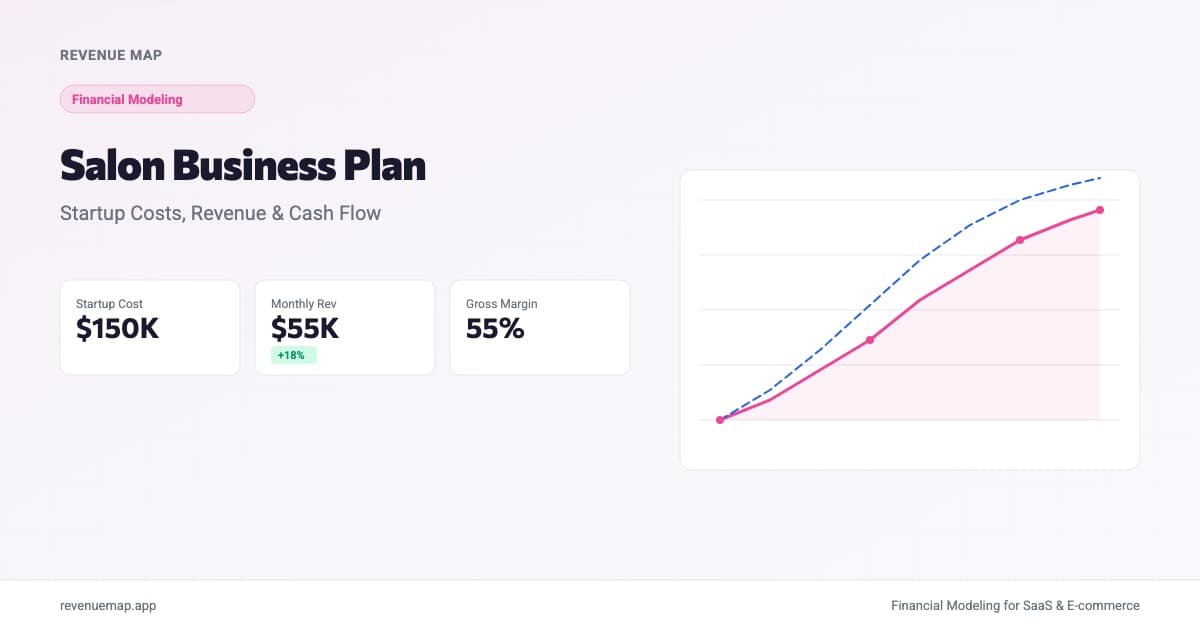
A salon business plan needs a financial section built on chair utilization, service pricing, and realistic ramp-up assumptions. Lenders approve salon loans based on projected cash flow, a startup cost breakdown they can audit, and evidence the shop can cover debt payments while stylists build their client books. The concept and portfolio matter, but the numbers close the deal.
Service businesses are drawing serious interest from first-time investors. Small Business Trends recently ranked the top small restaurant franchises for new operators, and the pattern extends across personal services too. Salons offer a different risk profile than restaurants: no perishable inventory, higher repeat visit rates, and commission-based labor that scales with revenue instead of running as a fixed cost. But lenders still need a plan they can underwrite.
Here is how to build the financial section of your salon business plan with the numbers banks and SBA lenders expect.
How Much Does It Cost to Open a Salon?
Startup costs for a salon range from about $62,000 for a modest two-station setup to $341,000 for a high-end, multi-chair location with custom buildout and premium finishes. Most independent hair salons land in the $100,000 to $250,000 range.
Here is a realistic breakdown for a 1,200-square-foot salon with six styling stations:
| Category | Low Estimate | Mid Estimate | High Estimate |
|---|---|---|---|
| Leasehold improvements and buildout | $15,000 | $45,000 | $120,000 |
| Styling stations (chairs, mirrors, storage) | $6,000 | $15,000 | $36,000 |
| Shampoo bowls and plumbing | $3,000 | $8,000 | $18,000 |
| Equipment (dryers, tools, color processing) | $4,000 | $10,000 | $25,000 |
| Retail product inventory | $3,000 | $8,000 | $20,000 |
| POS system and booking software | $1,500 | $4,000 | $8,000 |
| Permits, licenses, cosmetology compliance | $1,500 | $4,000 | $10,000 |
| Insurance (first year) | $2,000 | $5,000 | $9,000 |
| Marketing, signage, website | $2,000 | $6,000 | $15,000 |
| Working capital (6 months) | $24,000 | $45,000 | $80,000 |
| Total | $62,000 | $150,000 | $341,000 |
The buildout is typically the single largest expense. Plumbing for shampoo bowls, electrical upgrades for dryers, and ventilation for color processing all add up. A turnkey space that previously housed a salon can save $15,000 to $40,000 on the buildout alone.
Working capital is just as critical here as it is for a coffee shop or bakery. A new salon can take three to six months to fill a client book, and stylists still need to earn enough during that ramp to stay. A plan that spends everything on the buildout and opens with an empty cash reserve is the scenario lenders reject first. Use the startup cost calculator to adjust these numbers for your market.
How to Project Salon Revenue
Revenue for a service-based salon is driven by the number of working stylists, clients per stylist per day, and average service ticket. The core formula:
Monthly Revenue = Stylists × Clients per Day × Avg Ticket × Days Open
Here is what benchmarks look like across different salon formats:
| Format | Stylists | Clients/Stylist/Day | Avg Ticket | Days/Month | Monthly Revenue |
|---|---|---|---|---|---|
| Solo booth rental | 1 | 6 | $75 | 22 | $9,900 |
| Small salon (3 chairs) | 3 | 5 | $65 | 26 | $25,350 |
| Mid-size salon (6 chairs) | 6 | 5 | $70 | 26 | $54,600 |
| Full-service salon with spa | 8 | 5 | $95 | 26 | $98,800 |
| Barbershop-salon hybrid | 4 | 8 | $35 | 26 | $29,120 |
The mid-size salon is the sweet spot for most independent owners. Six chairs at five clients per stylist per day and a $70 average ticket produces about $54,600 in monthly revenue at full utilization. Add-on services (color, treatments, extensions) are the primary lever for increasing the average ticket.
For year one, assume 40% utilization in months one through three, ramping to 65% by month six, and reaching 85% by month nine. Even a "stabilized" salon runs at 80% to 90% utilization because cancellations, no-shows, and scheduling gaps are unavoidable. Any plan showing 100% utilization from day one will get flagged. Our financial projections template guide covers the framework for building these ramp curves.
Calculate Your Salon Revenue
Salon Revenue Calculator
Estimate your monthly and annual salon revenue
Salon Margins and Cost Benchmarks
Service margins in a salon are fundamentally different from food service. There is no perishable inventory eating into your gross margin. The dominant cost is labor, and in a commission-based model, that cost scales directly with revenue. That is the structural advantage of salons: your biggest expense is variable, not fixed.
| Category | % of Revenue | Monthly (at $55K rev) |
|---|---|---|
| Product and supply costs | 8-12% | $4,400-$6,600 |
| Stylist compensation (commission or salary + commission) | 35-50% | $19,250-$27,500 |
| Rent and occupancy | 10-15% | $5,500-$8,250 |
| Other operating expenses | 6-10% | $3,300-$5,500 |
| Net profit (before owner draw) | 8-15% | $4,400-$8,250 |
Here's the thing: that stylist compensation line is the variable that defines your business model. Commission-only salons typically pay 40% to 50% of service revenue to the stylist. Salary-plus-commission structures run 30% to 40% base but require consistent scheduling regardless of demand. Booth rental is the third model, where stylists pay a fixed weekly rent ($150 to $400 per station) and keep their own revenue entirely. Each structure produces a very different margin profile.
Product costs are low compared to a restaurant or bakery because the consumable cost per service (color, developer, shampoo, treatment products) runs $3 to $12 per client. Retail product sales (shampoo, styling products sold to clients) carry 40% to 50% margins and add revenue without adding chair time.
Track commission payouts by stylist weekly. One underperforming chair in a six-chair salon drags the overall margin more than most new owners expect. If a stylist averages three clients per day instead of five, that chair generates $4,550 per month in revenue while still consuming its share of rent and overhead.
12-Month Cash Flow for a New Salon
The cash flow forecast is the section that gets the loan funded. Here is a simplified 12-month projection for a six-chair salon with $150,000 in startup costs, a $110,000 SBA loan, and $40,000 in owner equity. Working capital reserve after buildout: $45,000.
| Month | Revenue | Products (10%) | Labor (45%) | Other OpEx | Loan Payment | Net Cash Flow | Cumulative Cash |
|---|---|---|---|---|---|---|---|
| 1 | $21,840 | $2,184 | $9,828 | $8,000 | $1,290 | $538 | $45,538 |
| 2 | $25,480 | $2,548 | $11,466 | $8,000 | $1,290 | $2,176 | $47,714 |
| 3 | $29,120 | $2,912 | $13,104 | $8,100 | $1,290 | $3,714 | $51,428 |
| 6 | $40,040 | $4,004 | $18,018 | $8,300 | $1,290 | $8,428 | $71,998 |
| 9 | $47,320 | $4,732 | $21,294 | $8,500 | $1,290 | $11,504 | $104,253 |
| 12 | $49,140 | $4,914 | $22,113 | $8,600 | $1,290 | $12,223 | $140,519 |
Other operating expenses include rent, utilities, insurance, booking software, marketing, and supplies. The loan payment assumes a 10-year SBA 7(a) loan at 10.5% interest. Net cash flow is before any owner draw.
Notice the first month is already slightly positive. That is the commission model working as designed: labor costs $9,828 instead of $20,000+ in fixed salaries because compensation scales with utilization. Compare that to the bakery, where bakers need to arrive at 3 AM whether the shop has five customers or fifty.
Track your actual burn rate against this plan weekly. The gap between projected and actual costs shows up first in product usage and stylist scheduling.
What Do Lenders Check in a Salon Business Plan?
The financial section carries the lending decision. Our full guide on writing a business plan for a business loan covers the broader framework, but here are the items salon lenders focus on:
-
Debt service coverage ratio (DSCR). Can the salon generate enough cash to cover loan payments with room to spare? Most lenders require 1.25x or higher. In the year-one example above, stabilized net cash flow of roughly $12,200 per month against a $1,290 payment gives a DSCR of 9.5x before owner draw. After a $4,000 monthly owner draw, the remaining $8,200 still produces a DSCR of 6.4x.
-
Use of funds. Every dollar needs a specific destination. Not "equipment" but "Belvedere Scroll styling chairs, 6 at $1,200 each ($7,200), Takara Belmont shampoo units, 3 at $2,400 each ($7,200)." Specificity signals preparation.
-
Owner equity. SBA loans typically require 10% to 20% owner injection. The example above shows $40,000 on a $150,000 project (27%), comfortably exceeding the minimum.
-
Compensation model. Lenders want to understand whether stylists are on commission, salary, or booth rental, and how that affects the breakeven. A commission model has a lower breakeven but depends on retaining productive stylists. A salary model has a higher breakeven but offers more predictable staffing.
-
Client retention and rebooking rate. Salons live on repeat visits. A rebooking rate of 60% or higher at checkout signals a sustainable revenue base. If your projections assume clients returning every 5 to 6 weeks, a lender will want to see how you build that habit (prepaid packages, automated rebooking, loyalty programs). See how the food truck business plan handles a very different repeat-visit model.
Common Mistakes in Salon Financial Plans
-
Projecting full utilization from day one. A six-chair salon at 100% utilization generates $54,600 per month, but reaching 85% takes most shops six to nine months. Ramp your projections monthly and show the path from 40% to stabilized capacity.
-
Ignoring no-show and cancellation rates. The industry average for no-shows is 10% to 15% of booked appointments. Build this into your utilization assumptions rather than treating every booking as guaranteed revenue.
-
Underestimating the cost of good stylists. The commission rate is the number on paper, but recruiting talented stylists often requires signing bonuses, guaranteed minimums during their first 90 days, or covering the cost of continuing education. Budget $2,000 to $5,000 per stylist in onboarding costs.
-
Skipping retail revenue projections. Product sales are high-margin revenue that requires zero additional chair time. A well-merchandised salon generates 10% to 15% of total revenue from retail. Ignoring this line understates both revenue and profit.
Key Takeaways
- Salon startup costs range from $62,000 for a two-station setup to $341,000 for a full buildout. Always include 6 months of working capital in the total.
- Build revenue projections from stylists times clients per day times average ticket times days open. A six-chair salon at $70 per ticket generates about $54,600 per month at full utilization.
- Commission-based labor (35% to 50% of revenue) is your largest cost but also your biggest structural advantage: it keeps breakeven low during the ramp-up months.
- Net margins of 8% to 15% (before owner draw) leave room for debt service and reinvestment. Track stylist utilization and product costs weekly, not monthly.
- Lenders want a DSCR of 1.25x or higher. A stabilized six-chair salon should clear this threshold comfortably even after an owner draw.
Ready to build the financial model behind your salon business plan? Start with Revenue Map, select your business type, and get a three-year projection you can hand to a lender. Free, two minutes.
Related Articles
Beauty Supply Store Business Plan: Costs and Projections
Build the financial section of your beauty supply store business plan with real startup costs, revenue projections, and the cash flow forecast lenders require.
Salon Suite Business Plan: Costs and Projections
Build the financial section of your salon suite business plan with startup costs, rental revenue projections, and the cash flow lenders check.
Hot Dog Cart Business Plan: Costs and Projections
Build the financial section of your hot dog cart or food cart business plan with startup costs, revenue projections, and the cash flow lenders check.