Laundromat Business Plan: Costs and Projections
A laundromat business plan should include startup costs of $200,000 to $500,000 depending on size and build-out approach, revenue projections based on machines times turns per day, and a 12-month cash flow forecast. Lenders typically require a debt service coverage ratio of 1.25x or higher.
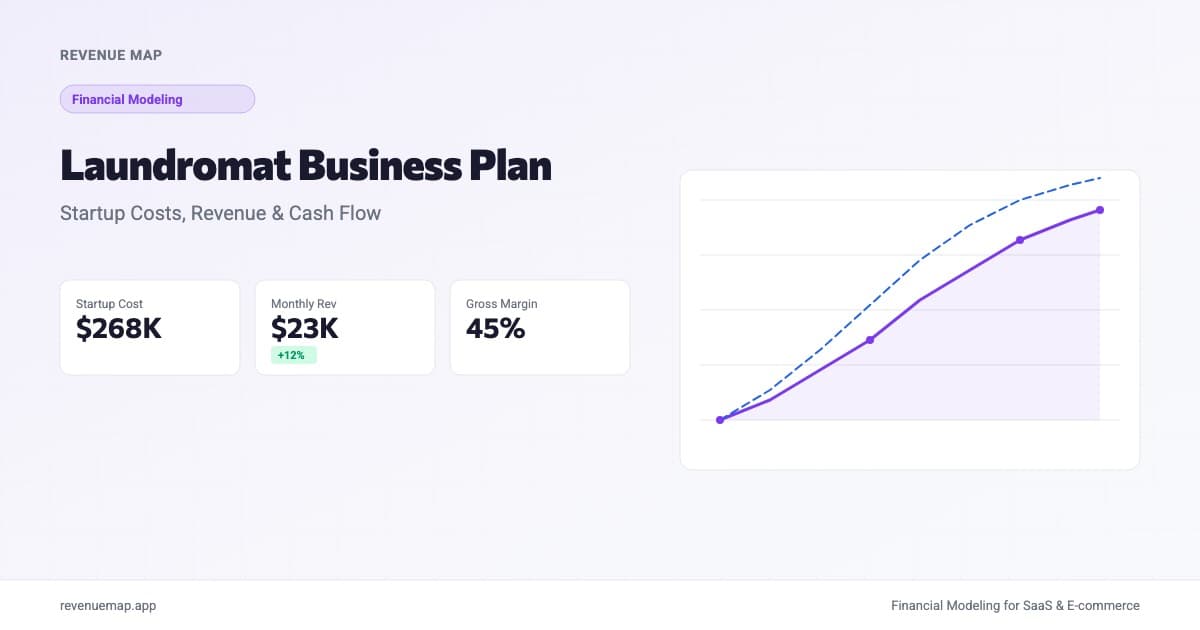
A laundromat business plan needs a financial section built on realistic equipment costs, utility projections, and revenue per machine. Lenders approve laundromat loans based on projected cash flow, a clear startup cost breakdown, and proof the business can service its debt during slow months. The equipment is the collateral, but the numbers are what close the deal.
That financial credibility matters more than most first-time owners expect. Entrepreneur recently reported that lenders evaluate far more than the balance sheet when reviewing a loan application, weighing operational understanding and market knowledge alongside the spreadsheet. For a laundromat, that means your plan needs to show you grasp utility economics, equipment lifecycles, and the demographics of your trade area.
Here is how to build the financial section of your laundromat business plan with the numbers lenders actually check.
How Much Does It Cost to Open a Laundromat?
Startup costs depend on whether you are building from scratch, converting a retail space, or acquiring an existing location. A small neighborhood laundromat with 20 machines can launch for around $200,000. A larger facility with 40 to 60 machines, card payment systems, and a wash-and-fold counter typically runs $350,000 to $500,000.
| Approach | Startup Cost | Typical Loan | Machines | Staff |
|---|---|---|---|---|
| Acquire existing location | $150,000 - $300,000 | $110,000 - $225,000 | 20-30 | 1-2 |
| Convert retail space (small) | $200,000 - $350,000 | $150,000 - $260,000 | 20-30 | 1-2 |
| Build from scratch (mid-size) | $350,000 - $500,000 | $260,000 - $375,000 | 40-50 | 2-3 |
| Large full-service facility | $500,000 - $1,000,000 | $375,000 - $750,000 | 50-80 | 3-5 |
Acquiring an existing location is often the fastest path for first-time owners. You inherit a customer base, existing plumbing and drainage, and sometimes a below-market lease. The risk: inheriting deferred maintenance on aging machines. Budget for a professional equipment inspection before signing.
Laundromats are one of the most frequently cited passive income business ideas, and for good reason. The recurring demand and simple operations create steady cash flow. But the upfront capital is real, and the financial section of the plan is where lenders decide whether to fund it.
Where the Money Goes
For a mid-size laundromat in a converted retail space, the startup budget breaks down roughly like this:
| Category | Low Estimate | Mid Estimate | High Estimate |
|---|---|---|---|
| Lease deposit and build-out | $25,000 | $55,000 | $90,000 |
| Commercial washers (25-35 units) | $40,000 | $75,000 | $130,000 |
| Commercial dryers (20-30 units) | $25,000 | $50,000 | $85,000 |
| Plumbing and drainage | $15,000 | $30,000 | $50,000 |
| Card/payment systems | $5,000 | $12,000 | $22,000 |
| Signage, security, seating | $4,000 | $8,000 | $18,000 |
| Permits and licenses | $2,000 | $4,000 | $8,000 |
| Insurance (first year) | $3,000 | $5,500 | $10,000 |
| Working capital (6 months) | $15,000 | $28,000 | $50,000 |
| Total | $134,000 | $267,500 | $463,000 |
The plumbing line is the one that catches first-time operators by surprise. Commercial washers need dedicated hot and cold water feeds, oversized drain lines, and gas connections for the dryers. In older buildings, bringing plumbing up to code can add $20,000 to $40,000 beyond initial estimates. A lender who has funded laundromats will ask about it.
Use the startup cost calculator to adjust these figures for your market and build-out approach.
How to Project Laundromat Revenue
Revenue for a self-service laundromat comes down to machines, turns per day, and the average price per cycle. The core formula:
Monthly Revenue = Washers x Turns Per Day x Avg Price x Days Open x Dryer Multiplier
Dryer revenue typically adds 40% to 50% on top of washer revenue, since nearly every customer who washes also dries. Here is what the numbers look like at different scales (using a 1.45x dryer multiplier):
| Size | Washers | Turns/Day | Avg Price | Monthly Revenue |
|---|---|---|---|---|
| Small (20 washers) | 20 | 3.5 | $4.00 | $12,180 |
| Mid-size (30 washers) | 30 | 4.0 | $4.50 | $23,490 |
| Large (50 washers) | 50 | 4.5 | $5.00 | $48,940 |
Larger-capacity front-load washers (40 lb, 60 lb) command $6 to $10 per load and produce higher revenue per square foot, though they cost more upfront. If your plan relies on a premium machine mix, show the lender the per-machine revenue breakdown rather than a blended average.
The Wash-and-Fold Upside
Adding a drop-off wash-and-fold service changes the revenue picture. Operators typically charge $1.50 to $2.00 per pound, with an average drop-off order running 15 to 25 pounds. A location processing 15 orders per day at $30 average generates roughly $13,500 per month on top of self-service revenue.
The trade-off: wash-and-fold requires dedicated staff, pushing labor costs from near-zero (for self-service) to 25% to 30% of that segment's revenue. Model it as a separate line in your projections. Lenders want to see the self-service business standing on its own before giving credit for a service add-on.
What Does It Cost to Run a Laundromat Each Month?
Utilities define laundromat economics. Water, gas, and electricity can consume 20% to 30% of gross revenue, and that ratio climbs quickly if equipment is older or inefficient.
| Expense | Small (20 washers) | Mid-Size (30 washers) | Large (50 washers) |
|---|---|---|---|
| Water and sewer | $1,100 | $1,800 | $3,000 |
| Gas (dryer heat, hot water) | $800 | $1,400 | $2,200 |
| Electricity | $600 | $1,000 | $1,600 |
| Rent or lease | $2,200 | $3,500 | $6,000 |
| Loan payment | $1,300 | $2,400 | $4,200 |
| Insurance | $350 | $550 | $900 |
| Attendant labor | $1,800 | $3,000 | $5,000 |
| Maintenance and repairs | $400 | $750 | $1,300 |
| Card system fees and supplies | $200 | $350 | $600 |
| Total monthly | $8,750 | $14,750 | $24,800 |
The gross margin for a self-service laundromat typically runs 35% to 55%. The wide range comes down to equipment age (newer machines use 30% to 40% less water and gas per cycle), local utility rates, and whether you own or lease the building. Use your actual utility rate schedule when building projections, not a national average.
How to Calculate Break-Even for a Laundromat
Break-even tells you how many machine turns per day your laundromat needs to cover all costs. The formula:
Break-Even Turns/Day = Monthly Costs / ((Avg Price x Dryer Multiplier - Variable Cost Per Turn) x Days Open)
For a mid-size laundromat with $14,750 in monthly costs, a $4.50 average wash price, a 1.45x dryer multiplier, and a variable cost of about $0.80 per turn (water, gas, electricity):
Break-Even = $14,750 / (($4.50 x 1.45 - $0.80) x 30) = $14,750 / ($5.73 x 30) = 86 turns per day
With 30 washers averaging 4 turns per day (120 total), you have a 40% cushion above break-even. That margin matters because laundromat volume can be seasonal, particularly near colleges where summer months drop 20% to 30%. Your plan needs to show the lender that cash flow stays positive during the slowest month, not just the annual average.
For a deeper look at how break-even works and how to present it to a lender, see our break-even analysis guide.
Calculate Your Laundromat Revenue
Laundromat Revenue Calculator
Estimate monthly revenue for your laundromat (includes dryer revenue at 1.45x)
Want to model this over 36 months with scenarios? Try Revenue Map free →
What Lenders Look For in a Laundromat Business Plan
Laundromats are generally considered a lower-risk loan category by SBA lenders: predictable demand, simple operations, and tangible collateral in the machines. But "lower-risk category" does not mean automatic approval. As Entrepreneur recently reported in coverage of what lenders really evaluate beyond the financials, loan officers weigh operational credibility alongside the numbers.
If you are putting together a business plan for a business loan, here is what gets scrutinized for a laundromat:
- Debt Service Coverage Ratio (DSCR): net operating income divided by total debt payments. Lenders want 1.25x or higher. For a mid-size laundromat generating $23,490 in revenue with $14,750 in total expenses, net operating income is $8,740 against a $2,400 loan payment, giving a DSCR of 3.64x. That passes comfortably.
- Use of funds: a line-by-line breakdown of how the loan will be spent. Equipment, build-out, plumbing, working capital: every dollar accounted for. Lump-sum categories get pushback.
- Trade area demographics: population density, median household income, renter percentage, and the number of competing laundromats within a three-mile radius. High-renter neighborhoods with fewer in-unit laundry connections produce the strongest demand.
- Equipment condition and lifecycle: if you are acquiring an existing location, the lender will want to know the age and remaining useful life of every machine. Commercial washers typically last 10 to 15 years. Plan for a replacement reserve in your projections.
Key Takeaways
- Laundromat startup costs range from $150,000 (acquiring a small existing location) to $500,000 or more for a full-service build-out. Most first-time owners land in the $200,000 to $350,000 range.
- Revenue is driven by washers, turns per day, and average price per cycle. A 30-washer mid-size location doing 4 turns per day at $4.50 per wash generates roughly $23,500 per month including dryer revenue.
- Utilities are the defining operating cost. Water, gas, and electricity can consume 20% to 30% of revenue, making equipment efficiency a direct profitability lever.
- Lenders evaluate DSCR, trade area demographics, equipment condition, and use-of-funds specificity. The financial section of your plan must address all four.
- Wash-and-fold adds significant revenue potential but requires staff. Model it separately so the lender sees the self-service core standing on its own.
Want to see what the first three years look like for your laundromat concept? Build your projection in Revenue Map: pick the laundromat template, plug in your numbers, and have a lender-ready forecast in a few minutes.
Related Articles
Car Wash Business Plan: Costs and Projections
Build the financial section of your car wash business plan with real startup costs, revenue projections, and the numbers lenders require.
Gym Business Plan: Costs, Revenue, Projections
Build the financial section of your gym business plan with real startup costs, membership revenue models, and cash flow projections lenders require.
Salon Business Plan: Costs and Projections
Build the financial section of your salon business plan with real startup costs, revenue projections, and cash flow forecasts lenders require.