How to Segment Churn Rate and Find Hidden Patterns
Segmenting churn rate means breaking down customer loss by plan tier, acquisition cohort, company size, or use case. This reveals which groups are leaving and why, so you can fix retention where it actually matters instead of optimizing an average that hides the real problem.
Segmenting your churn rate means calculating separate churn numbers for each customer group (by plan, cohort, size, or channel) instead of relying on one blended average. The blended number is almost always misleading because it hides divergent retention stories across segments. If you want to actually reduce churn, you need to know where it lives.
SaaStr recently made this point bluntly: churn is not a GAAP metric, every company defines it differently, and even public companies use that ambiguity to obscure the real picture. The takeaway for founders building financial models is clear. Stop reporting a single churn number. Start segmenting it.
Why Your Average Churn Rate Is Lying to You
Here's a scenario we see constantly in early-stage SaaS models. A founder reports "3% monthly churn" and calls it acceptable. But when you break that number apart:
| Segment | Customers | Monthly Churn | MRR Impact |
|---|---|---|---|
| Starter ($29/mo) | 280 | 6.1% | -$495 |
| Growth ($99/mo) | 85 | 2.4% | -$202 |
| Enterprise ($499/mo) | 35 | 0.6% | -$105 |
| Blended | 400 | 3.0% | -$802 |
The "3%" masks the fact that your Starter tier is hemorrhaging customers at triple the acceptable rate while Enterprise retention is excellent. These are fundamentally different problems requiring different solutions. A company-wide retention campaign (in-app messaging, loyalty perks) wastes resources on Enterprise customers who are already happy while barely denting the Starter problem, which is likely a pricing or onboarding issue.
How to Segment Churn Rate: The Core Dimensions
There is no single "right" segmentation. The best approach depends on your business model and what you can actually act on. Here are the four dimensions that reveal the most for subscription businesses.
1. Segment by Plan Tier
The most immediately actionable cut. Calculate churn separately for each pricing tier. In nearly every SaaS business we've modeled, monthly self-serve plans churn at 3-5x the rate of annual contracts. That's not surprising, but quantifying the exact gap lets you model the revenue impact of shifting customers toward annual billing.
Segment Churn Rate = (Customers Lost in Segment / Customers at Start in Segment) x 100
If your Starter plan churns at 6% monthly while your Pro plan churns at 2%, the obvious question becomes: what's different about Pro customers? Usually the answer is some combination of higher commitment (annual billing), deeper integration (API usage, team seats), and better fit (they actually need the product daily).
2. Segment by Acquisition Cohort
Cohort analysis tracks when customers signed up and how quickly they leave. Group customers by signup month, then plot what percentage of each cohort survives at 30, 60, 90, and 180 days.
This reveals two things your average never will:
- Improving or deteriorating product-market fit over time. If your January cohort retains better than your October cohort at every time point, something got worse (or your acquisition channels shifted to lower-quality traffic).
- The "danger zone" window. Most SaaS products have a critical period where churn concentrates. For SMB tools, it's typically days 14-45. After that, survivors tend to stick. Knowing this window lets you focus intervention resources precisely.
3. Segment by Company Size or Industry
If you serve multiple customer profiles, their retention stories diverge wildly. A horizontal SaaS tool might see 1% monthly churn from 50-person companies and 8% from solo founders. Solo founders churn because they outgrow you, get acquired, or simply shut down at much higher rates. That's not a product problem; it's a market-segment problem.
Track at least three size bands. For B2B SaaS, we typically recommend: 1-10 employees, 11-100, and 100+. For e-commerce tools: under $100K GMV, $100K-$1M, and over $1M.
4. Segment by Revenue vs. Logo
This one is often overlooked. Calculate both customer churn (how many accounts left) and revenue churn (how much MRR left) for each segment. The gap between these two numbers tells you whether you're losing big fish or small ones.
A segment with 5% logo churn but 2% revenue churn is losing its smallest customers. That's often fine, or even desirable. A segment with 2% logo churn but 6% revenue churn is losing its largest customers. That's an emergency.
Calculate Your Segment Churn Rate
Segment Churn Rate Calculator
Calculate churn rate for a specific customer segment
Building a Churn Segmentation Model
Once you have the data, the next step is modeling the revenue impact. This is where segmented churn becomes a forecasting tool, not just a reporting exercise.
Step 1: Establish baselines. Calculate trailing 3-month average churn for each segment. Three months smooths out noise without hiding trends. One month is too volatile; twelve months is too slow to catch deterioration.
Step 2: Weight by revenue contribution. A segment with 8% churn that represents 5% of your MRR is less urgent than a segment with 3% churn representing 60% of MRR. Multiply each segment's churn rate by its MRR share to get a "weighted churn impact" score.
Step 3: Model the intervention. For each segment, estimate what churn rate is achievable with a targeted fix. Say your Starter plan churns at 6% and you believe better onboarding could bring it to 4%. Model the 12-month MRR difference:
Monthly MRR Saved = Segment MRR x (Current Churn% - Target Churn%) / 100
Annual Impact = Monthly MRR Saved x 12
For a Starter segment with $8,100 MRR: ($8,100 x 2) / 100 = $162/month saved, or $1,944 annually. That looks small, but the compound effect matters. Lower churn means more customers surviving to month 6, 12, 18, each contributing revenue the entire time.
Step 4: Prioritize by effort-to-impact ratio. Rank your segments by (projected MRR saved / estimated cost to fix). The segment with the highest ratio gets resources first.
Churn Segmentation Benchmarks
What should segmented churn look like for a healthy SaaS business? Based on modeling patterns across hundreds of financial models:
| Segment Type | Target Monthly Churn | Warning Level |
|---|---|---|
| Self-serve monthly plans | 3-5% | > 7% |
| Self-serve annual plans | 0.5-1.5% | > 2% |
| Mid-market (sales-assisted) | 1-2% | > 3% |
| Enterprise (annual contract) | 0.3-0.8% | > 1.5% |
| First-30-day cohort window | 8-15% | > 20% |
| Post-90-day mature customers | 1-2% | > 3% |
The honest answer is that benchmarks vary enormously by vertical, price point, and business maturity. A $9/month consumer tool and a $2,000/month enterprise platform cannot be compared on the same scale. Use these as starting points, then calibrate against your own historical data.
Common Mistakes When Segmenting Churn
Segmenting too finely. With 200 customers, you cannot draw meaningful conclusions from a segment of 12. Keep segments large enough that month-over-month changes reflect real patterns, not statistical noise. A minimum of 30-50 customers per segment is a reasonable floor.
Ignoring reactivations. Some "churned" customers return. If your Starter plan shows 6% gross churn but 2% of those reactivate within 60 days, your net churn for that segment is actually lower. Track reactivation rates by segment too.
Confusing churn with contraction. A customer downgrading from Pro to Starter is not churn in the logo sense, but it is revenue churn. Segment your revenue churn into "full cancellation" and "downgrade" components. These have very different causes and solutions.
Measuring without acting. The point of segmentation is action. If you've been tracking segmented churn for three months without changing anything about your product, pricing, or onboarding for the worst segment, you're collecting data for its own sake.
Connecting Segmented Churn to Your Financial Model
Segmented churn feeds directly into more accurate SaaS financial models. Instead of projecting revenue with a single churn assumption, model each segment independently. This gives you:
- More accurate MRR forecasts (because segment mix shifts over time as you acquire differently)
- Better net revenue retention projections (because NRR depends on which segments expand vs. contract)
- Clearer unit economics by customer type (because LTV calculations using blended churn overstate value for high-churn segments and understate it for low-churn ones)
If you're building a financial model for fundraising, investors will push on your churn assumptions. "2% monthly" invites the follow-up: "Is that blended? What's it by segment?" Having the answer ready signals operational maturity.
Key Takeaways
- A blended churn rate hides more than it reveals. Segment by plan tier, cohort, company size, and revenue impact to find where retention actually breaks down.
- Most SaaS businesses discover that one segment drives the majority of their churn. Fixing that single segment often has more impact than company-wide retention initiatives.
- Cohort analysis reveals whether product-market fit is improving or deteriorating over time, something no snapshot metric can show.
- Use segmented churn as a forecasting input, not just a reporting metric. Model the revenue impact of reducing churn in your worst segment by even 1-2 percentage points.
- The "right" segmentation depends on what you can act on. If you can't change anything about a segment's experience, there's limited value in measuring it separately.
Segmented churn analysis sounds like a nice-to-have until you actually do it and realize your "average" was masking a fixable problem. Build a model that tracks churn by segment from day one, and you'll spot retention issues months before they show up in your top-line numbers.
Related Articles

Churn Rate Calculation: Formulas, Benchmarks, and How to Reduce It
Learn how to calculate SaaS churn rate with the right formula, compare your numbers to industry benchmarks, and apply proven strategies to reduce customer loss.
Net Revenue Retention (NRR): How to Calculate and Improve It
Learn how to calculate net revenue retention, see 2026 NRR benchmarks by company stage, and find strategies to push your NRR above 110%.
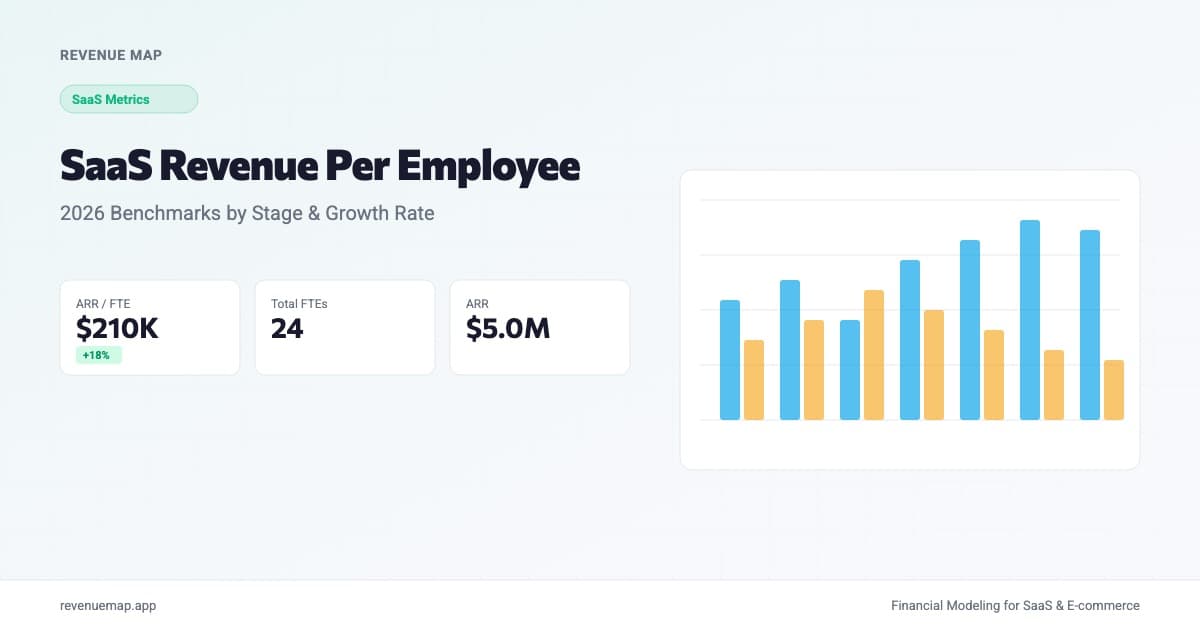
SaaS Revenue Per Employee: 2026 Benchmarks
How much ARR should each employee generate? See 2026 SaaS revenue per employee benchmarks by stage and growth rate, with formulas and a free calculator.