Bakery Startup Costs: Full 2026 Breakdown
Bakery startup costs range from $20,000 for a home bakery to $324,000 for a full retail shop with cafe seating. The biggest expenses are leasehold improvements, commercial ovens and mixers, and six months of working capital.
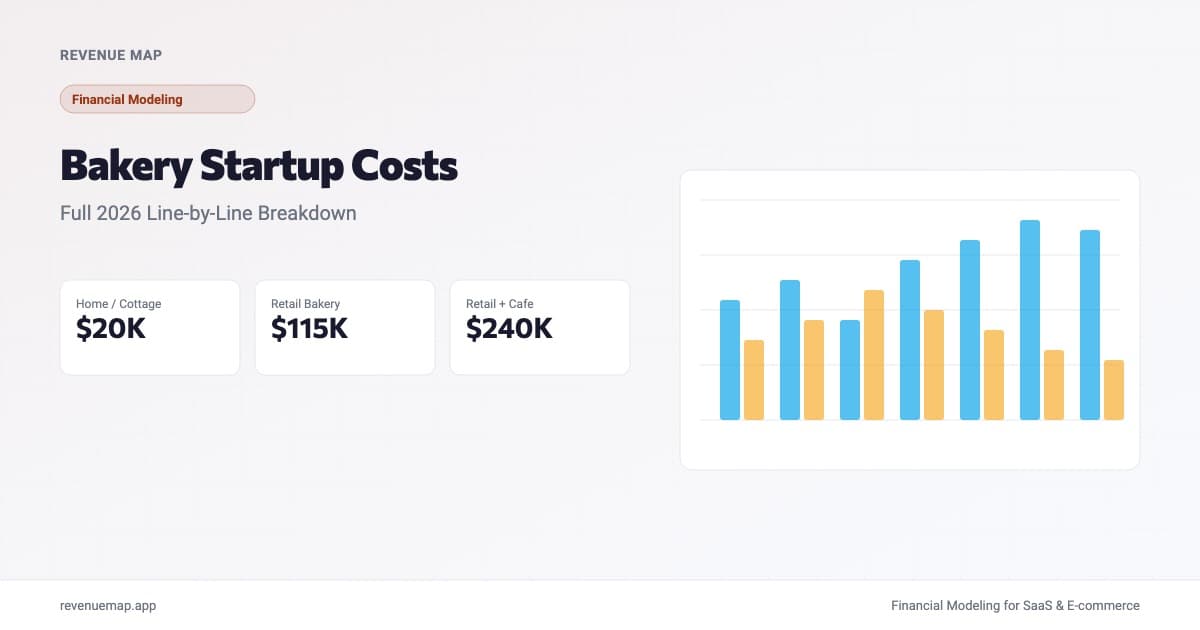
Bakery startup costs range from about $20,000 for a home or cottage bakery to $324,000 for a full retail shop with a commercial kitchen, display counter, and cafe seating. Most independent retail bakeries spend $70,000 to $200,000 all in. The biggest cost drivers are leasehold improvements, commercial ovens and mixers, and the working capital needed to cover the first six months before the business reaches a stable daily customer count.
That financial math is unforgiving. Chip City, a cookie concept funded by Danny Meyer's group, announced this week that it is closing all remaining locations amid a legal dispute with its former CEO. A recognizable name and investor backing are not enough when the unit economics fall apart. Meanwhile, September's foodservice employment report shows the sector added only 10,800 jobs, roughly one-third of August's pace, which signals that labor costs are stabilizing but still elevated heading into 2027. If you are putting together a bakery business plan, getting the startup cost section right is the difference between a funded launch and a stalled one.
What Does It Cost to Open a Bakery?
The total depends heavily on format. A home bakery operating under a cottage food law needs almost no buildout. A retail bakery in a leased storefront needs commercial equipment, fixtures, and a full kitchen. Adding cafe seating or an espresso program pushes the total higher still.
| Category | Home / Cottage | Retail Bakery | Retail + Cafe |
|---|---|---|---|
| Leasehold improvements | $0 | $20,000 to $50,000 | $50,000 to $110,000 |
| Ovens and baking equipment | $3,500 to $8,000 | $16,000 to $35,000 | $35,000 to $75,000 |
| Display cases, furniture, POS | $500 to $2,000 | $5,000 to $16,000 | $16,000 to $35,000 |
| Permits, licenses, insurance | $1,000 to $3,000 | $5,000 to $10,000 | $10,000 to $20,000 |
| Inventory, packaging, marketing | $1,000 to $3,000 | $5,000 to $12,000 | $12,000 to $24,000 |
| Working capital (6 months) | $2,000 to $6,000 | $20,000 to $35,000 | $35,000 to $60,000 |
| Total | $8,000 to $22,000 | $71,000 to $158,000 | $158,000 to $324,000 |
Most independent bakery owners land in the retail column: $80,000 to $160,000 for a neighborhood storefront in a second-generation space with moderate renovation, new or refurbished equipment, and enough cash to cover six slow months. If you are building out a raw shell with no existing kitchen infrastructure, add $25,000 to $50,000 before any equipment goes in.
How Much Do Commercial Bakery Ovens Cost?
The oven is the most consequential equipment decision you will make. It determines what you can produce, how fast, and at what consistency.
| Oven Type | Price Range | Best For |
|---|---|---|
| Convection | $5,000 to $15,000 | Cookies, pastries, small bread batches |
| Deck | $8,000 to $25,000 | Artisan bread, high-crust-quality products |
| Rack / Rotary | $15,000 to $40,000 | High-volume production or wholesale |
A convection oven is the most common starting point for a neighborhood bakery producing pastries, cookies, and basic breads. If artisan bread is your core product, a deck oven delivers better crust quality but costs more and takes up more floor space. Rack ovens are production workhorses: if you are baking 500 or more items per day or filling wholesale orders, the throughput justifies the price.
Beyond the oven, budget for a commercial mixer ($3,000 to $12,000 depending on bowl capacity), a dough proofer ($2,000 to $6,000), a sheeter for laminated doughs like croissants ($4,000 to $10,000), and commercial refrigeration ($3,000 to $8,000). Buying used equipment from restaurant liquidators can cut this category by 30% to 40%. A refurbished deck oven at $6,000 bakes the same bread as a new one at $15,000. Check warranty coverage and electrical compatibility before buying.
Working Capital: The Cost That Determines Survival
Working capital is the cash reserve that keeps the lights on while your bakery builds a customer base. Most retail bakeries take 3 to 6 months to reach a stable daily volume, and during that ramp your rent, payroll, and ingredient costs do not pause.
The standard guidance is six months of operating expenses. For a small retail bakery running $6,000 to $8,000 per month in overhead (rent, one or two employees, ingredients, utilities), that means $36,000 to $48,000 in reserve.
Here is the thing: undercapitalization is the most common reason bakeries fail in year one. Opening with two months of reserves means one equipment repair or one slow holiday week tips you into a cash crisis. The Chip City closure is an extreme case, but the underlying lesson applies at every scale. Your financial plan needs to model the ramp-up period honestly. If you have not done that math yet, our break-even analysis guide walks through it step by step.
Costs That First-Time Bakery Owners Underestimate
The table above covers the headline categories. These are the line items that catch people off guard:
- Health department and fire inspections. Commercial kitchen inspections can require hood ventilation, grease trap installations, or fire suppression systems not visible during a lease walkthrough. Budget $2,000 to $8,000 beyond the basic permit fees if your space does not already have a compliant commercial kitchen.
- Packaging and branding. Custom boxes, bags, labels, and stickers add up quickly once you scale past farmers-market quantities. A basic branded packaging run costs $1,500 to $4,000.
- Pre-opening labor. You need bakers trained and recipes tested at production scale before day one. Budget 1 to 3 weeks of payroll ($1,500 to $6,000) for pre-opening runs and recipe calibration.
- Delivery platform commissions. If you list on DoorDash or Uber Eats, expect 15% to 30% of each delivery order as commission. Many bakery owners overlook this when projecting their gross margin and are surprised when delivery revenue barely breaks even.
- Ingredient cost volatility. Flour, butter, and sugar prices shift with commodity markets. A 10% spike in butter prices directly compresses your margin on croissants and pastries. Build a 5% to 10% cost buffer into your ingredient projections.
How to Reduce Your Bakery Startup Costs
Not every bakery needs a $150,000 buildout. Proven ways to lower the total:
- Start as a home bakery. Most states now have cottage food laws that allow home-based baking with minimal permitting. Test your product-market fit for $10,000 to $20,000, then scale to a commercial space once you have steady demand.
- Lease a second-generation space. A location that previously housed a bakery or restaurant already has hood ventilation, plumbing, gas lines, and possibly commercial electrical. This can save $20,000 to $50,000 in leasehold improvements compared to a raw retail shell.
- Buy refurbished equipment. Restaurant liquidators sell commercial ovens, mixers, and refrigeration at 30% to 50% off retail. A certified refurbished mixer at $2,000 does the same job as a new one at $5,000.
- Use a commissary kitchen. Shared commercial kitchens rent by the hour ($15 to $30 per hour in most markets). Produce in a commissary and sell through farmers markets, online orders, or wholesale accounts to avoid a storefront lease entirely until revenue justifies it.
- Negotiate a tenant improvement allowance. Many landlords contribute $10 to $25 per square foot toward buildout costs in exchange for a longer lease commitment. On a 1,000-square-foot bakery, that is $10,000 to $25,000 off your upfront investment.
How to Fund a Bakery Startup
The most common funding paths for a retail bakery:
- SBA 7(a) loan. The most popular loan for brick-and-mortar food businesses. Requires a business plan with financial projections, a 10% to 20% down payment, and a personal credit score above 680. See our SBA loan business plan guide for what the application requires.
- Equipment financing. Lenders finance commercial ovens, mixers, and refrigeration with the equipment itself as collateral. Typical terms run 5 to 7 years at 6% to 12% APR.
- Personal savings. Still the most common source for home and cottage bakeries. The advantage is speed and no underwriting process. The risk is personal.
If you are applying for any loan, the startup cost breakdown and a 12-month cash flow projection are the two sections lenders scrutinize most.
Estimate Your Bakery Startup Costs
Bakery Startup Cost Calculator
Estimate your total bakery investment
Want to model this over 36 months with scenarios? Try Revenue Map free →
Key Takeaways
- Bakery startup costs range from $8,000 for a home or cottage operation to $324,000 for a full retail bakery with cafe seating. Most independent retail bakeries spend $70,000 to $200,000.
- Equipment and leasehold improvements together account for roughly 60% of the total. Choosing a second-generation space and buying used equipment can cut tens of thousands from the initial investment.
- Working capital for six months of operating expenses is the single most important line item. Undercapitalization kills more bakeries than bad products.
- Hidden costs like packaging, pre-opening labor, and delivery commissions add $5,000 to $15,000 that first-time owners often miss.
- Ready to put your numbers on paper? Use the startup cost calculator for a quick estimate, or build a full financial projection with Revenue Map. It is free and takes about two minutes.
Related Articles
Gym Startup Costs: Full 2026 Breakdown
Gym startup costs range from $50K for a personal training studio to $500K for a full-service facility. Full line-by-line breakdown with real numbers.
Car Wash Startup Costs: Full 2026 Breakdown
Opening a car wash costs $70,000 to $500,000 depending on format. Full cost breakdown for mobile, hand wash, self-service, and tunnel operations.
Laundromat Startup Costs: Full 2026 Breakdown
Opening a laundromat costs $200K to $500K. Full line-by-line breakdown with real equipment prices, build-out costs, and financing options.