Gym Startup Costs: Full 2026 Breakdown
Gym startup costs range from $50,000 for a small personal training studio to $500,000 or more for a full-service facility. Equipment and leasehold improvements account for roughly 60% of the total. Budget at least six months of working capital on top of the buildout.
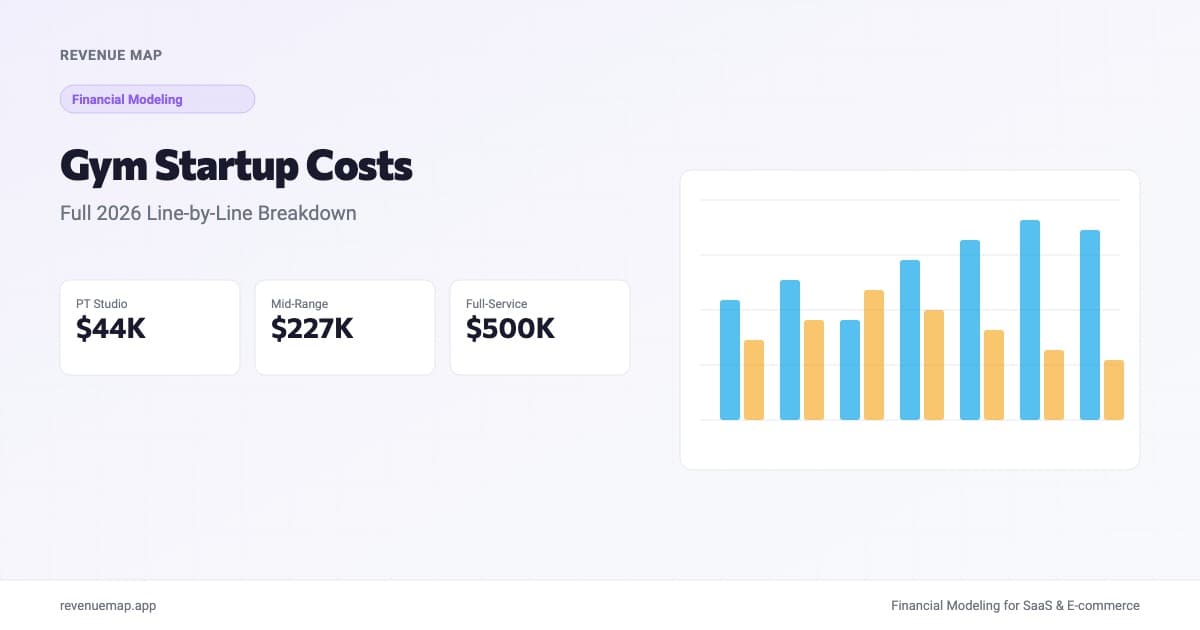
Gym startup costs range from about $50,000 for a small personal training studio to $500,000 or more for a full-service facility with cardio floors, free weights, group fitness rooms, and locker rooms. Equipment and leasehold improvements make up roughly 60% of the total, with permits, marketing, technology, and working capital covering the rest.
Timing matters almost as much as the dollar figure. Small Business Trends recently outlined how seasonal sales planning shapes profitability for small businesses, and few industries are as seasonal as fitness. January is the single biggest membership acquisition month of the year for gyms. That means founders who want to capture the New Year rush need to sign leases, start buildouts, and order equipment in Q4, which means knowing these costs in detail right now.
Here is a full breakdown of gym startup costs in 2026, organized by format, with the line items lenders and landlords actually ask about.
What Does It Cost to Open a Gym?
The total depends on three things: the format (personal training studio vs. boutique vs. full-service), the condition of the space (second-generation fitness space vs. raw shell), and the market (rent in Austin looks nothing like rent in Manhattan).
Here is a realistic range across the four most common formats:
| Category | PT Studio | Boutique (CrossFit, Cycling) | Mid-Range Independent | Full-Service |
|---|---|---|---|---|
| Leasehold improvements | $5,000 | $20,000 | $60,000 | $120,000 |
| Equipment (cardio + strength) | $15,000 | $30,000 | $65,000 | $150,000 |
| Locker rooms, showers, plumbing | $0 | $5,000 | $20,000 | $50,000 |
| Sound system, TVs, facility tech | $1,000 | $3,000 | $6,000 | $15,000 |
| POS, member management software | $1,000 | $2,000 | $5,000 | $12,000 |
| Permits, licenses, insurance (year 1) | $2,000 | $5,000 | $8,000 | $18,000 |
| Marketing, signage, branding | $2,000 | $5,000 | $8,000 | $20,000 |
| Working capital (6 months) | $18,000 | $35,000 | $55,000 | $115,000 |
| Total | $44,000 | $105,000 | $227,000 | $500,000 |
Most first-time independent gym owners land in the mid-range: $150,000 to $300,000 all in. That assumes a 3,000 to 5,000 square foot space in a suburban strip center or light industrial park, with a mix of new and used equipment.
The Five Biggest Cost Categories
1. Equipment ($15,000 to $150,000)
Equipment is the single most variable line item and usually the largest. The range reflects the gulf between a personal training studio with kettlebells, dumbbells, and a few racks versus a full-service gym with treadmills, ellipticals, rowing machines, cable stations, squat racks, benches, and plate-loaded machines.
| Format | Core Equipment | Typical Cost |
|---|---|---|
| Personal training studio | Dumbbells, kettlebells, benches, 1-2 racks | $10,000 to $25,000 |
| CrossFit/functional fitness | Rigs, bars, bumper plates, rowers, bikes | $25,000 to $50,000 |
| Mid-range independent gym | Cardio (8-12 pieces), free weights, machines | $50,000 to $80,000 |
| Full-service facility | Full cardio floor, circuit machines, free weights, group fitness | $100,000 to $150,000 |
Buying used commercial-grade equipment from brands like Life Fitness, Precor, or Hammer Strength can cut costs by 40% to 60% on cardio and 20% to 30% on strength. Restaurants have liquidation auctions because restaurants close often. Gyms close too, and the equipment market for used commercial fitness gear is active. Check sites like GymStarters, Global Fitness, or local restaurant/fitness equipment auctions.
The exception: specialty studio equipment (Pilates reformers, Woodway treadmills) rarely shows up used and holds its retail price.
2. Leasehold Improvements ($5,000 to $120,000)
A second-generation fitness space (one that previously housed a gym or studio) is the cheapest path. The flooring, mirrors, and possibly HVAC upgrades are already in place. You might spend $5,000 to $15,000 on paint, minor repairs, and branding. Converting a raw retail or office shell into a gym costs dramatically more because you are installing rubber flooring, reinforcing floors for heavy equipment, upgrading electrical capacity, installing mirrors, and potentially adding showers and plumbing.
Here's the thing: the lease negotiation can make or break this line item. A landlord who wants a fitness tenant (good for foot traffic) may offer a tenant improvement allowance of $10 to $30 per square foot. On a 4,000 square foot space, that could cover $40,000 to $120,000 of buildout, essentially eliminating the leasehold improvement cost from your out-of-pocket startup budget. Ask for it. The worst they can say is no.
3. Working Capital ($18,000 to $115,000)
Working capital is the line item that separates gyms that survive the ramp-up from gyms that close in month four. New gyms almost always run at a loss for the first three to six months while building membership. If every dollar goes into equipment and buildout, a single slow month forces difficult choices.
Budget at least six months of fixed operating expenses: rent, insurance, loan payments, software subscriptions, and minimum staffing. For a mid-range gym with $8,000 in monthly rent and $4,000 in other fixed costs, that means $55,000 to $72,000 in cash reserves before you open the doors.
This is especially critical given how seasonal gym membership acquisition is. A gym that opens in February misses the January rush and faces eight months of slower growth before the next peak. A gym that opens in December or early January can ride the wave, but only if it has enough working capital to survive until that revenue stabilizes.
4. Permits, Licenses, and Insurance ($2,000 to $18,000)
Fitness businesses require a standard business license, a certificate of occupancy, and potentially a health department permit if you offer showers or a juice bar. Add general liability insurance ($1,000 to $3,000/year), professional liability insurance for trainers ($500 to $1,500/year), and workers' comp if you have employees.
Check local requirements before signing a lease. A zoning issue discovered after the buildout is an expensive surprise.
5. Technology and Software ($2,000 to $27,000)
Modern gyms run on member management software (Mindbody, Glofox, or Wodify for CrossFit boxes), access control systems (key fob or app-based door entry), and POS systems for retail. Budget $2,000 to $7,000 for initial setup and hardware, plus $200 to $800 per month in software subscriptions. Sound systems and TVs add $1,000 to $10,000 depending on how much atmosphere you want to create.
Hidden Costs That Catch First-Time Gym Owners
Beyond the table above, these expenses surprise new operators:
- Pre-sale costs. A 4 to 8 week founding member campaign before opening costs $3,000 to $10,000 in marketing and temporary staff, but can generate $10,000 to $30,000 in prepaid memberships.
- Equipment delivery and installation. Commercial equipment requires professional installation and floor anchoring. Delivery fees run $2,000 to $5,000.
- Utility deposits and upgrades. Gyms draw heavy electrical load. Expect utility deposits of $1,000 to $3,000 and potentially an electrical panel upgrade of $2,000 to $8,000.
- Cleaning. Members notice immediately if standards slip. Contract cleaning costs $500 to $2,000/month from day one.
How to Finance Gym Startup Costs
Most gym owners use a combination of personal savings, an SBA loan, and equipment financing. Here is how the typical capital stack looks:
Total Startup Cost = Owner Equity (10-30%) + SBA 7(a) Loan (50-70%) + Equipment Financing (10-30%)
SBA 7(a) loans are the most common financing vehicle for independent gyms, with terms up to 10 years for equipment and 25 years for real estate. The SBA requires a business plan with financial projections, a startup cost breakdown, and a debt service coverage ratio (DSCR) of at least 1.15x to 1.25x.
Equipment financing covers the single largest line item separately. Vendors like Life Fitness offer in-house financing, and third-party lenders specialize in fitness equipment loans with 3 to 7 year terms at 6% to 12% interest.
Calculate Your Gym Startup Costs
Gym Startup Cost Calculator
Estimate your total investment by gym format
Want to model this over 36 months with scenarios? Try Revenue Map free →
What Revenue Do You Need to Cover These Costs?
Gym revenue is driven by membership dues, personal training, group classes, and retail. Understanding your gross margin by format helps determine how quickly you recoup startup costs. The core formula for projecting monthly revenue:
Monthly Revenue = (Active Members x Avg Monthly Dues) + PT Revenue + Retail
A mid-range gym with $227,000 in startup costs, financed at 60% via an SBA loan, needs roughly $10,000 to $12,000 per month in operating profit to service the debt and repay equity within five years. At $50 average monthly dues, that requires 350 to 400 members at stabilization. For the full revenue model and membership growth curves, see the gym business plan guide and break-even analysis.
| Format | Avg Monthly Dues | Break-Even Members | Typical Break-Even Timeline |
|---|---|---|---|
| Personal training studio | $200 to $300 | 40 to 60 | 6 to 9 months |
| Boutique studio | $120 to $180 | 100 to 150 | 9 to 12 months |
| Mid-range independent | $40 to $60 | 300 to 400 | 12 to 18 months |
| Full-service gym | $30 to $50 | 500 to 700 | 18 to 24 months |
How to Reduce Gym Startup Costs
- Lease a second-generation space. A former gym already has flooring, mirrors, and HVAC upgrades. Savings: $30,000 to $80,000 on leasehold improvements.
- Buy used commercial equipment. Used Life Fitness treadmills sell for 40% to 60% below retail. Strength gear trades at a 20% to 30% discount.
- Negotiate tenant improvement allowances. A $20/sf TI on a 4,000 sf space covers $80,000 of your buildout. Landlords often offer this because gyms drive foot traffic.
- Phase equipment purchases. Open with the essentials and add specialty equipment as revenue grows.
- Run a pre-sale campaign. A founding member campaign can generate $10,000 to $30,000 in prepaid memberships before opening, reducing the working capital you need to hold.
Key Takeaways
- Gym startup costs range from $50,000 (personal training studio) to $500,000 (full-service facility), with most independent gyms landing between $150,000 and $300,000.
- Equipment and leasehold improvements account for about 60% of total costs. Buying used and leasing second-generation space are the two highest-leverage savings.
- Budget at least six months of working capital. Gyms are deeply seasonal, and opening without cash reserves to survive the ramp-up is the most common financial mistake.
- SBA 7(a) loans plus equipment financing cover 70% to 90% of startup costs for qualified borrowers. Start with a solid business plan and cash flow projection.
- Use the gym startup cost calculator to adjust these numbers for your specific format and market, then plug them into a full projection. Build yours free in two minutes.
Related Articles
Car Wash Startup Costs: Full 2026 Breakdown
Opening a car wash costs $70,000 to $500,000 depending on format. Full cost breakdown for mobile, hand wash, self-service, and tunnel operations.
Laundromat Startup Costs: Full 2026 Breakdown
Opening a laundromat costs $200K to $500K. Full line-by-line breakdown with real equipment prices, build-out costs, and financing options.
Franchise Startup Costs: Full 2026 Breakdown
Franchise startup costs range from $25K to $500K+ depending on the brand and format. Full cost breakdown, comparison table, and financing tips inside.