Laundromat Startup Costs: Full 2026 Breakdown
Laundromat startup costs range from $200,000 to $500,000 for a new build-out. The three biggest line items are commercial washers and dryers ($65,000 to $215,000), plumbing and build-out ($40,000 to $140,000), and working capital for the first six months ($15,000 to $50,000).
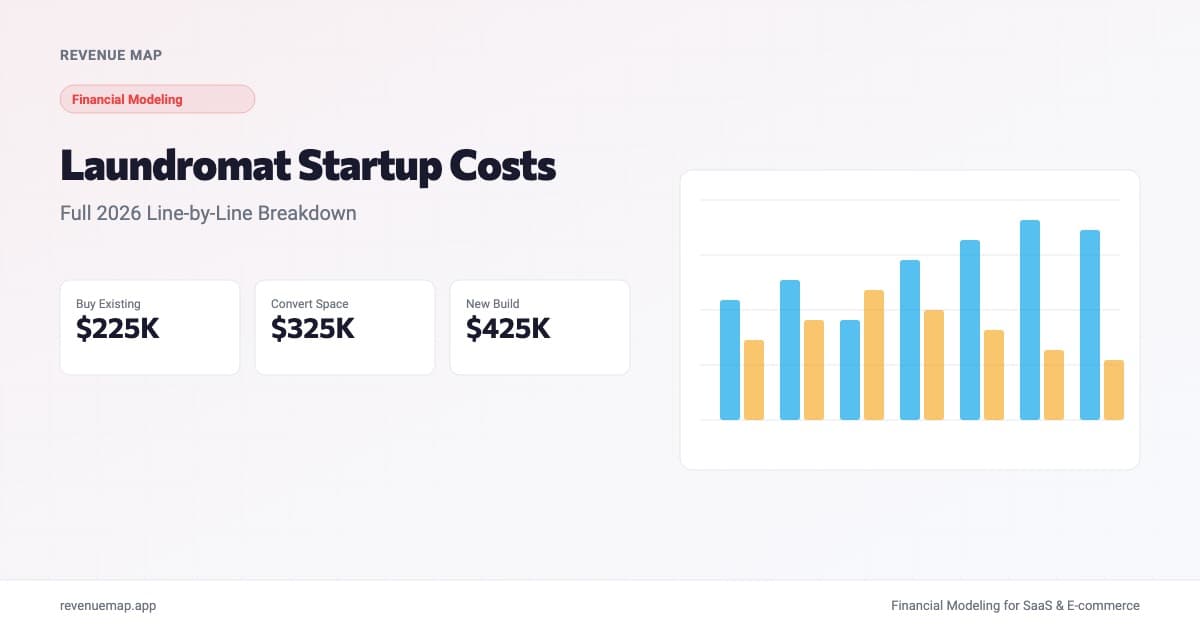
Laundromat startup costs run $200,000 to $500,000 for a new build-out, with equipment and plumbing taking the largest share. Buying an existing location drops the entry point to $150,000 to $300,000 because you skip the build-out and inherit working plumbing, drainage, and a customer base.
Those numbers put laundromats in a different category than most brick-and-mortar investments. Small Business Trends recently profiled the most profitable restaurant franchises, where initial franchise fees alone can exceed $50,000 before a single wall gets painted. Laundromats carry comparable total investment but with lower ongoing labor costs and simpler operations. The trade-off is that you are building the brand yourself. Here is exactly where the startup money goes, what first-time owners underestimate, and how to keep the total under control.
How Much Does It Cost to Open a Laundromat?
The total depends on your approach: buying an existing location, converting a retail space, or building from scratch. Each path has a different cost profile and risk level.
| Approach | Total Cost | Equipment | Build-Out | Working Capital |
|---|---|---|---|---|
| Acquire existing (15-25 machines) | $150,000 - $300,000 | Included | Minimal | $15,000 - $30,000 |
| Convert retail space (25-35 machines) | $250,000 - $400,000 | $90,000 - $160,000 | $55,000 - $100,000 | $20,000 - $40,000 |
| New build, mid-size (35-50 machines) | $350,000 - $500,000 | $130,000 - $215,000 | $80,000 - $140,000 | $30,000 - $50,000 |
Most first-time owners land in the middle tier: converting a retail space with 25 to 35 machines for $250,000 to $400,000. That said, the acquisition route deserves serious consideration. You pay less upfront, generate revenue from day one, and avoid the 4 to 8 months of construction and permitting that a new build requires.
If you are putting these numbers into a formal plan for a lender, the laundromat business plan guide covers revenue projections, break-even calculations, and what SBA reviewers specifically check.
What Are the Biggest Laundromat Startup Expenses?
Commercial Washers ($40,000 to $130,000)
Washer costs vary dramatically by capacity. Small top-loaders are cheap but generate less revenue per square foot. Large-capacity front-loaders cost more upfront but command higher prices per cycle and attract the families and small-business customers who spend the most.
| Machine Type | Capacity | New Price Each | Used Price Each |
|---|---|---|---|
| Top-load washer | 20 lb | $1,200 - $1,800 | $500 - $900 |
| Front-load washer | 20 lb | $2,500 - $3,500 | $1,200 - $1,800 |
| Front-load washer | 40 lb | $4,500 - $6,000 | $2,000 - $3,500 |
| Front-load washer | 60 lb | $7,000 - $9,000 | $3,500 - $5,500 |
The honest answer is that the machine mix matters more than the machine count. A location with 10 large-capacity front-loaders and 15 standard units will often outperform a location with 30 small top-loaders, both in revenue per square foot and in customer satisfaction. Most modern business plans skew 60% to 70% front-load.
Commercial Dryers ($25,000 to $85,000)
Dryers are simpler machines with fewer moving parts, so they cost less than washers and last longer (12 to 18 years versus 10 to 15 for washers). Stack dryers save floor space and are standard for new builds.
| Machine Type | New Price Each | Used Price Each |
|---|---|---|
| Single-pocket gas dryer (30 lb) | $2,500 - $3,500 | $1,000 - $1,800 |
| Stack dryer (2 x 30 lb) | $4,500 - $6,500 | $2,200 - $3,500 |
| Large gas dryer (50-75 lb) | $5,000 - $8,000 | $2,500 - $4,500 |
Gas dryers are significantly cheaper to operate than electric. If your space has a gas line, go gas. If it does not, adding one costs $2,000 to $5,000, but the monthly savings on utility bills pay that back within the first year.
Plumbing, Drainage, and Build-Out ($40,000 to $140,000)
This is the cost category that causes the most budget overruns. Commercial washers need dedicated hot and cold water feeds, oversized drain lines (2-inch minimum per machine, 4-inch mains), and a water heater sized for peak demand. In older buildings, bringing plumbing and drainage up to code can add $20,000 to $40,000 beyond initial estimates.
Here's the thing: the plumbing bid you get before demolition is an educated guess. The plumbing bid you get after opening the walls is the real number. Budget a 20% contingency on this line.
Build-out costs beyond plumbing include flooring (commercial tile or sealed concrete, $3 to $8 per square foot), lighting, HVAC upgrades for humidity control, ADA-compliant restrooms, and electrical work for payment systems and lighting.
Working Capital ($15,000 to $50,000)
A self-service laundromat is cash-flow positive faster than most retail businesses because there is no inventory and labor costs are minimal. Even so, you need reserves for the first 3 to 6 months while the customer base builds. Budget for rent, utilities, loan payments, insurance, and a maintenance fund. Running out of cash three months in because the water bill was higher than projected is an avoidable failure.
Buying an Existing Laundromat vs. Building New
| Factor | Buy Existing | Build New |
|---|---|---|
| Total cost | $150K - $300K | $300K - $500K |
| Time to open | 30 - 60 days | 4 - 8 months |
| Revenue start | Immediate | Month 1 post-opening |
| Plumbing risk | Already installed | Full build required |
| Equipment condition | Inspect carefully | Brand new, warranty |
| Customer base | Inherited | Build from scratch |
| Lease terms | Transferable (maybe) | Negotiable |
The acquisition path is not risk-free. Aging equipment, deferred maintenance, and an unfavorable lease transfer can eat into the price advantage. Before signing, hire an independent technician to inspect every machine, pull utility bills for the last 24 months, and review the lease assignment terms with an attorney. Equipment that is 12 years into a 15-year life span is not an asset; it is a replacement cost you are inheriting.
Hidden Costs That Catch First-Time Owners
Water heating capacity ($3,000 to $12,000). A residential water heater will not cut it. Commercial laundromats need a water heater rated for 200 to 500 gallons per hour at peak. Undersizing means cold wash cycles during busy hours and unhappy customers.
Card and payment system conversion ($8,000 to $25,000). Coin-operated machines are cheaper to install, but card and app-based payment systems increase revenue per cycle by 15% to 20% because customers spend more freely when they are not counting quarters. The upfront cost includes readers per machine, a central payment kiosk, and monthly processing fees of 3% to 5%.
ADA compliance ($5,000 to $15,000). Your location needs accessible entrances, restrooms, machine access aisles, and signage. Retrofitting an older space for ADA compliance is a permit requirement, not optional.
Security and cameras ($2,000 to $6,000). Laundromats operate extended hours, often unattended. A camera system with remote monitoring protects equipment and deters vandalism. Insurance providers may require it.
Ongoing maintenance reserve ($400 to $1,300/month). Commercial machines need regular maintenance: belt replacements, bearing checks, drain cleaning, and coin mechanism or card reader repairs. Budget 2% to 3% of equipment value per year.
Calculate Your Laundromat Startup Costs
Laundromat Startup Cost Calculator
Estimate your total investment by build-out approach
Want to model this over 36 months with scenarios? Try Revenue Map free →
For a more detailed estimate that factors in your specific location and machine mix, try the startup cost calculator.
How to Finance a Laundromat
SBA 7(a) loans are the most common route, covering $50,000 to $5 million with 10 to 25 year terms. Interest rates are currently prime plus 2.25% to 2.75%. You will need 10% to 20% owner equity, a complete business plan, and financial projections showing a DSCR above 1.25x. The full checklist for what lenders expect is in the business plan for a business loan guide.
Equipment financing works well if you want to finance the machines separately from the build-out. Lenders use the equipment as collateral, so approval is faster and terms run 5 to 7 years. Down payments are typically 10% to 20%. This lets you pair an SBA loan for the build-out with equipment financing for the washers and dryers.
Seller financing is common in laundromat acquisitions. The current owner carries 20% to 40% of the purchase price as a note, reducing your upfront capital and aligning their incentives with a smooth transition.
How to Reduce Startup Costs Without Cutting Corners
Buy an existing location. Skipping the build-out saves $80,000 to $140,000. If the machines are in decent shape (under 10 years old), this is the fastest path to positive cash flow.
Mix new and used equipment. Buy new large-capacity front-loaders for your anchor machines and fill in with quality used equipment from laundromat liquidation sales. A used 20 lb front-loader at $1,500 versus $3,000 new adds up fast across 15 machines.
Negotiate a tenant improvement allowance. Landlords often contribute $15 to $40 per square foot toward build-out in exchange for a longer lease. On a 2,000 square foot space, that is $30,000 to $80,000 you do not need to finance.
Start without wash-and-fold. Adding a service counter, folding tables, and dedicated staff increases startup costs by $15,000 to $30,000 and adds ongoing labor. Launch with self-service only, prove the location, and add services once cash flow supports the overhead. Track your gross margin monthly so you know exactly when the numbers support the expansion.
Key Takeaways
- Laundromat startup costs range from $150,000 (acquiring a small existing location) to $500,000 for a mid-size new build. Most first-time owners spend $250,000 to $400,000 converting a retail space.
- Equipment accounts for roughly 50% of costs. Large-capacity front-load washers generate more revenue per square foot than top-loaders, and gas dryers cost significantly less to run than electric.
- Plumbing and drainage are the biggest budget-busting line item. Get bids after opening the walls, not before, and carry a 20% contingency.
- Buying an existing laundromat saves $80,000 to $140,000 in build-out costs and provides revenue from day one. Inspect every machine and pull 24 months of utility bills before closing.
- SBA 7(a) loans and equipment financing are the standard funding combination. Both require a written business plan with projections and a DSCR above 1.25x.
Ready to map out the full financial picture for your laundromat? Build your startup cost projections and first-year cash flow for free with Revenue Map. Pick the laundromat template, plug in your numbers, and have a lender-ready forecast in a few minutes.
Related Articles
Franchise Startup Costs: Full 2026 Breakdown
Franchise startup costs range from $25K to $500K+ depending on the brand and format. Full cost breakdown, comparison table, and financing tips inside.
Coffee Shop Startup Costs: Full 2026 Breakdown
Opening a coffee shop costs $85,000 to $325,000. Full line-by-line cost breakdown with equipment, buildout, permits, and working capital.
Restaurant Startup Costs: Full 2026 Breakdown
How much does it cost to open a restaurant? Expect $175K to $750K depending on concept and location. Full line-by-line breakdown inside.