SBA Loan Business Plan: What Lenders Require
An SBA loan business plan must include a use-of-funds breakdown, three to five years of financial projections, a 12-month cash flow forecast, and a debt service coverage ratio of at least 1.15x to 1.25x. SBA 7(a) loans also require an owner resume and a personal financial statement.
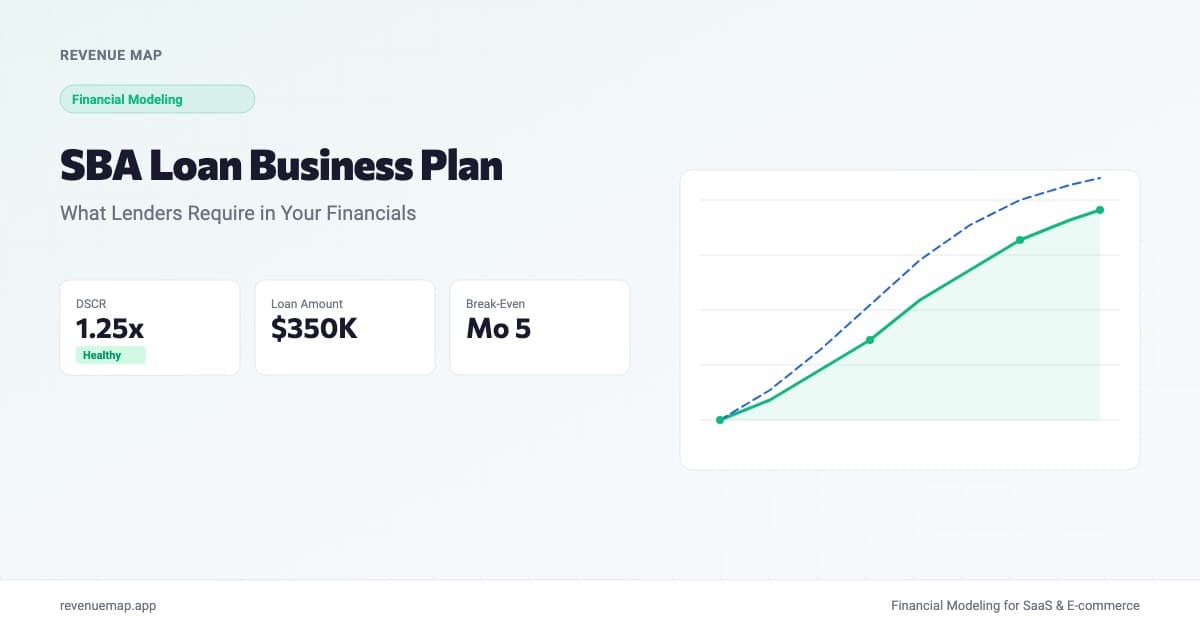
An SBA loan business plan is a business plan written specifically to meet the requirements of SBA-backed lenders. It includes the same sections as a general loan business plan, but SBA programs have additional requirements: owner resumes, personal financial statements, specific projection horizons, and a debt service coverage ratio that clears the SBA's threshold. If you are applying for a 7(a) or 504 loan, your plan needs to hit these marks or the lender will send it back before it reaches underwriting.
Franchises like Hawaiian Bros, which plans to grow its average unit volume from $2.5 million to $3.5 million across its 83 locations, rely heavily on SBA financing for new unit openings. Nearly every franchise on Small Business Trends' most successful franchises to own list depends on 7(a) loans as the primary funding vehicle. Whether you are buying a franchise or opening an independent shop, the business plan determines whether you get funded.
What Makes an SBA Business Plan Different?
An SBA business plan is not fundamentally different from any other business plan. The structure is the same: executive summary, company overview, market analysis, management team, financial projections. The difference is in the specifics the SBA requires on top of that standard framework.
SBA-backed lenders must demonstrate to the SBA that the borrower can repay the loan. That means your plan needs to provide evidence the bank can reference during its review. Beyond the narrative sections, the SBA requires:
- Personal financial statement from every owner holding 20% or more equity
- Owner resumes showing industry-relevant experience
- Use-of-funds schedule detailing exactly how every dollar of loan proceeds will be spent
- Collateral summary listing assets that can secure the loan
- Three to five years of financial projections with monthly detail in year one
The financial projections section is where most SBA loan applications fail. A lender reviewing a conventional bank loan might accept a spreadsheet with annual summaries. An SBA lender wants to see monthly cash flow for the first year, annual projections for years two through five, and a clear path to a DSCR above their floor.
SBA 7(a) vs 504: Which Loan Requires What?
The two most common SBA programs have different use cases and different plan requirements. Here is what each expects:
| Requirement | SBA 7(a) | SBA 504 |
|---|---|---|
| Max loan amount | $5 million | $5.5 million |
| Primary use | Working capital, equipment, inventory, real estate | Fixed assets (real estate, heavy equipment) |
| Projection horizon | 3 years (monthly Year 1, annual Years 2-3) | 5 years (monthly Year 1, annual Years 2-5) |
| DSCR minimum | 1.15x to 1.25x (varies by lender) | 1.20x to 1.25x |
| Down payment | 10-20% | 10% (borrower), 40% (bank), 50% (CDC) |
| Personal guarantee | Required for owners with 20%+ equity | Required for owners with 20%+ equity |
| Collateral | Required where available | The asset itself serves as collateral |
| Typical term | 7-10 years (working capital), 25 years (real estate) | 10 years (equipment), 20-25 years (real estate) |
If you are opening a brick-and-mortar business and buying the building or making significant leasehold improvements, the 504 program's lower rates are attractive. But the longer projection horizon means more work in the financial section. For most first-time borrowers, the 7(a) program is the starting point because it covers nearly any legitimate business purpose.
How to Build Financial Projections for an SBA Loan
Start With the Use-of-Funds Schedule
Before projecting revenue, list every dollar you will spend from the loan proceeds. SBA lenders want a line-by-line breakdown, not a lump sum labeled "startup costs." For a restaurant applying for a $350,000 7(a) loan, the schedule might look like this:
| Category | Amount |
|---|---|
| Leasehold improvements | $120,000 |
| Kitchen equipment | $85,000 |
| Initial inventory | $18,000 |
| POS system and technology | $12,000 |
| Licenses, permits, insurance | $8,000 |
| Marketing (pre-launch) | $15,000 |
| Working capital (6 months) | $92,000 |
| Total | $350,000 |
The working capital line is critical. SBA lenders know that new businesses burn cash before revenue ramps. Requesting six months of operating expenses as working capital signals that you understand the ramp period. Skipping this line, or underfunding it, tells the lender you will run out of cash before the business can sustain itself.
If you are not sure what your trade's typical startup costs look like, the startup costs guide breaks down averages by business type.
Build Revenue From Unit Economics, Not Top-Down Guesses
SBA lenders reject "we expect $500K in Year 1 revenue" with no supporting math. Build revenue from the bottom up:
Monthly Revenue = Units Sold × Average Transaction Value × Operating Days
For a restaurant: 80 covers per day multiplied by a $22 average check multiplied by 26 operating days per month equals $45,760 in monthly revenue. For a gym: 200 members multiplied by $55 monthly dues equals $11,000, plus personal training and retail. The lender can verify each assumption independently.
Ramp the first six months conservatively. Most lenders expect month one revenue at 40-60% of your steady-state projection, growing 5-10% per month through month six. The revenue forecast template shows how to model this ramp cleanly.
Project Monthly Cash Flow for Year One
The 12-month cash flow projection is the document SBA lenders scrutinize most heavily. It shows whether the business can cover its obligations every month, not just on an annualized basis.
Map every expense to the month it actually hits. Payroll, rent, COGS, loan payments, insurance, and taxes each have their own timing. A quarterly insurance premium of $4,000 does not appear as $1,333 per month in a credible forecast. It appears as $4,000 in the months it is due and zero in the others.
For shorter-term visibility, many SBA lenders also request a 13-week cash flow forecast as a supplemental exhibit. This weekly format catches timing mismatches that monthly projections smooth over.
Calculate Your Debt Service Coverage Ratio
The DSCR is the single most important number in your SBA loan application. It measures whether the business generates enough income to cover its loan payments:
DSCR = Annual Net Operating Income / Annual Debt Service
Net operating income is revenue minus all operating expenses (COGS, rent, labor, utilities, insurance) but before debt payments and income taxes. Annual debt service is the total of all loan payments (principal plus interest) over 12 months.
A DSCR of 1.25x means the business earns $1.25 for every $1.00 it owes in debt payments. Most SBA lenders require at least 1.15x, and many set their floor at 1.25x. Falling below 1.0x means the business cannot cover its debt from operations, which is an automatic rejection.
For example, say a coffee shop projects $180,000 in annual net operating income and has $144,000 in annual debt service (a $350,000 loan at 7.5% over 10 years). The DSCR is $180,000 divided by $144,000, which equals 1.25x. That clears the threshold, but just barely. A lender seeing a DSCR at exactly the floor may ask for additional collateral or a larger down payment.
Your gross margin feeds directly into this number. If COGS runs 5% higher than projected, the DSCR drops accordingly. Conservative margin assumptions protect you here.
Calculate Your Debt Service Coverage Ratio
SBA Loan DSCR Calculator
Check whether your business clears the SBA lender's threshold
Want to model this over 36 months with scenarios? Try Revenue Map free →
If your DSCR falls below 1.25x, you have three options: increase projected revenue (only if supportable), reduce operating expenses, or request a smaller loan amount. Reducing the loan reduces the annual debt service, which improves the ratio. Sometimes the fastest path to approval is simply borrowing less and funding the gap with owner equity.
SBA Loan Business Plan DSCR Benchmarks
| DSCR Range | Lender Interpretation |
|---|---|
| Below 1.0x | Automatic rejection. Business cannot cover debt payments. |
| 1.0x to 1.15x | Weak. Most lenders decline or require significant collateral. |
| 1.15x to 1.25x | Acceptable for strong borrowers with experience and collateral. |
| 1.25x to 1.50x | Healthy. Standard approval range for most SBA 7(a) loans. |
| Above 1.50x | Strong. May qualify for better terms or larger loan amounts. |
Common Mistakes That Get SBA Plans Rejected
Omitting the owner's personal financial statement. SBA guidelines require a personal financial statement (SBA Form 413) from every owner with 20% or more equity. Submitting without it delays the process by weeks.
Using annual projections instead of monthly. A plan showing only annual totals for Year 1 tells the lender nothing about cash timing. SBA underwriters need monthly detail to verify the business can cover obligations during the ramp and seasonal dips.
Inflating revenue projections. First-year revenue is the assumption lenders push back on most. If your restaurant projects 120 covers per day starting month one, the lender will compare it against industry benchmarks and reject it. Start at 50-60% of capacity and ramp.
Ignoring working capital needs. A loan that covers equipment and buildout but leaves nothing for operating expenses is a red flag. Include at least three to six months of operating expenses as working capital in your use-of-funds schedule.
Copying a generic template without trade-specific numbers. An SBA lender reviewing a restaurant plan expects food cost at 28-35%, labor at 25-35%, and occupancy at 6-10%. Generic percentages signal that the borrower has not done the research. For trade-specific benchmarks, the break-even analysis guide includes margin ranges by business type.
Key Takeaways
- An SBA loan business plan includes everything a standard business plan does, plus personal financial statements, owner resumes, collateral summaries, and SBA-specific projection formats.
- SBA 7(a) loans require three years of projections with monthly detail in Year 1. SBA 504 loans require five years. Both demand a DSCR of at least 1.15x to 1.25x.
- Build revenue projections from unit economics (covers per day, members, transactions), not top-down guesses. Ramp conservatively: 40-60% of capacity in month one.
- The DSCR is the most scrutinized number in the application. If yours is below 1.25x, consider requesting a smaller loan or increasing your equity contribution before submitting.
- Include three to six months of working capital in your use-of-funds schedule. Lenders reject plans that fund the buildout but leave nothing for the ramp period.
Ready to build the projections your SBA lender is waiting for? Start with Revenue Map's free projection tool. It takes about two minutes, and the output includes the monthly cash flow and DSCR calculation your banker needs to see.
Related Articles
Business Plan for a Business Loan: What to Include
Learn exactly what lenders want in a business plan for a loan. Covers financial projections, cash flow, DSCR, and use-of-funds with real examples.
13 Week Cash Flow Forecast: How to Build One
A 13 week cash flow forecast tracks weekly inflows and outflows so lenders and owners can see exactly when cash runs short. Template logic and examples inside.
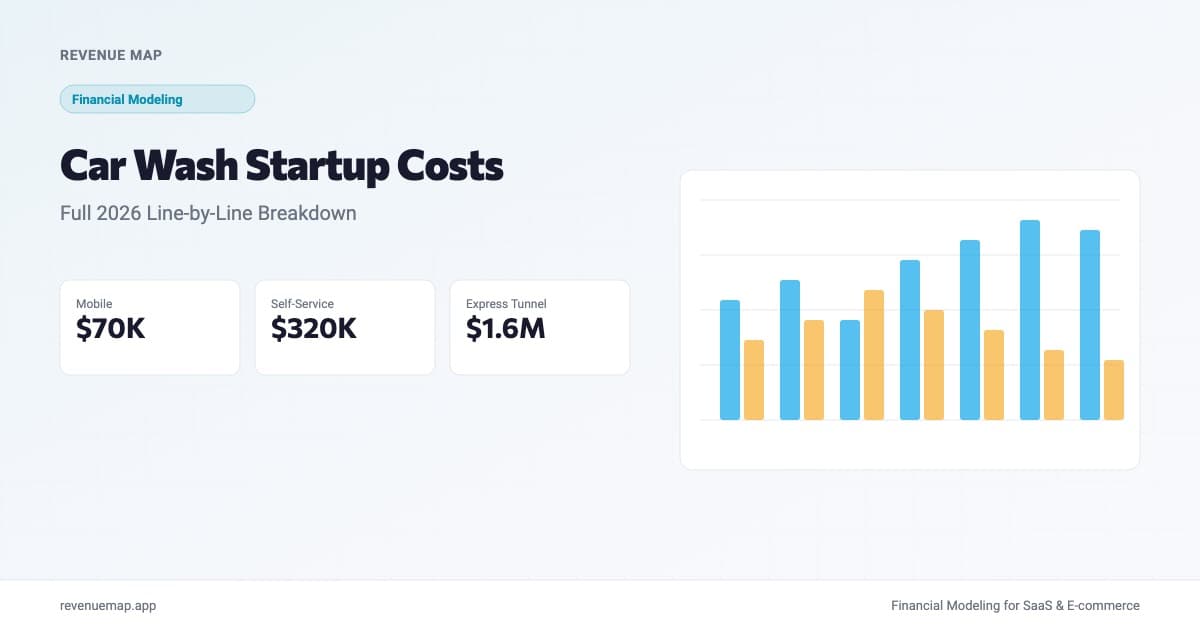
Car Wash Startup Costs: Full 2026 Breakdown
Opening a car wash costs $70,000 to $500,000 depending on format. Full cost breakdown for mobile, hand wash, self-service, and tunnel operations.