Car Detailing Business Plan: Costs and Projections
A car detailing business plan should include startup costs of $5,000 to $50,000 for a mobile operation or $80,000 to $200,000 for a fixed location. Revenue projections should be built from cars per day times average ticket, which typically ranges from $150 to $500 per vehicle depending on the service tier.
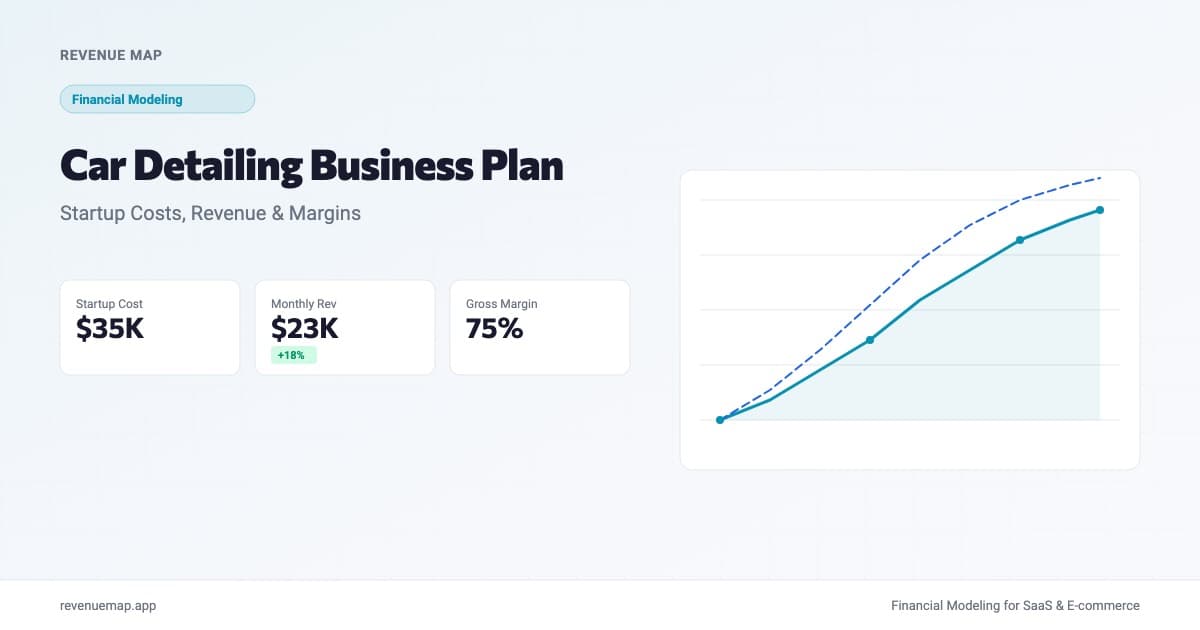
A car detailing business plan needs a financial section built on realistic startup costs, defensible per-vehicle pricing, and a cash flow forecast that proves the business can cover its expenses in slow months. Detailing is one of the lowest-barrier trades to enter, but lenders and partners still want to see the numbers before they commit capital.
That financial discipline is what separates businesses that scale from those that stall out. According to Entrepreneur, YuChiang Cheng's company nearly ran out of cash after cutting ties with Subway, then rebuilt its financial plan from scratch and grew to $54 million in annual revenue. Different industry, same principle: when you are building something on your own, the projection is what keeps the lights on.
Here is how to build the financial section of your car detailing business plan with the numbers a lender will actually check.
How Much Does It Cost to Start a Car Detailing Business?
Startup costs depend almost entirely on whether you go mobile or lease a fixed location. A mobile operation working out of a van or trailer can launch for under $20,000 in equipment and supplies. A storefront with dedicated bays, plumbing, and signage runs $80,000 to $200,000.
| Format | Startup Cost | Typical Loan | Avg Ticket | Staff |
|---|---|---|---|---|
| Solo mobile (car or SUV) | $5,000 | $0 (self-funded) | $150 | 1 |
| Mobile van/trailer | $15,000 to $50,000 | $10,000 to $35,000 | $200 | 1 to 2 |
| Fixed shop (2 bays) | $80,000 to $200,000 | $60,000 to $150,000 | $300 | 2 to 4 |
Most first-time detailers start mobile. The honest answer is that a shop lease only makes sense once you have enough recurring clients to fill two or more bays consistently, which usually takes 12 to 18 months of mobile work.
Where the Money Goes (Mobile Setup)
For a mobile detailing operation launching with a van, here is a realistic cost breakdown:
| Category | Low Estimate | Mid Estimate | High Estimate |
|---|---|---|---|
| Vehicle (used cargo van) | $8,000 | $18,000 | $35,000 |
| Pressure washer and steamer | $800 | $2,500 | $5,000 |
| Dual-action polisher and pads | $300 | $800 | $1,500 |
| Extractor (interior cleaning) | $200 | $600 | $1,200 |
| Water tank and filtration | $300 | $800 | $1,500 |
| Chemicals, towels, and supplies | $500 | $1,200 | $2,500 |
| Ceramic coating inventory | $400 | $1,000 | $2,000 |
| Branding, wrap, and signage | $500 | $2,000 | $4,500 |
| Insurance (first year) | $1,200 | $2,000 | $3,500 |
| Licenses and permits | $200 | $500 | $1,000 |
| Working capital (3 months) | $3,000 | $6,000 | $12,000 |
| Total | $15,400 | $35,400 | $69,700 |
One thing to flag: the vehicle is by far the largest line item. If you already own a suitable SUV or van, you can cut total startup costs by 40% to 50%. Plenty of detailers start with the vehicle they already have and upgrade after six months of revenue. Use the startup cost calculator to adjust these figures for your situation.
How to Project Car Detailing Revenue
Revenue for a detailing business comes down to cars per day, average ticket, and days worked. The core formula:
Monthly Revenue = Cars Per Day x Average Ticket x Days Worked Per Month
Unlike a car wash that processes 100+ vehicles a day at $7 to $55 each (see the car wash financial model for a side-by-side comparison), a detailing business handles fewer vehicles at a much higher price point. A full interior-exterior detail takes 2 to 4 hours per vehicle, which caps throughput for a solo operator at 3 to 5 cars per day.
Here is what the revenue range looks like across different service tiers:
| Service Tier | Avg Ticket | Time Per Car | Cars/Day (Solo) | Monthly Revenue |
|---|---|---|---|---|
| Basic wash and interior | $75 to $125 | 1 to 1.5 hrs | 5 to 6 | $9,750 to $19,500 |
| Full detail (interior + exterior) | $150 to $250 | 2 to 3 hrs | 3 to 4 | $11,700 to $26,000 |
| Paint correction | $300 to $600 | 4 to 8 hrs | 1 to 2 | $7,800 to $31,200 |
| Ceramic coating | $500 to $1,500 | 6 to 10 hrs | 1 | $13,000 to $39,000 |
The numbers show something important. Paint correction and ceramic coating produce the highest revenue per hour, but they require specialized training and premium equipment. Most detailers build toward those services over time rather than starting there. A realistic first-year plan focuses on full details at $175 to $225 average, with ceramic coating as an upsell that grows in year two.
The Recurring Client Model
The best detailing businesses build a base of recurring clients on monthly or quarterly schedules. A client who books a $175 monthly maintenance detail generates $2,100 per year with zero acquisition cost after the first booking. If you build a base of 30 recurring monthly clients, that is $5,250 per month in predictable revenue before walk-in or one-time jobs.
Model recurring revenue separately in your projections. Show the lender a ramp from zero to your target recurring client count over 12 months, with one-time bookings as the baseline. Predictable cash flow is what lenders want to see.
What Does It Cost to Run a Detailing Business Each Month?
Operating costs for a mobile detailer are among the lowest in the trades. No rent, minimal staff, and material costs per vehicle that rarely exceed $25.
| Expense | Mobile (Solo) | Mobile (2 Staff) | Fixed Shop |
|---|---|---|---|
| Vehicle fuel and maintenance | $600 | $1,200 | $200 |
| Chemicals and supplies | $400 | $800 | $1,200 |
| Insurance | $200 | $350 | $500 |
| Phone, software, booking | $150 | $200 | $300 |
| Marketing | $300 | $500 | $800 |
| Labor (employees) | $0 | $6,000 | $10,000 |
| Rent and utilities | $0 | $0 | $3,500 |
| Equipment replacement fund | $100 | $200 | $400 |
| Loan payment | $0 | $350 | $1,500 |
| Total monthly | $1,750 | $9,600 | $18,400 |
The gross margin on detailing is high because materials are a small fraction of the ticket price. A $200 full detail uses roughly $15 in chemicals and supplies, putting gross margin around 70% to 80% for a solo operator. That margin compresses when you add employees, since labor is the largest operating cost for a staffed operation.
Calculate Your Car Detailing Revenue
Car Detailing Revenue Calculator
Estimate monthly revenue for your detailing business
Want to model this over 36 months with scenarios? Try Revenue Map free →
How to Calculate Break-Even for a Detailing Business
Break-even tells you how many cars per month (or per day) you need to cover all costs. The formula:
Break-Even Cars Per Day = Monthly Fixed Costs / (Average Ticket - Variable Cost Per Car) / Days Worked
For a solo mobile detailer with $1,750 in monthly costs and a variable cost of about $15 per car:
Break-Even = $1,750 / ($175 - $15) / 26 = 0.42 cars per day
That means a solo mobile detailer breaks even by completing one car every other day. At five cars per day, the cushion above break-even is enormous, which is why mobile detailing is attractive as a low-risk entry point. The risk is not profitability per car. It is filling the schedule. Marketing, reviews, and referrals determine whether you actually reach five bookings per day.
For a fixed-location shop with $18,400 in monthly costs:
Break-Even = $18,400 / ($300 - $25) / 26 = 2.6 cars per day
That is tighter. A two-bay shop needs to average at least 3 cars per day to stay above water. If you are preparing a business plan for a business loan, show the lender both the average-month and worst-month scenarios. A break-even analysis that only shows the annual average does not prove the business survives January.
What Lenders Check in a Detailing Business Plan
If you are applying for an SBA loan or a small business line of credit, the financial section of your plan will get the most scrutiny. Here is what lenders focus on:
- Startup cost breakdown: a specific, line-by-line list. Lenders push back on vague categories like "equipment: $10,000." Itemize the pressure washer, polisher, extractor, chemicals, and vehicle separately.
- Revenue assumptions: your projected cars per day and average ticket, with supporting logic. Citing local competition pricing and your booking pipeline is more convincing than industry averages alone.
- 12-month cash flow forecast: monthly projections showing that cash stays positive even in the slowest month. Seasonal dips are expected. The plan needs to show the business can absorb them.
- Debt service coverage ratio (DSCR): net operating income divided by total debt payments. Most lenders require 1.25x or higher.
- Owner experience: for a skills-based trade like detailing, lenders want to see training, certifications, or prior work in the field. It reduces their perceived risk.
Key Takeaways
- Mobile car detailing can launch for $5,000 to $50,000. A fixed-location shop runs $80,000 to $200,000. Most first-time detailers start mobile and upgrade.
- Revenue comes from cars per day times average ticket. A solo mobile detailer doing five vehicles at $175 each generates about $22,750 per month.
- Gross margins are 60% to 80% because material costs per vehicle are low. The real constraint is filling the schedule, not per-car profitability.
- Recurring monthly clients create predictable revenue. A base of 30 clients on monthly maintenance details adds $5,250 per month before one-time bookings.
- Lenders want a line-by-line startup cost breakdown, a 12-month cash flow forecast, and a DSCR above 1.25x.
Ready to see what the first three years look like for your detailing business? Build your projection in Revenue Map: pick a service business template, plug in your costs and pricing, and have a lender-ready forecast in a few minutes.
Related Articles
Cake Shop Business Plan: Costs and Projections
Build the financial section of your cake shop business plan with real startup costs, custom cake pricing, and the cash flow projections lenders require.
Pizza Shop Business Plan: The Financial Section
Build the financials for your pizza shop business plan with real startup costs, revenue projections, and margins lenders verify.
Ice Cream Truck Business Plan: Costs and Numbers
Build the financial section of your ice cream truck business plan with real startup costs, seasonal revenue projections, and the cash flow lenders need.