Pizza Shop Business Plan: The Financial Section
A pizza shop business plan should include startup costs of $95,000 to $450,000, revenue projections built from daily orders times average ticket, and a 12-month cash flow forecast showing cumulative cash never goes negative. Lenders expect a debt service coverage ratio of 1.25x or higher.
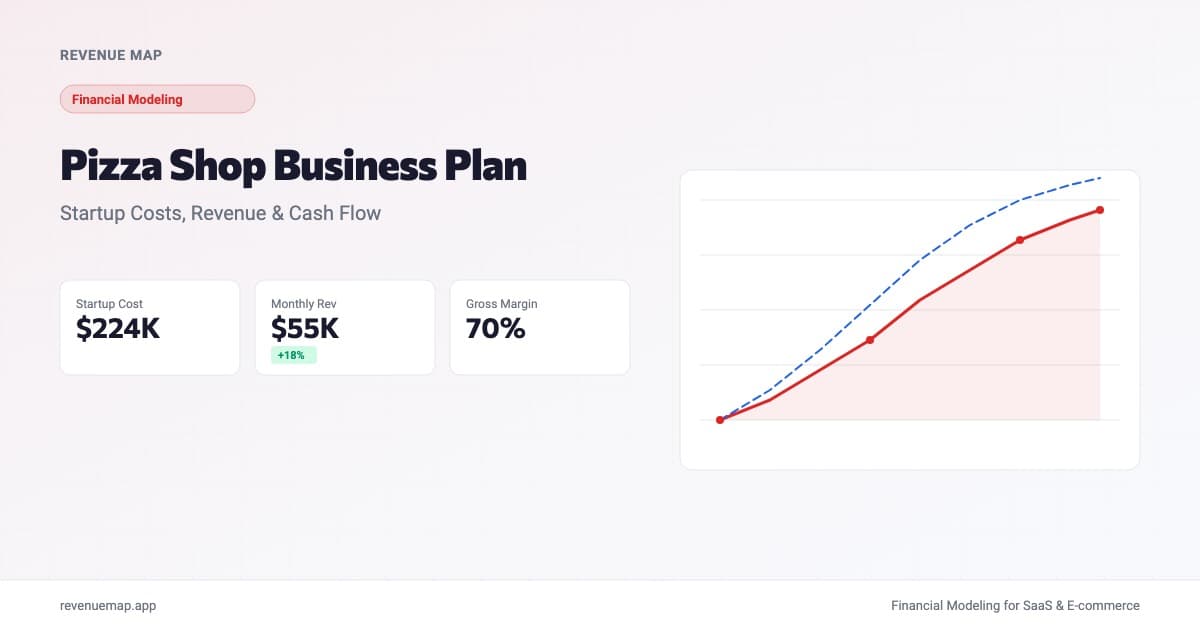
A pizza shop business plan needs a financial section that holds up to scrutiny, not a napkin sketch of how many pies you expect to sell. Lenders and landlords approve deals based on startup cost breakdowns, monthly cash flow projections, and proof that the shop can cover its debt. The concept gets you the meeting. The numbers close it.
Overhead is a big part of why those numbers matter more than most first-time owners expect. A recent Small Business Trends report on service business overhead found that fixed costs like insurance, utilities, and delivery logistics consistently surprise operators who plan around food cost alone. At the same time, Visa's latest consumer spending data shows that "couch economy" spending on delivery and takeout keeps growing, which reshapes how pizza shop revenue projections should look in 2026.
Here is how to build the financial section of your plan with numbers a lender can verify.
How Much Does It Cost to Open a Pizza Shop?
Startup costs for a pizza shop depend heavily on whether you are building a delivery-focused operation or a dine-in pizzeria with a brick oven and a liquor license. A takeout-and-delivery shop in a strip mall costs significantly less than a full-service restaurant.
Here is a realistic breakdown across three concept types:
| Category | Takeout/Delivery | Casual Dine-In | Full-Service Pizzeria |
|---|---|---|---|
| Leasehold improvements | $15,000 | $50,000 | $120,000 |
| Kitchen equipment (ovens, prep) | $25,000 | $55,000 | $95,000 |
| Furniture, fixtures, signage | $5,000 | $20,000 | $50,000 |
| POS system and technology | $3,000 | $6,000 | $12,000 |
| Permits and licenses | $3,000 | $8,000 | $20,000 |
| Initial inventory (food, packaging) | $4,000 | $8,000 | $15,000 |
| Insurance (first year) | $4,000 | $7,000 | $12,000 |
| Marketing and launch | $4,000 | $10,000 | $18,000 |
| Delivery setup (bags, app fees, signage) | $3,000 | $5,000 | $8,000 |
| Working capital (3-6 months) | $30,000 | $55,000 | $100,000 |
| Total | $96,000 | $224,000 | $450,000 |
The working capital line is where most pizza shop plans fall short. The first three to six months will include slow weeks, equipment repairs, and staffing costs that exceed projections. A plan that allocates every dollar to buildout and leaves nothing for operating cash is the exact profile that leads to default before the first lease renewal.
The startup cost calculator adjusts these figures by concept type and location. If you are financing the launch with a bank or SBA loan, the working capital line is what keeps you solvent while revenue ramps.
How to Project Pizza Shop Revenue
Revenue projections for a pizza shop should be bottom-up and defensible. The core formula:
Monthly Revenue = Daily Orders × Average Ticket × Operating Days per Month
The inputs vary by format. A delivery-heavy shop generates more orders at a lower average ticket. A dine-in pizzeria serves fewer customers at a higher check. Here are benchmarks by concept:
| Pizza Shop Type | Avg Ticket | Daily Orders | Days/Month | Monthly Revenue |
|---|---|---|---|---|
| Takeout and delivery | $22 | 80 | 30 | $52,800 |
| Casual dine-in | $30 | 70 | 26 | $54,600 |
| Full-service pizzeria (with bar) | $38 | 85 | 26 | $84,084 |
| Slice shop (counter service) | $12 | 140 | 30 | $50,400 |
The "couch economy" trend matters here. Delivery and takeout now account for a growing share of pizza revenue, so your model should not assume all customers walk through the door. For a shop doing 40% to 60% of revenue through delivery apps, factor in the 15% to 30% commission those platforms charge. Model it as a separate cost line, not a general assumption.
For your first year, assume 50% to 60% of the daily orders above in months one through three, ramping to 80% by month five, and reaching stabilized volume by month eight. Lenders discount plans that show full capacity on opening day. The financial projections template guide walks through building these ramp assumptions.
Calculate Your Pizza Shop Revenue
Pizza Shop Revenue Calculator
Estimate your monthly and annual pizza shop revenue
Pizza Shop Margins and Cost Benchmarks
Pizza has some of the best food margins in the restaurant industry. Dough, sauce, and cheese cost $2 to $4 per pie, while the average pie sells for $14 to $22. That translates to food cost percentages well below the full-service restaurant average.
| Cost Category | % of Revenue | Notes |
|---|---|---|
| Food cost (COGS) | 25-35% | Lower for cheese pizza, higher for specialty toppings |
| Labor | 25-30% | Includes drivers for delivery shops |
| Rent and occupancy | 6-10% | Strip mall locations on the low end |
| Delivery commissions | 4-10% | Zero if self-delivery only, 15-30% on third-party orders |
| Other overhead | 5-8% | Insurance, utilities, supplies, marketing, repairs |
| Net profit | 7-12% | After all expenses including loan payments |
The gap between pizza's strong gross margin and the final net margin comes almost entirely from labor and overhead. That Small Business Trends report on overhead costs highlights a pattern we see in pizza shop projections: founders budget carefully for flour and mozzarella, then underestimate insurance, delivery logistics, and equipment maintenance by 20% or more.
Here's the thing: a 2% miss on food cost is manageable. A 20% miss on overhead, stacked across insurance, POS fees, packaging, and equipment repairs, adds up to thousands per month. Budget overhead line by line, not as a single estimate.
Beer and wine programs improve net margins. A shop doing 15% to 20% of revenue from beverages can push net margins toward the higher end because alcohol margins run 70% to 80%.
12-Month Cash Flow for a New Pizza Shop
The cash flow forecast is what determines whether your plan gets funded. Here is a projection for a casual dine-in pizza shop with $224,000 in startup costs, a $170,000 SBA loan, and $54,000 in owner equity:
| Month | Revenue | COGS (30%) | Labor (28%) | Other OpEx | Loan Payment | Net Cash Flow | Cumulative Cash |
|---|---|---|---|---|---|---|---|
| 1 | $27,300 | $8,190 | $7,644 | $8,500 | $1,975 | $991 | $45,991 |
| 2 | $32,760 | $9,828 | $9,173 | $8,500 | $1,975 | $3,284 | $49,275 |
| 3 | $38,220 | $11,466 | $10,702 | $8,700 | $1,975 | $5,377 | $54,652 |
| 6 | $49,140 | $14,742 | $13,759 | $9,000 | $1,975 | $9,664 | $83,357 |
| 9 | $54,600 | $16,380 | $15,288 | $9,200 | $1,975 | $11,757 | $118,628 |
| 12 | $54,600 | $16,380 | $15,288 | $9,400 | $1,975 | $11,557 | $153,499 |
Other operating expenses include rent ($3,500 to $5,000), utilities, insurance, delivery costs, marketing, packaging, and equipment maintenance. The loan payment assumes a 10-year SBA 7(a) loan at 10.5% interest.
Cumulative cash stays positive throughout the year, which is the single most important signal for a lender. If your projection shows cumulative cash dipping below zero in any month, you need more working capital, a phased opening, or a lower-cost concept. Track your actual burn rate weekly against these projections to catch overruns early.
What Do Lenders Check in a Pizza Shop Business Plan?
If you are applying for an SBA loan or a conventional business loan, the financial section carries the decision. Our guide on writing a business plan for a business loan covers the general framework. Here is what pizza shop lenders focus on specifically:
-
Debt service coverage ratio (DSCR). Can the shop generate enough cash to cover loan payments with margin? Most lenders require 1.25x or higher. In the year-one example above, stabilized monthly operating income of roughly $13,500 against a $1,975 payment gives a DSCR above 6x. Even during the ramp-up, coverage clears the 1.25x threshold. Use the break-even calculator to test different scenarios.
-
Use of funds. Every dollar of the loan needs a specific destination. "Kitchen equipment" is not enough. Itemize: deck oven ($6,500), dough mixer ($3,200), prep tables ($2,400), walk-in cooler ($7,000). More detail means more credibility.
-
Owner equity. SBA loans typically require 10% to 20% owner equity. In the example above, $54,000 on a $224,000 project is 24%, which exceeds the minimum.
-
Comparable data. Anchor projections to benchmarks a loan officer can verify. Average ticket for your market, food cost percentages for pizza concepts, and local rent per square foot. Your numbers should be consistent with what a restaurant business plan in the same area shows, adjusted for the pizza format.
-
Delivery channel economics. This one is specific to pizza. A lender will ask how much of your revenue comes through third-party delivery apps and what that costs. If 40% of revenue runs through DoorDash at 25% commission, that is 10 percentage points of revenue going to platform fees. Model this explicitly. Shops that run their own delivery save on commissions but carry the cost of drivers and vehicles.
Common Mistakes in Pizza Shop Financial Plans
-
Ignoring delivery app commissions in the margin calculation. A $22 order through a third-party app at 25% commission nets $16.50 before food cost. That is a fundamentally different margin than a walk-in order. Model each channel separately.
-
Projecting full volume on day one. No pizza shop fills 80 orders per day in its first week. Ramp from 50% of target volume in month one to 80% by month five. Lenders reject plans that skip the ramp-up.
-
Underestimating overhead. Insurance, packaging, cleaning, POS software fees, equipment maintenance, and small supplies add up to 5% to 8% of revenue. Budget these line by line, not as a lump sum.
-
Skipping working capital. Three to six months of operating expenses, held in reserve. This is the buffer that keeps you open through slow weeks and surprise repairs. Without it, a single oven breakdown in month two can cascade into a cash crisis.
Key Takeaways
- Pizza shop startup costs range from $95,000 for a takeout-and-delivery concept to $450,000 for a full-service pizzeria with a bar. Always include 3 to 6 months of working capital.
- Build revenue projections from daily orders times average ticket times operating days. A casual dine-in pizza shop doing 70 orders at $30 average generates roughly $54,600 per month at full capacity.
- Gross margins of 65% to 75% are strong, but net margins of 7% to 12% require careful overhead management. Budget delivery commissions, insurance, and equipment maintenance as separate line items.
- Your 12-month cash flow forecast should show cumulative cash that never goes negative after funding. This is the most scrutinized section in any loan application.
- Lenders want a DSCR of 1.25x or higher. Delivery channel economics, including platform commissions, are now a standard question in pizza shop loan reviews.
Ready to build the financial model behind your pizza shop business plan? Start with Revenue Map, select your concept type, and get a three-year projection you can hand to a lender. Free, two minutes.
Related Articles
Ice Cream Truck Business Plan: Costs and Numbers
Build the financial section of your ice cream truck business plan with real startup costs, seasonal revenue projections, and the cash flow lenders need.
Self Storage Business Plan: Costs and Projections
Build the financial section of your self storage business plan with real startup costs, revenue projections, and the numbers lenders require.
Nail Salon Business Plan: Costs and Projections
Build the financial section of your nail salon business plan with real startup costs, revenue projections, and cash flow forecasts lenders require.