Financial Model vs Budget: When You Need Each
A financial model is a dynamic tool that projects revenue, costs, and cash flow across multiple scenarios over 3 to 5 years. A budget is a fixed spending plan that allocates money across departments for a single year. Startups need both: the model to explore what could happen, and the budget to control what actually gets spent.
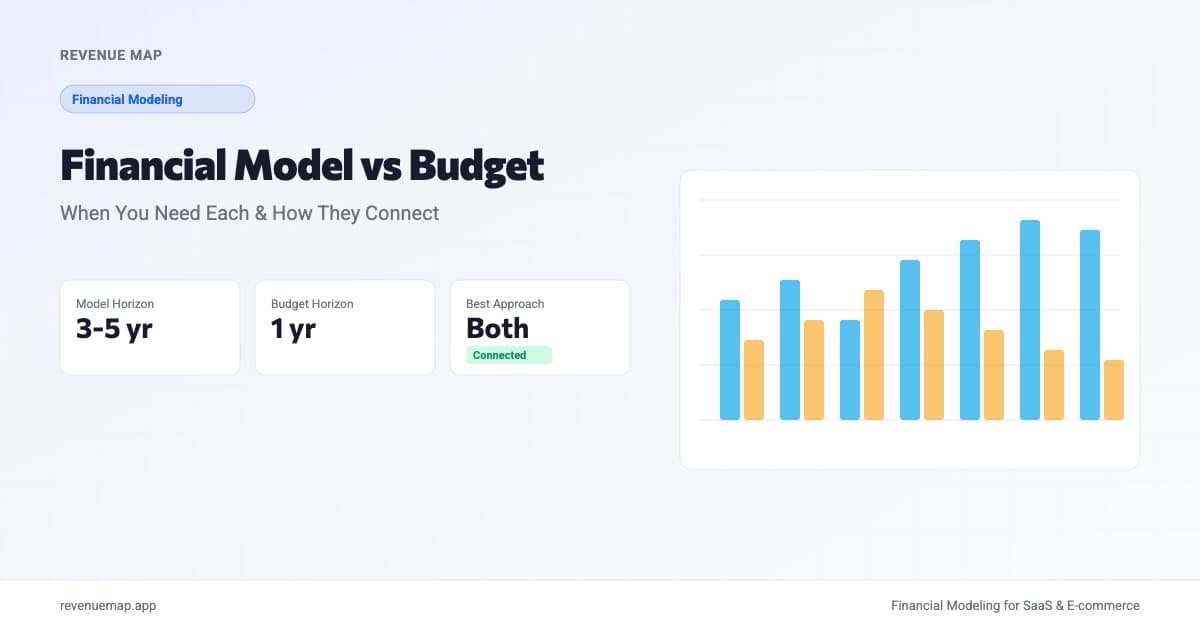
A financial model projects what could happen to your business over the next 3 to 5 years across multiple scenarios. A budget tells your team exactly how much they can spend this year. Founders often treat these as the same document, but they solve fundamentally different problems: the model explores possibilities, the budget enforces discipline.
This distinction matters more when your startup reaches the point where pricing decisions ripple through both documents differently. SaaStr's Jason Lemkin recently argued that founders should double their pricing on the next big deal when going upmarket. That kind of decision shows up in a financial model as a changed assumption (ARPU doubles, sales cycle extends, close rate drops). In a budget, it shows up as a line item: more expensive sales reps, longer ramp time, bigger commission checks. If you only maintain one of these documents, you either miss the strategic picture or lose control of cash.
What Is a Financial Model?
A financial model is a dynamic projection of revenue, costs, and cash flow built on a set of interconnected assumptions. Change one input and every downstream number recalculates. That is the defining feature: it responds to "what if" questions.
For startups, a model typically covers 3 to 5 years and includes a revenue layer (new customers, expansion, churn), a cost layer (headcount, infrastructure, marketing spend), and a cash flow layer that produces runway and burn rate projections. The best models include multiple scenarios: base, optimistic, and pessimistic.
If you have not built one yet, the financial model template guide walks through every section.
What Is a Budget?
A budget is a fixed spending plan that allocates a defined pool of money across departments, teams, or line items for a specific period, usually one fiscal year broken into months or quarters.
Where a financial model asks "what could revenue look like if we grow 15% month over month?", a budget asks "given that we expect $600K in revenue this year, how do we split $480K of operating expenses across engineering, sales, marketing, and G&A?"
The core elements of a startup budget include:
- Revenue assumptions (pulled from the model, then frozen for the year)
- Headcount plan (roles, start dates, fully loaded cost per hire)
- Non-headcount operating costs (tools, infrastructure, rent, legal)
- Capital expenditures (hardware, equipment, office buildout)
- Contingency buffer (typically 5-15% of total spend)
Our startup budget guide covers how to build one from scratch with benchmarks by stage.
How Do They Differ?
Here's the thing: many founders build a single spreadsheet and call it both their model and their budget. That works until you need to answer different questions with the same document and find it cannot serve both purposes.
| Dimension | Financial Model | Budget |
|---|---|---|
| Time horizon | 3-5 years | 1 year (monthly detail) |
| Purpose | Explore scenarios, plan strategy | Allocate and control spending |
| Flexibility | Dynamic: change inputs, outputs recalculate | Fixed: set at period start, tracked against |
| Audience | Founders, investors, board | Department leads, finance team |
| Update cadence | When assumptions change | Monthly (actuals vs plan) |
| Level of detail | Category-level costs | Line-item, per-department |
| Key output | Revenue trajectory, runway, valuation | Variance reports, spend pacing |
| Scenarios | Base, optimistic, pessimistic | Single plan (with contingency) |
The simplest way to think about it: a model tells you whether a strategy is viable. A budget tells you whether you can afford to execute it this year.
When Does Each One Matter Most?
Use a financial model when:
- Raising capital (investors expect 3-5 year projections with multiple scenarios)
- Evaluating strategic decisions (new pricing, new market, new product line)
- Running scenario analysis on churn rate or gross margin changes
- Answering board questions about long-term trajectory
Use a budget when:
- Hiring: determining whether you can afford a new role in Q3
- Setting department spending limits for the quarter
- Tracking actual spend against plan (variance analysis)
- Preparing for a board meeting where operational efficiency is on the agenda
Most seed-stage startups can operate with just a financial model and a simple cost layer. Once you pass 10 employees and have real revenue, you need a separate budget. By Series A, both documents should exist and talk to each other.
How to Connect Your Model and Budget
The biggest mistake founders make is building these in complete isolation. The model says "we'll hit $2M ARR by Q4" while the budget allocates $40K per month to marketing, and nobody checks whether those two numbers are consistent.
Here's how to connect them:
Step 1: Let the Model Set the Targets
Your financial model produces revenue projections, burn rate estimates, and runway calculations. These outputs become the inputs to your budget. If the model says you need 200 new customers this year at a CAC of $800, then your marketing budget should be at least $160K, plus the sales headcount to close those deals.
Step 2: Let the Budget Constrain the Model
This works in reverse, too. If your board approved a $1.2M annual budget, your model's assumptions need to reflect what is achievable within that spending envelope. A model that projects 3x growth while the budget only funds 2x growth is lying to someone.
Step 3: Reconcile Monthly
Each month, compare actual revenue and spend against both documents. Update the budget's remaining allocations based on where actuals landed. If actuals deviate significantly from what the model predicted, that's a signal to revisit your model assumptions, not just adjust the budget.
Calculate Your Monthly Burn Rate
Burn Rate Calculator
Calculate monthly net burn and remaining runway
This calculator gives you the burn rate and runway that should appear in both your financial model (as a computed output) and your budget (as a spending constraint). If the model shows 18 months of runway but the budget is pacing toward 12, something needs to change.
Common Mistakes
-
Treating the model as a budget. A model that says you'll spend $50K on marketing in Month 6 is a projection, not permission. Without a budget process, that number becomes a self-fulfilling prophecy whether it's still the right allocation or not.
-
Budgeting without a model. Setting department budgets based on "last year plus 20%" ignores what your strategy actually requires. The model tells you where incremental dollars create the most value. One risk to watch: teams that budget in isolation tend to build empires rather than outcomes.
-
Never updating the model. Some founders build a model for their seed raise and never touch it again. Your assumptions at $10K MRR are wrong by the time you hit $100K. Update the model whenever you have new data, like the real churn rate you've observed over 6 months rather than the benchmark you assumed at launch.
-
Annual budgets with no monthly checkpoints. An annual budget that only gets reviewed in December is a planning exercise, not a management tool. Compare actuals to plan monthly and reallocate when needed.
How AI Changes the Equation
This comparison has a practical update in 2026. Rippling's engineering team recently tested 15 AI models on 2,100 real payroll agent runs and found that the cheapest model tied the most expensive one on task accuracy. That finding has direct budget implications: AI infrastructure costs are no longer proportional to performance.
For founders building AI-powered products, this data point matters in both documents. In the financial model, it changes your gross margin assumptions (cheaper inference means better margins at scale). In the budget, it changes your Q3 infrastructure line item today. The model captures the strategic shift; the budget captures the tactical spend.
If you are still figuring out how AI tools fit into your financial planning process, our guide on AI financial projections covers what works and what breaks.
Financial Model vs Budget vs Business Plan
This is the companion question to financial model vs business plan. All three serve different purposes:
| Document | Purpose | Updates |
|---|---|---|
| Business Plan | Narrative strategy for stakeholders | Annually or for fundraising |
| Financial Model | Dynamic, scenario-driven number projections | When assumptions change |
| Budget | Fixed spending allocation by department | Monthly (actuals vs plan) |
A business plan tells the story. A financial model runs the numbers. A budget controls the spending. Most investors expect to see a model and a plan. Most operators need a model and a budget. The overlap is the revenue and cost assumptions that flow through all three.
Key Takeaways
- A financial model explores what could happen; a budget controls what does happen. You need both once your startup has revenue and a team.
- The model feeds the budget. Revenue projections and growth assumptions from your model become the inputs your budget is built around.
- The budget constrains the model. If the board approves a fixed spending envelope, your model must reflect what's achievable within it.
- Reconcile monthly. Compare actuals against both documents. Budget variance tells you about execution. Model variance tells you about assumptions.
- Start with the model, add a budget after seed stage. Pre-revenue companies need scenarios more than spending controls.
A financial model that does not connect to a real spending plan is a theory. A budget that does not connect to a model is a spreadsheet without strategy. Build your financial model with Revenue Map and let the outputs drive a budget you can actually manage against.
Related Articles
Budget vs Forecast vs Projection for Startups
Budgets, forecasts, and projections serve different purposes. Learn when to use each and how they connect in your startup financial plan.
Startup Financial Model Template (2026 Guide)
Build a startup financial model from scratch with this step-by-step template. Covers revenue, costs, runway, and the metrics investors expect.
How to Create a Startup Budget in 2026
Step-by-step guide to building a startup budget with allocation frameworks, benchmarks, and a free calculator. Includes what VCs look for.