How to Create a Startup Budget in 2026
A startup budget is a spending plan that allocates your available capital across product development, marketing, hiring, and operations over a defined period. Build one by listing fixed and variable costs, setting monthly spending caps by category, and tracking budget versus actual spend each month.
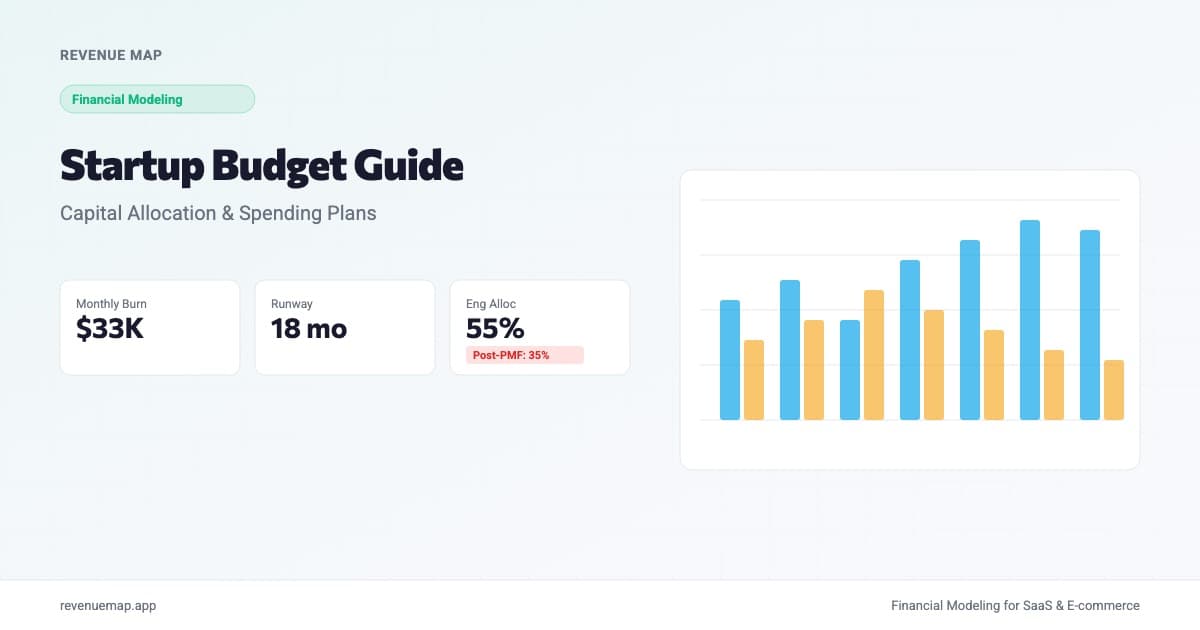
A startup budget is a month-by-month spending plan that allocates your available capital across product, marketing, hiring, and operations. It answers the question every founder eventually faces: you have a finite amount of money, so where should each dollar go to maximize your odds of survival and growth? Build one by mapping your fixed and variable costs into categories, setting monthly spending caps for each, and tracking actual spending against the plan.
Getting capital allocation right matters more now than it has in years. According to SaaStr's analysis of VC fund economics, the best investment in a venture fund needs to return the entire fund for the GP to hit a 3x return. That means the capital VCs deploy into your startup carries an implicit expectation of outsized performance. Founders who budget with discipline, allocating every dollar toward the activities that compound growth, are the ones who earn the next check. Founders who spray cash without a plan are the ones who get written off.
What Is a Startup Budget?
A startup budget is a structured spending plan that breaks your total available capital into monthly allocations across functional categories. It is not a list of what things cost (that is a startup cost estimate). It is a plan for how, when, and where to deploy capital over the next 12 to 24 months.
A useful startup budget has three layers:
- Category allocations: how much goes to engineering, marketing, sales, G&A, and contingency each month
- Line-item detail: specific expenses within each category (cloud hosting under engineering, ad spend under marketing, accounting software under G&A)
- Tracking and variance: a monthly comparison of budgeted versus actual spending, with a running total that feeds into your runway calculation
The budget connects strategy to operations. If you want to double ad spend in Q2, the budget shows exactly what you need to cut or raise to fund it.
How Is a Budget Different from Startup Costs?
Startup costs answer the question "how much money do I need to launch?" A budget answers "given the money I have, how should I spend it month by month to reach my goals?"
Here's the difference in practice:
| Startup Costs | Startup Budget | |
|---|---|---|
| Question it answers | "How much do I need?" | "How should I spend it?" |
| Time horizon | One-time estimate | Monthly, rolling 12 to 24 months |
| Structure | List of expenses | Category allocations with caps |
| Tracking | None (it is a snapshot) | Budget vs. actual each month |
| Audience | Founders planning a launch | Founders managing ongoing spend |
You need both. Costs come first: you estimate what it takes to launch and raise enough capital to cover it. Then the budget takes over as your ongoing spending plan. If you have estimated your startup costs but are still spending without a category-level budget, you are flying with a fuel gauge but no flight plan.
How to Create a Startup Budget: Step by Step
Step 1: Define Your Available Capital
Start with the total capital you have or expect to raise in the next 12 to 24 months. This includes:
- Cash in the bank
- Committed funding (signed term sheets, grants, revenue)
- Expected revenue (be conservative, use 60 to 70% of your forecast)
This total is your budget ceiling. Everything flows from it.
Step 2: Set Your Target Runway
Before allocating a single dollar, decide how many months of runway you need. The standard for venture-backed startups is 18 to 24 months of runway after each funding round. Bootstrapped companies should target 6 to 12 months minimum.
Maximum Monthly Burn = Available Capital / Target Runway (months)
If you have $600,000 in the bank and want 18 months of runway, your maximum monthly burn rate is $33,333. That is your spending ceiling. Every category allocation has to fit inside it.
Step 3: Allocate by Category
This is where the real decisions happen. The right allocation depends on your stage and business model. Here are benchmarks we have seen work across hundreds of startup financial models.
Pre-revenue / pre-product-market fit:
| Category | % of Monthly Budget | Example ($33K/mo) |
|---|---|---|
| Product & Engineering | 50 to 60% | $16,500 to $19,800 |
| Marketing & Sales | 10 to 15% | $3,300 to $4,950 |
| General & Admin | 15 to 20% | $4,950 to $6,600 |
| Contingency / Buffer | 10 to 15% | $3,300 to $4,950 |
Post-PMF / scaling:
| Category | % of Monthly Budget | Example ($80K/mo) |
|---|---|---|
| Product & Engineering | 30 to 40% | $24,000 to $32,000 |
| Marketing & Sales | 30 to 40% | $24,000 to $32,000 |
| General & Admin | 15 to 20% | $12,000 to $16,000 |
| Contingency / Buffer | 5 to 10% | $4,000 to $8,000 |
The biggest shift from pre-PMF to post-PMF is the marketing and sales allocation. Before you have product-market fit, pouring money into acquisition is waste. After you find it, marketing becomes the growth engine that investors are funding you to build.
Step 4: Break Categories into Line Items
Each category needs specific line items. Product & Engineering covers salaries, cloud infrastructure, dev tools, and design. Marketing & Sales includes paid acquisition, content, CRM tooling, and sales compensation. G&A covers legal, accounting, insurance, and corporate software. Contingency is your unallocated reserve for surprises.
Step 5: Track Budget vs. Actual
A budget without tracking is a wish list. Each month, compare actual spending per line item against plan. When a category runs 15% or more over budget for two consecutive months, either adjust the budget or cut back.
Calculate Your Monthly Budget
Startup Budget Calculator
Estimate your monthly budget ceiling from available capital and target runway
What VCs Look for in Your Budget
The SaaStr analysis of venture fund economics makes the investor perspective clear: a VC fund investing in 20 to 30 companies needs its top performer to return the entire fund. When a VC invests $2M in your startup, they are not hoping for a modest return. They need you to become a company worth hundreds of millions.
That changes how you should think about your budget. Investors evaluate three things:
1. Capital efficiency. How much revenue or growth do you generate per dollar burned? The best metric for this is the burn multiple: net burn divided by net new ARR. A burn multiple under 2x is strong. Over 3x raises questions about whether your spending is productive.
2. Allocation logic. Does your budget match your stated strategy? If you tell investors your moat is product quality but 45% of your budget goes to sales, the numbers contradict the narrative. Budget allocations should tell the same story as your pitch.
3. Runway to milestone. Investors want confidence that their money will last long enough for you to hit the milestone that triggers the next round. A budget showing 14 months of runway when the next milestone is 18 months away is an automatic red flag.
The honest answer: investors do not need your budget to be perfect. They need it to exist, be internally consistent, and show you think about capital allocation with the same rigor you bring to product.
Budget Allocation Benchmarks by Stage
| Metric | Pre-Seed to Seed | Series A | Series B+ |
|---|---|---|---|
| Eng / Product | 55 to 65% | 35 to 45% | 25 to 35% |
| Sales & Marketing | 10 to 15% | 25 to 35% | 35 to 45% |
| G&A | 15 to 20% | 15 to 20% | 15 to 20% |
| Buffer | 10 to 15% | 5 to 10% | 5% |
| Typical Monthly Burn | $15K to $40K | $80K to $200K | $300K to $1M+ |
| Target Runway | 18 to 24 mo | 18 to 24 mo | 18 to 24 mo |
Two patterns stand out. G&A stays flat across stages because legal, accounting, and ops tools do not scale linearly with revenue. If yours creeps above 25%, look for bloat. And target runway barely changes: whether you raised $500K or $50M, the standard is 18 to 24 months.
Common Budget Mistakes
-
No contingency buffer. Without 10 to 15% reserved, every unexpected cost shortens runway.
-
Flat-line forecasts. Real spending is lumpy. Hiring happens in spurts, marketing ramps before launches. Build in milestone-driven changes.
-
Confusing revenue with cash. Use net cash received, not top-line revenue, when calculating available capital. COGS, processing fees, and collection delays eat into what you can actually spend.
-
Skipping tracking. A budget you never compare to actuals is just a forecast. The monthly variance review is where the budget earns its value.
-
Budgeting for the best case. Build your budget against the base or pessimistic case from your startup financial projections. One bad month should not break the plan.
How to Adjust Your Budget Over Time
Update quarterly based on what you have learned. After PMF signals, shift budget from product to marketing. Cut channels that have not delivered measurable pipeline after 3 months, and reallocate to channels with proven CAC. Shrink your contingency buffer from 10 to 15% down to 5% as your cost structure stabilizes.
Most importantly: re-forecast runway after every update. If burn rate is climbing faster than revenue, you need to cut spend or accelerate fundraising. Do not wait until you have 4 months of cash to notice this. If you are still exploring what kind of business to build, browse startup ideas by industry to find models with proven unit economics before committing your budget.
Key Takeaways
- A startup budget is a spending plan, not a cost estimate. It allocates capital across categories and tracks actual versus planned spending.
- Set your maximum monthly burn by dividing available capital by target runway (18 to 24 months for most venture-backed startups).
- Pre-PMF startups should allocate 50 to 60% to product and 10 to 15% to marketing. Post-PMF, the ratio flips.
- Always include a 10 to 15% contingency buffer. It protects your runway from the surprises every startup encounters.
- Review monthly, update quarterly, and re-forecast runway after each adjustment.
A budget forces the tradeoffs that spreadsheets alone cannot reveal. It connects every spending decision to runway, growth, and the milestone your investors need you to hit. Start building your financial model with Revenue Map to turn your budget into a living plan you can stress-test in minutes.
Related Articles
Startup Burn Rate: How to Calculate, Benchmark, and Cut It
Learn how to calculate gross and net burn rate, compare to stage-specific benchmarks, and apply proven strategies to extend your startup's runway.
Budget vs Forecast vs Projection for Startups
Budgets, forecasts, and projections serve different purposes. Learn when to use each and how they connect in your startup financial plan.
Financial Model vs Budget: When You Need Each
A financial model projects scenarios over 3-5 years. A budget allocates spending for 12 months. Here is when to use each and how to connect them.