Home Bakery Business Plan: Start for Under $20K
A home bakery business plan should include startup costs of $8,000 to $22,000, a revenue projection built from weekly order volume and average ticket, and a cash flow forecast showing break-even by month three or four. Most cottage bakeries can launch without a commercial lease.
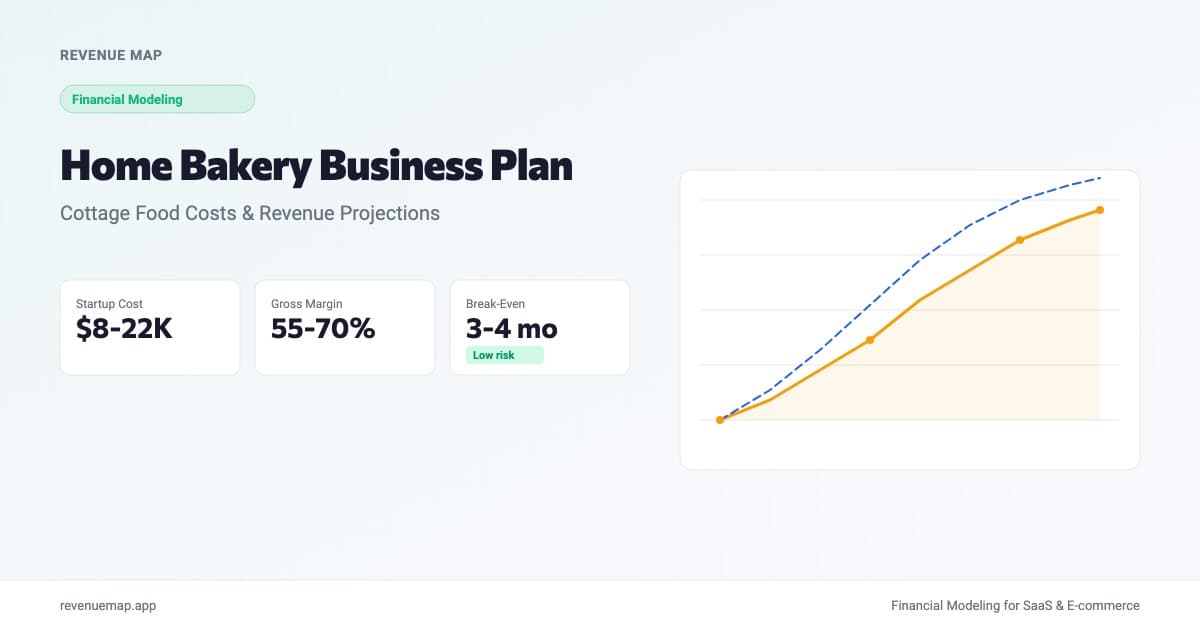
A home bakery business plan covers the financial side of launching a baking operation from your own kitchen, typically under cottage food laws that let you sell directly to customers without a commercial lease. Startup costs run $8,000 to $22,000, and most cottage bakeries reach monthly profitability within three to four months because overhead stays low. If you are putting together a cottage bakery business plan for a lender or simply to set pricing that actually works, the financial section is where the real decisions happen.
Inventory management is one of those decisions that trips up new home bakers more often than pricing does. Small Business Trends recently outlined the key components of inventory logistics, emphasizing how accurate forecasting and streamlined processes reduce waste and protect margins. For a home baking business, that means tracking ingredient shelf life, ordering in the right quantities for your weekly order volume, and not tying up cash in flour and butter that expires before you use it. The financials in your plan need to reflect those realities.
What Is a Home Bakery?
A home bakery is a food business operated from a residential kitchen under state cottage food laws. These laws allow you to produce and sell certain low-risk baked goods (cookies, breads, cakes, muffins, pastries) without obtaining a commercial food establishment license. The rules vary by state: some cap annual revenue at $25,000, others allow up to $75,000 or more. Some restrict sales to direct-to-consumer channels like farmers markets, online orders, and local delivery, while others permit wholesale to small retailers.
The financial model for a home bakery looks nothing like a commercial bakery business plan. You skip the $20,000 to $110,000 leasehold improvement line entirely. Equipment costs drop because you are upgrading a home kitchen, not outfitting a commercial one from scratch. And labor is usually just you, at least in the first year.
How Much Does a Home Bakery Cost to Start?
Home bakery startup costs range from about $8,000 to $22,000 depending on how much kitchen equipment you already own and how aggressively you invest in branding and packaging. Here is a realistic breakdown:
| Category | Low Estimate | Mid Estimate | High Estimate |
|---|---|---|---|
| Oven upgrade (convection or residential commercial) | $1,500 | $3,500 | $6,000 |
| Stand mixer and small equipment | $800 | $1,500 | $3,000 |
| Baking pans, tools, molds | $300 | $600 | $1,200 |
| Packaging and labels | $400 | $800 | $1,500 |
| Permits, licenses, insurance | $500 | $1,200 | $2,500 |
| Initial ingredient inventory | $500 | $1,000 | $2,000 |
| Website, logo, photography | $500 | $1,200 | $2,500 |
| Working capital (3 months) | $3,000 | $4,000 | $6,000 |
| Total | $7,500 | $13,800 | $24,700 |
The working capital line matters more than most new bakers expect. You need cash to cover ingredients for orders you have not been paid for yet, to absorb a slow week, and to handle the gap between placing supply orders and collecting payment. If you are working with a lender on an SBA microloan, the bakery startup costs breakdown covers both home and retail formats in deeper detail.
Use the startup cost calculator to adjust these ranges for your specific situation and market.
How to Project Home Bakery Revenue
Revenue for a home bakery is driven by weekly order volume and average order value. The core formula:
Monthly Revenue = Weekly Orders x Average Order Value x 4.3
Here is what the numbers look like across different home bakery formats:
| Format | Weekly Orders | Avg Order Value | Monthly Revenue |
|---|---|---|---|
| Cookies and bars (social media sales) | 12 | $30 | $1,548 |
| Custom cakes and cupcakes | 8 | $75 | $2,580 |
| Bread and pastry subscription | 20 | $25 | $2,150 |
| Mixed menu (cakes + everyday items) | 18 | $45 | $3,483 |
| Farmers market + online orders | 25 | $35 | $3,763 |
These are illustrative ranges based on common home bakery formats. Your actual numbers depend on your local market, product mix, and how actively you market through Instagram, Facebook, and word of mouth.
Here is the thing: most home bakers undercharge in the first few months. Ingredient costs typically run 30% to 40% of revenue, and your time is a real cost even if you are not paying yourself a salary yet. A home bakery business plan template that shows only ingredient costs and ignores labor will overstate your margins and mislead a lender. Factor in at least $15 to $20 per hour for your own production time when pricing custom orders.
What Are Home Bakery Profit Margins?
Home bakeries typically achieve gross margins of 55% to 70% on baked goods, which is higher than most retail bakeries because there is no rent and minimal labor cost beyond the owner's time. Net margins (after all costs including a reasonable owner salary) usually land between 20% and 35% for a well-run cottage operation.
Here is how the economics compare side by side:
| Metric | Home Bakery | Retail Bakery |
|---|---|---|
| Ingredient cost (% of revenue) | 30% to 40% | 28% to 35% |
| Rent and utilities | $0 to $200/mo | $2,000 to $6,000/mo |
| Labor (beyond owner) | $0 | $3,000 to $8,000/mo |
| Gross margin | 55% to 70% | 55% to 65% |
| Net margin (with owner salary) | 20% to 35% | 4% to 9% |
The trade-off is scale. A retail bakery with foot traffic can generate $15,000 to $30,000 per month in revenue. A home bakery operating under cottage food caps is typically limited to $25,000 to $75,000 per year depending on state law. If your plan calls for outgrowing cottage food limits within the first year, your financial projections should include the cost of transitioning to a commercial kitchen or shared commissary space, which typically adds $1,500 to $3,500 per month in rent and shared-use fees.
Calculate Your Break-Even Point
Home Bakery Break-Even Calculator
Find how many orders per month you need to cover your costs
Want to model this over 36 months with scenarios? Try Revenue Map free →
What Should Your Home Baking Business Plan Include?
If you are writing this plan for a lender (SBA microloan, community bank, or credit union), the financial section needs five components:
-
Startup cost breakdown. A line-by-line list matching the table above. Lenders want to see where the money goes and whether you have priced it realistically. Round numbers and missing categories are red flags.
-
12-month revenue projection. Show a ramp-up from month one (say 8 orders per week) to a steady state by month four or five. Build it from weekly orders times average ticket, not from a top-down market size guess.
-
Monthly cash flow forecast. Map when cash comes in and when it goes out. Home bakeries often collect payment at delivery or pickup, so your cash conversion cycle is short. But ingredient purchases and packaging orders create lumpy outflows that a monthly forecast needs to capture.
-
Break-even analysis. Show the order volume at which monthly revenue covers your fixed costs. For most home bakeries, this is 12 to 20 orders per month. Include sensitivity to a 10% to 15% pricing change so the lender sees you have thought about downside scenarios.
-
Growth path. Outline what happens when you hit your state's cottage food revenue cap. Will you transition to a shared commissary, apply for a commercial kitchen license, or open a retail space? Lenders want to know you have thought past the first year, even for a small loan.
If you are applying for an SBA loan specifically, the business plan for a business loan guide covers the full document structure, including the debt service coverage ratio and use-of-funds breakdown that loan officers scrutinize.
That said, not every home baker needs outside financing. Many cottage bakeries bootstrap with $8,000 to $12,000 in personal savings and grow organically. Even without a lender in the picture, building the projections forces you to set prices that cover your real costs instead of guessing.
Key Takeaways
- A home bakery can launch for $8,000 to $22,000 by operating under cottage food laws and skipping the commercial lease entirely.
- Revenue projections should be built from weekly order count and average ticket, not from a top-down market size estimate.
- Gross margins of 55% to 70% are achievable because overhead stays minimal, but price your own labor realistically or you will understate costs.
- Include a 12-month cash flow forecast and break-even analysis in your plan, especially if you need financing to scale.
- Plan for what happens when you outgrow cottage food limits, because lenders and partners want to see a growth path beyond year one.
Ready to put your home bakery numbers on paper? Build your projections with Revenue Map. It is free and takes about two minutes.
Related Articles

Bakery Business Plan: Startup Costs $20K-$324K (2026)
Plan your bakery with real startup costs ($20K-$324K), 55-65% gross margins, and 12-month cash flow projections. Includes every number lenders check.
Salon Suite Business Plan: Costs and Projections
Build the financial section of your salon suite business plan with startup costs, rental revenue projections, and the cash flow lenders check.
Hot Dog Cart Business Plan: Costs and Projections
Build the financial section of your hot dog cart or food cart business plan with startup costs, revenue projections, and the cash flow lenders check.