Hot Dog Cart Business Plan: Costs and Projections
A hot dog cart business plan should include startup costs of $3,000 to $20,000, daily revenue projections built from foot traffic and average ticket, and a 12-month cash flow forecast. Most lenders require a debt service coverage ratio of 1.25x or higher.
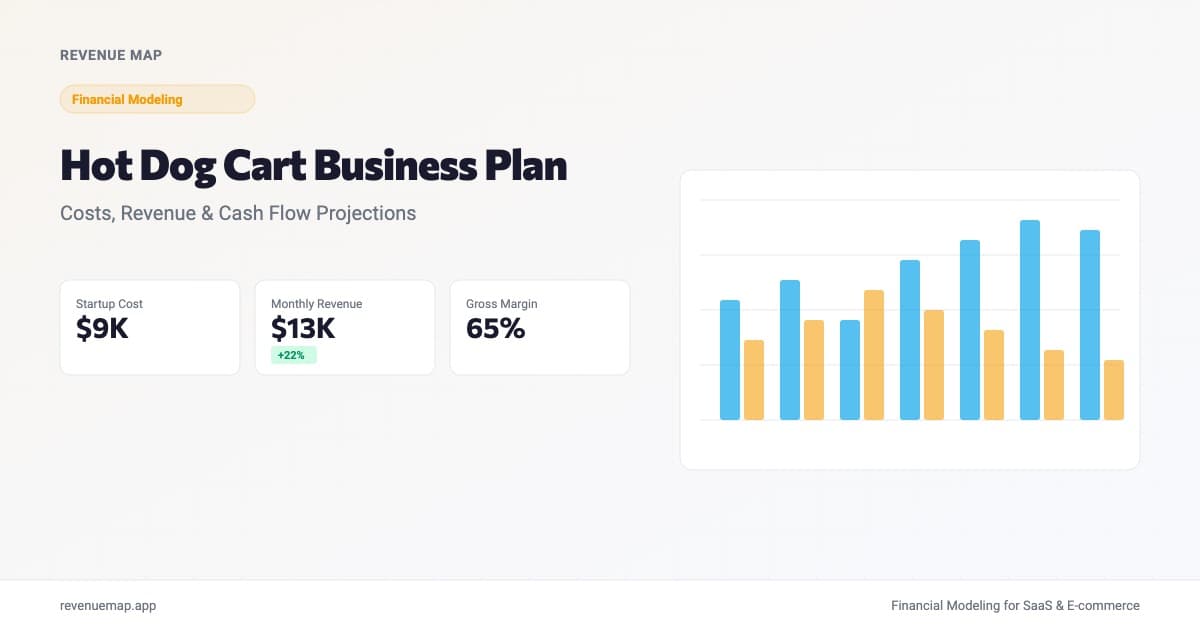
A hot dog cart business plan needs a financial section built on realistic daily customer counts, average ticket size, and a startup budget that accounts for permits, equipment, and working capital. Lenders evaluate food cart business plans the same way they evaluate any other small business loan application: they want to see that the numbers add up and that cash flow covers debt payments from month one. The difference is that the entry cost is so low (often under $10,000) that the math can work even for first-time operators with limited capital.
That low barrier stands in sharp contrast to the headlines dominating the restaurant industry right now. Starbucks is reportedly working with advisors on a proposal to acquire Chipotle, a deal that would be the largest acquisition in restaurant history according to the Financial Times. While billion-dollar chains consolidate at the top, the most accessible entry point into food service remains a cart, a permit, and a cooler full of inventory.
Here is how to build the financial section of your hot dog cart business plan with the numbers banks and SBA lenders expect to see.
How Much Does It Cost to Start a Hot Dog Cart?
Hot dog cart startup costs range from about $3,000 for a bare-bones used setup to $20,000 for a new full-sized cart with all the extras. Most first-time operators land in the $6,000 to $12,000 range, making this one of the cheapest food businesses to launch.
Here is a realistic breakdown:
| Category | Low Estimate | Mid Estimate | High Estimate |
|---|---|---|---|
| Cart (used vs. new) | $1,200 | $3,500 | $8,000 |
| Propane setup, tanks, and accessories | $150 | $400 | $800 |
| Umbrella, signage, and branding | $100 | $350 | $1,000 |
| Health department permits and licenses | $200 | $800 | $3,000 |
| Business license and sales tax permit | $50 | $200 | $500 |
| Liability insurance (first year) | $400 | $800 | $1,500 |
| Initial food and supply inventory | $200 | $500 | $1,200 |
| Commissary or shared kitchen access | $200 | $600 | $1,200 |
| Working capital (3 months) | $500 | $1,500 | $3,000 |
| Total | $3,000 | $8,650 | $20,200 |
The permit line is where costs vary the most. In many mid-sized cities a mobile food vendor permit runs $200 to $500 per year. In New York City, general vending permits are capped and auctioned, and secondary-market prices can exceed $15,000. Research your local requirements before budgeting.
Commissary access is a line item many new vendors overlook. Most health departments require that food cart operators prep, store, and dispose of waste at a licensed commercial kitchen. Monthly commissary fees typically run $200 to $400. If you already have access to a commercial kitchen (say, through a restaurant partnership or shared-use facility), this cost drops to near zero.
Compare these numbers to a food truck, which typically requires $50,000 to $200,000 to launch. A hot dog cart or food stand lets you test a market, build a customer base, and prove the concept before scaling up to a truck or brick-and-mortar location. Use the startup cost calculator to adjust these estimates for your specific market and setup.
How to Project Hot Dog Cart Revenue
Revenue for a hot dog stand business plan is driven by three variables: daily customer count, average ticket, and operating days per month. The core formula:
Monthly Revenue = Customers per Day x Avg Ticket x Days per Month
Customer count depends almost entirely on location. A cart on a busy downtown corner during lunch sees very different numbers than one working weekend festivals. Here is what the range looks like:
| Location Type | Customers/Day | Avg Ticket | Days/Month | Monthly Revenue |
|---|---|---|---|---|
| Low-traffic street corner | 40 | $5.00 | 22 | $4,400 |
| Busy downtown lunch spot | 100 | $6.00 | 22 | $13,200 |
| Events and festivals only | 200 | $7.00 | 8 | $11,200 |
| High-traffic tourist area | 150 | $6.50 | 26 | $25,350 |
The honest answer is that most cart operators who work a consistent daily spot earn between $8,000 and $18,000 per month in gross revenue. Event-focused operators can earn more per day but work fewer days, and their income is less predictable.
Average ticket matters more than you might think. A cart selling only plain hot dogs at $4 each has a very different business from one selling specialty dogs, loaded fries, and drinks at a $7 average ticket. Add-ons (cheese, chili, sauerkraut, bacon) and bundled combos are the simplest lever for increasing the ticket without adding complexity.
What Are the Margins on a Hot Dog Cart?
Hot dogs carry some of the best gross margins in the food business. A standard beef hot dog costs $0.50 to $1.00 wholesale. A bun adds $0.10 to $0.20. Condiments and toppings add another $0.15 to $0.30 per serving. That puts your total food cost at roughly $0.75 to $1.50 per unit, against a selling price of $4 to $7. Food cost percentage runs 20% to 35% depending on your menu and supplier pricing.
Here is a simplified monthly P&L for a cart averaging $12,000 per month in revenue:
| Line Item | Amount | % of Revenue |
|---|---|---|
| Gross revenue | $12,000 | 100% |
| Food costs (30%) | $3,600 | 30% |
| Commissary and storage | $400 | 3% |
| Propane and supplies | $250 | 2% |
| Permit and license amortization | $100 | 1% |
| Insurance (monthly) | $70 | 1% |
| Transportation (gas, parking) | $200 | 2% |
| Net before owner pay | $7,380 | 62% |
That 62% net margin is before the owner's salary, which for a solo operator is the same thing. A food vendor business plan for a lender should separate the owner's draw from net profit so the lender can see how much cash is available to service debt after the operator gets paid.
Calculate Your Monthly Revenue
Hot Dog Cart Revenue Calculator
Estimate your monthly gross revenue based on daily traffic and average ticket
Want to model this over 36 months with scenarios? Try Revenue Map free →
What Do Lenders Check in a Hot Dog Cart Loan Application?
Even for a small loan of $5,000 to $15,000, SBA and bank lenders evaluate the same core metrics. Your business plan for a business loan should include:
-
Use of funds. Itemize exactly where the loan goes. Lenders reject vague requests. "Cart: $4,000. Permits: $800. Working capital: $2,000" is the format they expect.
-
12-month cash flow forecast. Show monthly inflows and outflows. Hot dog carts have the advantage of near-immediate revenue (no build-out period), but lenders still want to see how you handle slow months. A cash flow projection that shows consistent positive cash flow after debt payments builds confidence.
-
Debt service coverage ratio (DSCR). Lenders want net operating income divided by total debt service to be at least 1.25x. For a $10,000 loan at 8% over 3 years, your monthly payment is about $313. If your net operating income after expenses (but before owner pay) is $5,000 per month, your DSCR is over 15x. That is the advantage of a low-cost business: even modest revenue produces strong coverage ratios.
-
Break-even analysis. With a $6 average ticket and $1.50 in variable costs per unit, your contribution margin is $4.50. If your fixed monthly costs (permits, insurance, commissary, transportation) total $1,020, you break even at 227 hot dogs per month, roughly 10 per operating day. That is a number most operators hit in week one.
Here is the thing: a hot dog cart loan is small enough that some lenders skip the formal business plan requirement entirely and approve based on personal credit and a simple application. But having projections ready separates you from applicants who are guessing. It also forces you to think through the numbers before you spend the money, which is the real value of the exercise.
Common Mistakes in Hot Dog Cart Financial Plans
-
Ignoring commissary costs. Health codes in most jurisdictions require a licensed commissary. Budgeting zero for this line item signals to a lender that you have not done your homework.
-
Overestimating daily traffic. New operators often project 200 customers per day from day one. Build your base case around 60 to 80 and model the upside as a separate scenario. Lenders trust conservative projections more than optimistic ones.
-
Skipping seasonality. In cold-weather markets, winter revenue can drop 40% to 60%. Your cash flow forecast should show this dip and demonstrate that you can still cover expenses. Some operators offset seasonality by switching to hot beverages, soup, or event-only schedules during colder months.
-
Forgetting to separate owner pay. A plan where all net income is labeled "profit" does not show the lender how the owner survives. Break out a monthly owner draw so the remaining cash flow clearly services the debt.
Key Takeaways
- Hot dog cart startup costs run $3,000 to $20,000, making this one of the cheapest food businesses to launch and one of the easiest to finance.
- Revenue depends on location and foot traffic. A busy downtown cart averaging 100 customers per day at $6 generates about $13,200 per month.
- Food cost percentages of 20% to 35% produce gross margins well above 60%, which is why break-even typically happens within the first few weeks.
- Even small-dollar SBA and bank loans require a cash flow forecast, a use-of-funds breakdown, and a DSCR above 1.25x.
- Start conservative: model 60 to 80 customers per day in your base case and show the upside scenario separately.
Ready to build the financial section of your plan? Run the numbers for your own cart, free, in about two minutes.
Related Articles
Salon Suite Business Plan: Costs and Projections
Build the financial section of your salon suite business plan with startup costs, rental revenue projections, and the cash flow lenders check.
Car Detailing Business Plan: Costs and Projections
Build the financial section of your car detailing business plan with real startup costs, revenue estimates, and break-even numbers lenders check.
Cake Shop Business Plan: Costs and Projections
Build the financial section of your cake shop business plan with real startup costs, custom cake pricing, and the cash flow projections lenders require.