Salon Suite Business Plan: Costs and Projections
A salon suite business plan should include buildout costs of $150,000 to $600,000 for a 10- to 20-suite location, monthly rental revenue based on suite count times occupancy rate times average rent, and a 12-month cash flow forecast. Most SBA lenders require a debt service coverage ratio of 1.25x or higher.
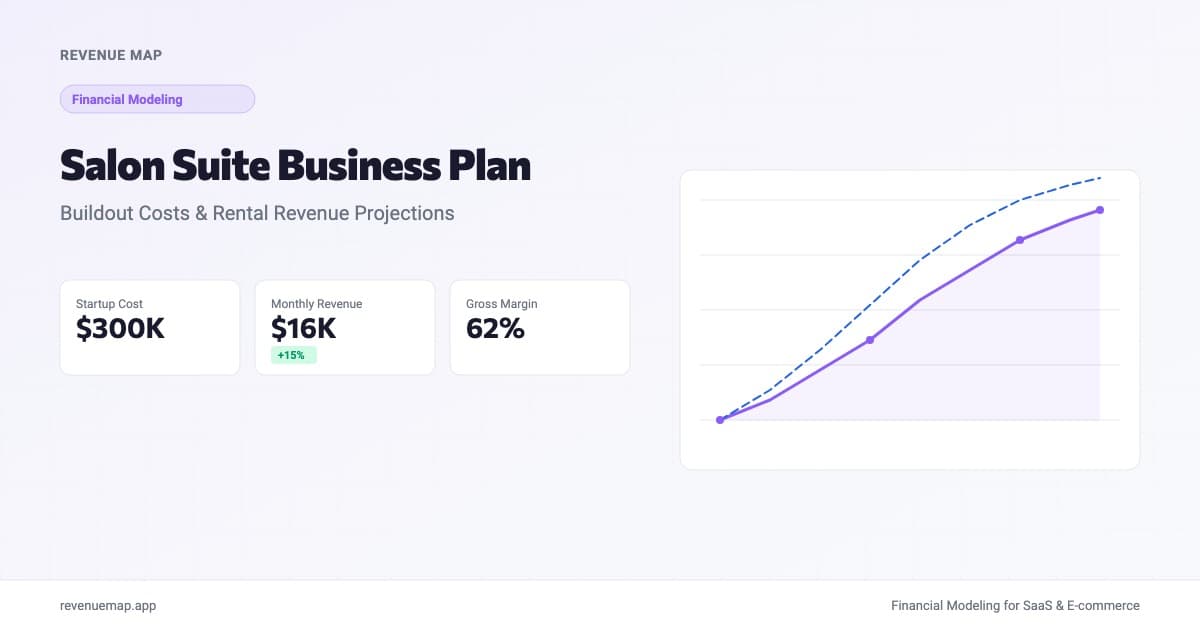
A salon suite business plan needs a financial section built on buildout costs, suite count, occupancy rates, and average monthly rent. Unlike a traditional salon business plan where revenue comes from services, the salon suite business model generates income from renting individual suites to independent beauty professionals who run their own client books. Lenders evaluate it more like a commercial real estate deal: they want to see that projected occupancy covers debt payments and operating expenses from month one.
The timing for this model keeps improving. The SBA just announced a $5 million investment in new centers to support aspiring entrepreneurs, expanding the infrastructure that helps first-time business owners access SBA loans, mentorship, and technical assistance. For salon suite operators, who typically need $250,000 to $400,000 for a buildout, that kind of support can make the difference between a fundable plan and a rejected application.
Here is how to build the financial section of your booth rental salon business plan with the numbers banks and SBA lenders expect to see.
What Is a Salon Suite Business?
A salon suite business is a facility where individual rooms (suites) are rented to licensed beauty professionals: hairstylists, estheticians, nail techs, massage therapists, and barbers. Each tenant operates as an independent business, sets their own prices, manages their own clients, and keeps 100% of their service revenue. The suite operator collects monthly rent.
Think of it as a WeWork for beauty professionals. The hair salon booth rental business plan is fundamentally a real estate play with beauty-industry tenants. Brands like Sola Salon Studios and Phenix Salon Suites have turned this into a franchise model, but independent operators can build a single location for significantly less than a franchise fee. The distinction matters for your projections: a traditional salon models service revenue, while a salon suite models rent. That changes every line.
How Much Does It Cost to Open a Salon Suite Business?
Salon suite startup costs range from about $150,000 for a basic 10-suite buildout in an existing retail space to $600,000 or more for a 20-suite premium location. Most independent salon suite operators land in the $250,000 to $400,000 range.
Here is a realistic breakdown for a 3,000-square-foot space with 15 individual suites:
| Category | Low Estimate | Mid Estimate | High Estimate |
|---|---|---|---|
| Lease deposit and first/last month rent | $8,000 | $18,000 | $35,000 |
| Buildout: framing, drywall, suite walls | $40,000 | $80,000 | $150,000 |
| Plumbing (sinks per suite, common shampoo area) | $15,000 | $35,000 | $70,000 |
| Electrical and lighting per suite | $10,000 | $25,000 | $50,000 |
| HVAC upgrades (individual climate control) | $8,000 | $20,000 | $40,000 |
| Flooring, paint, mirrors, and finishes | $12,000 | $25,000 | $50,000 |
| Common area (lobby, laundry, break room) | $5,000 | $15,000 | $30,000 |
| Security system, keyless entry per suite | $3,000 | $8,000 | $15,000 |
| Permits, licenses, and insurance (first year) | $4,000 | $10,000 | $20,000 |
| Marketing, signage, and website | $3,000 | $8,000 | $15,000 |
| Working capital (6 months of fixed costs) | $30,000 | $60,000 | $120,000 |
| Total | $138,000 | $304,000 | $595,000 |
Plumbing is typically the second-largest buildout expense. Each suite with a private shampoo sink adds $2,000 to $5,000. Some operators build a shared shampoo bar in the common area and reserve private sinks for premium suites. That trade-off lowers buildout costs but limits the rent you can charge for basic units.
Working capital matters more here than in many other small businesses. A new location can take six to nine months to reach 85% occupancy, and you are covering lease payments, utilities, insurance, and loan payments the entire time. Any plan that assumes full occupancy from day one will get flagged by lenders immediately. Compare this to the lease-up timeline for a self-storage business plan. Use the startup cost calculator to adjust these estimates for your market.
How to Project Salon Suite Revenue
Revenue for a salon suite business plan template is driven by three variables: suite count, average monthly rent per suite, and occupancy rate. The core formula:
Monthly Revenue = Suites × Avg Monthly Rent × Occupancy Rate
Suite rents vary by market, size, and amenities:
| Suite Type | Sq Ft | Monthly Rent | Includes |
|---|---|---|---|
| Basic (open station, shared sink) | 80-100 | $800-$1,000 | Chair, mirror, cabinet, shared shampoo |
| Standard (private room, shared sink) | 100-150 | $1,000-$1,400 | Lockable room, styling station, shared shampoo |
| Premium (private room, private sink) | 150-200 | $1,400-$1,800 | Private shampoo bowl, extra storage, larger mirror |
| Double/XL (two-chair suite) | 200-300 | $1,800-$2,500 | Two stations, private sink, retail shelving |
For a 15-suite location with a mix of types, $1,200 average monthly rent is a reasonable mid-market assumption. At 90% stabilized occupancy:
15 suites × $1,200 × 0.90 = $16,200/month ($194,400/year)
For year one, assume 30% occupancy in months one through three, ramping to 60% by month six, and reaching 85% to 90% by month nine to twelve. Locations near beauty schools or areas with a high concentration of independent stylists fill faster.
Some operators add ancillary revenue (laundry service, retail product sales, workshop space) that adds 5% to 10% on top of suite rental income, but these should not be the foundation of your projections.
Calculate Your Salon Suite Revenue
Salon Suite Revenue Calculator
Estimate your monthly and annual salon suite rental revenue
Want to model this over 36 months with scenarios? Try Revenue Map free →
Salon Suite Operating Expenses and Margins
Once suites are built and leased, operating costs are lean. Here are typical monthly expenses for a 15-suite location:
| Expense | Monthly Range | % of Revenue |
|---|---|---|
| Lease/rent (base + NNN) | $4,500-$8,000 | 28%-45% |
| Utilities (water, electric, gas, internet) | $1,200-$2,500 | 7%-15% |
| Insurance | $300-$600 | 2%-4% |
| Common area maintenance and cleaning | $500-$1,200 | 3%-7% |
| Marketing and advertising | $400-$1,000 | 2%-6% |
| Software (booking, keyless entry, CRM) | $200-$500 | 1%-3% |
| Repairs and maintenance reserve | $300-$600 | 2%-4% |
| Total operating expenses | $7,400-$14,400 | 45%-55% |
Gross margins for a stabilized salon suite business typically run 55% to 70% after operating expenses but before debt service, closer to the margins in self-storage or co-working than in traditional beauty.
The lease is the single largest fixed cost. Negotiate the longest possible free-rent period during buildout: three to six months is common for tenant improvement-heavy retail spaces. And here is a structural advantage worth noting: credit card processing fees are your tenants' problem, not yours. Each beauty professional handles their own payment processing, while your revenue comes from rent checks and ACH transfers.
Salon Suite vs. Traditional Salon: Financial Comparison
The choice between these two models changes every assumption in your plan. Here is a side-by-side comparison:
| Factor | Salon Suite | Traditional Salon |
|---|---|---|
| Revenue source | Rent from tenants | Service revenue from clients |
| Startup cost (mid-range) | $250,000-$400,000 | $100,000-$250,000 |
| Gross margin | 55%-70% | 40%-55% |
| Labor model | No employees (tenants are independent) | Stylists on commission or salary |
| Time to breakeven | 8-14 months | 2-6 months |
| Management intensity | Low (facility management) | High (staff, scheduling, inventory) |
Salon suites have higher startup costs and a longer path to breakeven, but once stabilized, they require less management and produce more predictable cash flow. For your business plan for a business loan, lenders will compare your model to these benchmarks. A salon suite plan showing 10-month breakeven with 85% stabilized occupancy is fundable. One claiming full occupancy in month three is not.
First-Year Cash Flow: What Lenders Check
The critical question in any salon suite business plan is how long the location bleeds cash before occupancy catches up. For a 15-suite location at $1,200 average rent with an SBA 7(a) loan of $300,000 at 7.5% over 10 years ($2,800/month debt service): months one through three run negative $5,000 to $8,000 with only three to six suites leased. Breakeven hits around month seven when 11 suites are filled. Cumulative cash flow turns positive near month 10.
Without six months of reserves, you risk running out of cash before the location fills. Lenders model this ramp, and they want reserves that cover the negative months with margin to spare. For a deeper look, see our guide to break-even analysis.
Common Mistakes in Salon Suite Business Plans
-
Assuming instant occupancy. The biggest financial risk in a salon suite is the lease-up period. Budget for six to nine months of sub-breakeven occupancy. Lenders who see a plan claiming 90% occupancy in month two will reject it.
-
Underestimating buildout costs. Plumbing and electrical work for individual suites adds up fast. Get three contractor bids before finalizing your startup budget. Costs can vary by 40% between contractors for the same scope.
-
Ignoring tenant turnover. Even a well-run location sees 15% to 25% annual turnover. Build a 10% vacancy buffer into stabilized projections, not just the ramp period.
-
Skipping the lease analysis. Triple-net (NNN) charges, annual escalators, and CAM fees can add 30% to 50% on top of base rent. Model the full lease cost, not just the base rate.
Key Takeaways
- A salon suite business plan is a real estate model, not a service model. Lenders evaluate it like a commercial lease-up.
- Mid-range startup costs run $250,000 to $400,000 for 15 suites, with the buildout consuming 60% to 70% of the budget.
- At $1,200 average rent and 85% to 90% occupancy, a 15-suite location generates roughly $15,300 to $16,200 per month.
- Breakeven takes 8 to 14 months. Budget at least six months of working capital to cover the gap.
Ready to build the financial section? Run the numbers for your own location, free, in about two minutes. Plug in your suite count, local rents, and buildout estimates to see projected cash flow before you sit down with a lender.
Related Articles
Hot Dog Cart Business Plan: Costs and Projections
Build the financial section of your hot dog cart or food cart business plan with startup costs, revenue projections, and the cash flow lenders check.
Car Detailing Business Plan: Costs and Projections
Build the financial section of your car detailing business plan with real startup costs, revenue estimates, and break-even numbers lenders check.
Cake Shop Business Plan: Costs and Projections
Build the financial section of your cake shop business plan with real startup costs, custom cake pricing, and the cash flow projections lenders require.