Nail Salon Business Plan: Costs and Projections
A nail salon business plan should include startup costs of $54,000 to $250,000, revenue projections based on stations times clients per day times average ticket, and a 12-month cash flow forecast. Most SBA lenders require a debt service coverage ratio of 1.25x or higher.
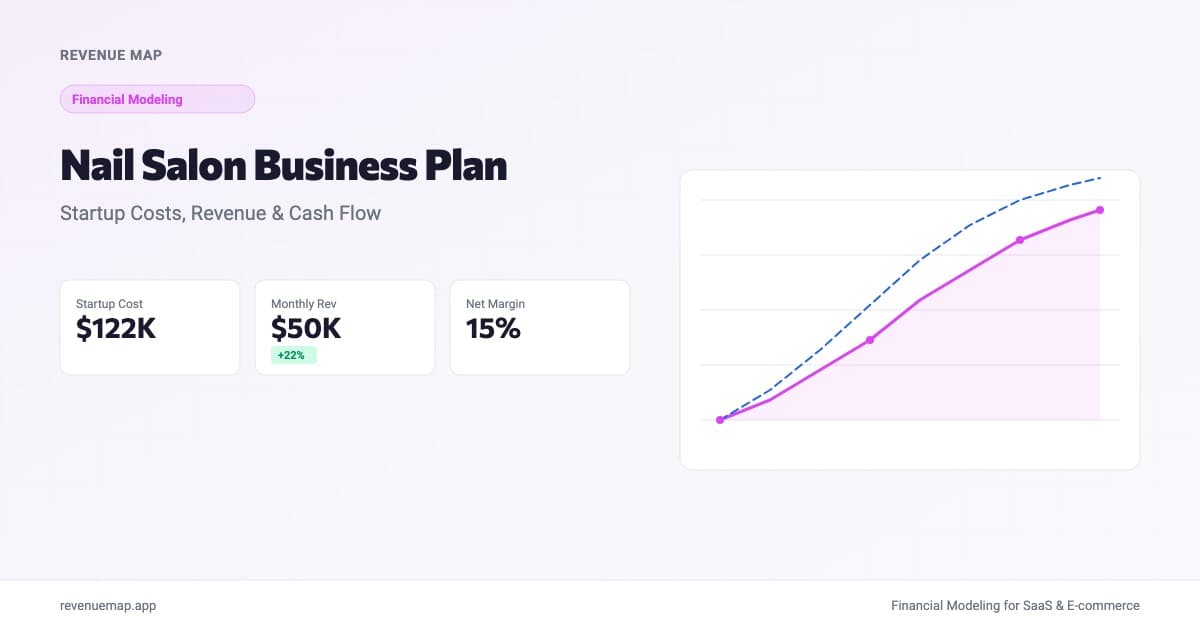
A nail salon business plan needs a financial section built on station count, service pricing, and a realistic ramp from opening day to full utilization. Lenders approve nail salon loans based on projected cash flow, a clear startup cost breakdown, and evidence the shop can cover its debt payments while building a walk-in base. The design concept and the service menu matter, but the numbers close the deal.
That financial discipline is getting more attention as delivery-first food ventures face a harder reality. Wonder just laid off more than 500 employees while consolidating production facilities into a single higher-capacity plant. Walk-in service businesses like nail salons succeed for the opposite reason: the value is physical, personal, and impossible to outsource to an app. But the same unit-economics rigor that matters in venture-backed food tech matters here too, just applied to stations instead of kitchens.
Here is how to build the financial section of your nail salon business plan with the numbers banks and SBA lenders expect.
How Much Does It Cost to Open a Nail Salon?
Startup costs for a nail salon range from about $54,000 for a basic six-station shop to $250,000 for a high-end location with spa pedicure thrones, a custom buildout, and premium ventilation. Most independent nail salons land in the $100,000 to $175,000 range.
Here is a realistic breakdown for a 900-square-foot nail salon with eight stations (six manicure tables, two spa pedicure chairs):
| Category | Low Estimate | Mid Estimate | High Estimate |
|---|---|---|---|
| Leasehold improvements and buildout | $10,000 | $30,000 | $70,000 |
| Manicure stations (tables, chairs, LED lamps) | $5,000 | $10,000 | $20,000 |
| Spa pedicure chairs (pipeless recommended) | $4,000 | $12,000 | $28,000 |
| Ventilation and air filtration | $3,000 | $8,000 | $18,000 |
| Tools, UV/LED curing lamps, sterilization | $2,000 | $5,000 | $10,000 |
| Initial product inventory (gel, acrylic, polish, supplies) | $3,000 | $6,000 | $12,000 |
| POS system and booking software | $1,500 | $3,000 | $6,000 |
| Permits, licenses, cosmetology compliance | $1,500 | $3,500 | $8,000 |
| Insurance (first year) | $2,000 | $4,000 | $8,000 |
| Marketing, signage, website | $2,000 | $5,000 | $12,000 |
| Working capital (6 months) | $20,000 | $35,000 | $58,000 |
| Total | $54,000 | $121,500 | $250,000 |
Ventilation deserves its own line because it is non-negotiable. Acrylic monomer, gel solvents, and acetone create fumes that state cosmetology boards regulate strictly. A basic exhaust system with source-capture vents at each station runs $3,000 to $8,000. A full HVAC-integrated filtration system for a larger shop can exceed $15,000. Skipping this line or underbudgeting it is the fastest way to fail a health inspection before you open the doors.
Working capital matters just as much. The math is similar to opening a hair salon or coffee shop: a new location can take three to five months to build consistent walk-in traffic, and technicians still need to earn enough during that ramp to stay. Use the startup cost calculator to adjust these numbers for your market.
How to Project Nail Salon Revenue
Revenue for a nail salon is driven by the number of active stations, clients per station per day, and average service ticket. The core formula:
Monthly Revenue = Stations x Clients per Station per Day x Avg Ticket x Days Open
Here is what benchmarks look like across different nail salon formats:
| Format | Stations | Clients/Station/Day | Avg Ticket | Days/Month | Monthly Revenue |
|---|---|---|---|---|---|
| Small manicure-only shop | 4 | 5 | $35 | 26 | $18,200 |
| Standard nail salon (mani + pedi) | 8 | 5 | $48 | 26 | $49,920 |
| Full-service nail spa | 10 | 4 | $65 | 26 | $67,600 |
| Express nail bar (high-traffic mall) | 6 | 8 | $30 | 30 | $43,200 |
The standard eight-station format is the sweet spot for most independent owners. At five clients per station per day and a $48 average ticket, it produces about $49,920 in monthly revenue at full utilization. Add-on services (gel extensions, dip powder, nail art, paraffin treatments) are the primary lever for pushing average ticket higher without adding station time.
For year one, assume 40% utilization in months one and two, ramping to 55% by month three, 75% by month six, and 80% by month nine. Even a mature nail salon runs at 75% to 85% capacity because no-shows, gaps between walk-ins, and slower weekday mornings are unavoidable. Any plan showing 100% utilization from day one will get flagged by a lender immediately. Our financial projections template guide covers the framework for building these ramp curves.
Calculate Your Nail Salon Revenue
Nail Salon Revenue Calculator
Estimate your monthly and annual nail salon revenue
Nail Salon Margins and Cost Benchmarks
Nail salons carry a different cost structure than hair salons. Product costs are higher per service because gel, acrylic, and specialty polish are consumed with every client. But the average service time is shorter (30 to 60 minutes versus 60 to 120 for hair), which means higher throughput per station. That tradeoff is what makes the model work.
| Category | % of Revenue | Monthly (at $50K rev) |
|---|---|---|
| Product and supply costs | 12-15% | $6,000-$7,500 |
| Technician compensation (hourly or commission) | 40-50% | $20,000-$25,000 |
| Rent and occupancy | 8-12% | $4,000-$6,000 |
| Other operating expenses | 5-8% | $2,500-$4,000 |
| Net profit (before owner draw) | 10-18% | $5,000-$9,000 |
Here's the thing about that technician compensation line: it determines your entire operating model. Most nail salons pay technicians hourly ($12 to $20 per hour depending on the market) plus a commission on services above a daily threshold, or a flat commission of 40% to 50%. The hourly-plus-commission model is more common in nail salons than in hair salons because service prices are lower and appointment times are shorter. A technician doing five mani-pedis at $48 each generates $240 per day. At 45% commission, that is $108, roughly $13.50 per hour on an eight-hour shift.
Product costs per service typically run $3 to $8 for a standard manicure and $5 to $12 for gel or acrylic sets. That is higher as a percentage of the ticket than in a hair salon, where consumables per client cost $3 to $5. The offset is speed: a skilled nail technician completes a gel manicure in 35 to 45 minutes, while a hair color service takes 90 minutes or more. Track your gross margin by service type weekly, not just at the salon level.
12-Month Cash Flow for a New Nail Salon
The cash flow forecast is what gets the loan funded. Here is a simplified 12-month projection for an eight-station nail salon with $120,000 in startup costs, an $85,000 SBA loan, and $35,000 in owner equity. Working capital reserve after buildout: $35,000.
| Month | Revenue | Products (13%) | Labor (45%) | Other OpEx | Loan Payment | Net Cash Flow | Cumulative Cash |
|---|---|---|---|---|---|---|---|
| 1 | $19,968 | $2,596 | $8,986 | $5,800 | $1,150 | $1,436 | $36,436 |
| 2 | $22,464 | $2,920 | $10,109 | $5,800 | $1,150 | $2,485 | $38,921 |
| 3 | $27,456 | $3,569 | $12,355 | $5,900 | $1,150 | $4,482 | $43,403 |
| 6 | $37,440 | $4,867 | $16,848 | $6,100 | $1,150 | $8,475 | $62,835 |
| 9 | $39,936 | $5,192 | $17,971 | $6,200 | $1,150 | $9,423 | $91,516 |
| 12 | $39,936 | $5,192 | $17,971 | $6,300 | $1,150 | $9,323 | $121,085 |
Other operating expenses include rent, utilities, insurance, booking software, marketing, and cleaning supplies. The loan payment assumes a 10-year SBA 7(a) loan at 10.5% interest. Net cash flow is before any owner draw.
Notice that month one is already positive. Walk-in nail salons generate revenue faster than appointment-only businesses because the decision to get a manicure is often spontaneous, especially in high-foot-traffic locations. Compare that to a bakery or restaurant where building a regular customer base requires repeated visits over weeks. That faster ramp is one reason lenders view nail salons favorably, but your projections still need to show the conservative path from 40% to stabilized utilization.
Track your actual burn rate against this plan weekly. The gap between projected and actual costs shows up first in product usage and technician scheduling.
What Do Lenders Check in a Nail Salon Business Plan?
The financial section carries the lending decision. Our full guide on writing a business plan for a business loan covers the broader framework. Here are the items nail salon lenders focus on:
-
Debt service coverage ratio (DSCR). Can the salon generate enough cash to cover loan payments with room to spare? Most lenders require 1.25x or higher. In the year-one example above, stabilized net cash flow of roughly $9,400 per month against a $1,150 payment gives a DSCR of 8.2x before owner draw. After a $4,000 monthly owner draw, the remaining $5,400 still produces a DSCR of 4.7x.
-
Use of funds. Every dollar needs a specific destination. Not "equipment" but "Continuum Maestro pedicure chairs, 2 at $4,500 each ($9,000), custom manicure stations, 6 at $1,200 each ($7,200)." Specificity signals preparation.
-
Ventilation compliance. Lenders reviewing a nail salon plan will look for the ventilation line item specifically. A plan that omits it or buries $500 in "miscellaneous" tells a lender you have not done your homework on state cosmetology board requirements.
-
Technician retention plan. Nail technician turnover is the single biggest operational risk. If your projections assume eight stations staffed consistently but you have no strategy for recruiting and retaining technicians, the plan falls apart. Mention competitive pay, continuing education, and the working environment you are creating.
-
Location and foot traffic. Nail salons depend on visibility and walk-in convenience more than most personal-care businesses. Strip malls, shopping centers, and downtown retail corridors outperform tucked-away office parks. Your plan should include foot traffic data or co-tenancy analysis for the proposed site.
Common Mistakes in Nail Salon Financial Plans
-
Ignoring ventilation costs. State boards in California, New York, and Texas require source-capture ventilation at every station. Retrofitting after a failed inspection costs two to three times more than installing it during the buildout. Budget for it upfront.
-
Treating all stations as equal. A pedicure chair generates a higher average ticket ($50 to $70) but takes longer per service (45 to 60 minutes). Manicure stations turn faster at a lower ticket ($25 to $45, 20 to 35 minutes). Your revenue projection should model each station type separately.
-
Underestimating product waste. Gel and acrylic products have shelf lives. Opened polish thickens, monomer evaporates, and colors fall out of trend. Budget 2% to 3% of product costs for waste and expiration, and track inventory turnover monthly.
-
Projecting seven-day revenue on a six-day schedule. Most nail salons close one day per week. Building your revenue model on 30 days instead of 26 inflates projections by 15%. Lenders catch this instantly.
Key Takeaways
- Nail salon startup costs range from $54,000 for a basic setup to $250,000 for a full buildout with spa amenities. Always include 6 months of working capital in the total.
- Build revenue projections from stations times clients per day times average ticket times days open. An eight-station salon at $48 per ticket generates about $49,920 per month at full utilization.
- Technician compensation (40% to 50% of revenue) is your largest cost. The hourly-plus-commission model is most common and keeps labor costs partially variable during the ramp.
- Product costs run 12% to 15% of revenue, higher than hair salons but offset by faster service times and higher station throughput.
- Lenders want a DSCR of 1.25x or higher. A stabilized eight-station salon should clear this comfortably even after an owner draw.
Ready to build the financial model behind your nail salon business plan? Start with Revenue Map, select your business type, and get a three-year projection you can hand to a lender. Free, two minutes.
Related Articles
Laundromat Business Plan: Costs and Projections
Build the financial section of your laundromat business plan with startup costs, revenue benchmarks, and the projections lenders expect.
Car Wash Business Plan: Costs and Projections
Build the financial section of your car wash business plan with real startup costs, revenue projections, and the numbers lenders require.
Gym Business Plan: Costs, Revenue, Projections
Build the financial section of your gym business plan with real startup costs, membership revenue models, and cash flow projections lenders require.