Self Storage Business Plan: Costs and Projections
A self storage business plan should include startup costs of $200,000 to $3.5 million depending on format, revenue projections based on rentable units times average monthly rent times occupancy rate, and a 12-month cash flow forecast. Lenders typically require a debt service coverage ratio of 1.25x or higher.
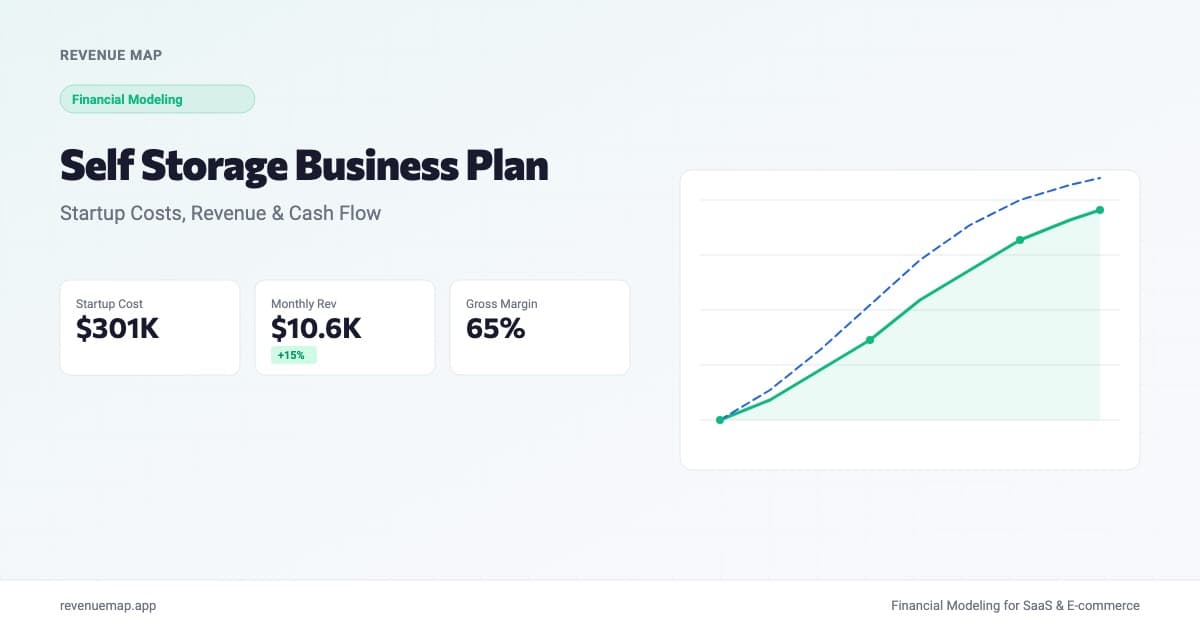
A self storage business plan needs a financial section built on realistic cost data and a defensible occupancy ramp, not an optimistic guess about filling every unit on opening day. Lenders approve storage loans based on projected cash flow, a clear startup cost breakdown, and proof that the facility can cover its debt payments during the slow lease-up period. The location and unit mix matter, but the numbers get the loan approved.
That financial discipline is showing up in the news this week. Meritage Hospitality Group, a 314-unit Wendy's franchisee, filed for Chapter 11 bankruptcy after closing 60 locations when operating costs outpaced revenue. Separately, Small Business Trends published a breakdown of overhead versus operating costs that highlights a distinction critical for self storage: this is a business where overhead (land, insurance, property taxes) dominates and variable operating costs are minimal. Understanding that structure is what separates a plan that gets funded from one that doesn't.
Here is how to build the financial section of your self storage business plan with the numbers lenders actually check.
How Much Does It Cost to Open a Self Storage Facility?
Startup costs for self storage vary dramatically by format. Converting an existing warehouse or retail building into storage units is the most accessible path for first-time operators. Ground-up construction produces a purpose-built facility but requires significantly more capital.
| Format | Startup Cost | Typical Loan | Units | Staff |
|---|---|---|---|---|
| Portable/container storage | $100,000 | $60,000 | 30-60 | 0-1 |
| Converted building (100 units) | $350,000 | $250,000 | 80-120 | 1 |
| Ground-up (200 units) | $2,500,000 | $1,875,000 | 150-250 | 2 |
| Climate-controlled (150 units) | $3,500,000 | $2,625,000 | 120-180 | 2 |
Most first-time self storage operators start with a building conversion. The portable container model keeps costs low but limits unit count and perceived quality. Ground-up construction generates the highest long-term returns but puts it out of reach for operators without significant equity or a real estate partner. Use the self storage startup cost calculator to adjust these figures for your market.
Where the Money Goes
For a converted building with 100 units, the startup budget breaks down roughly like this:
| Category | Low Estimate | Mid Estimate | High Estimate |
|---|---|---|---|
| Building purchase or lease deposit | $50,000 | $100,000 | $180,000 |
| Unit partitioning and buildout | $40,000 | $75,000 | $120,000 |
| Security (gates, cameras, access control) | $15,000 | $30,000 | $50,000 |
| Paving, lighting, signage | $10,000 | $25,000 | $45,000 |
| Software (management, billing, website) | $3,000 | $6,000 | $10,000 |
| Permits, zoning, insurance (first year) | $8,000 | $15,000 | $25,000 |
| Working capital (12 months) | $30,000 | $50,000 | $80,000 |
| Total | $156,000 | $301,000 | $510,000 |
The working capital line is larger here than in most small business plans. Self storage has a slow occupancy ramp (18 to 36 months to stabilize), so the facility needs to cover debt payments and fixed costs during the months when only 40% to 60% of units are rented. A lender who has funded storage deals before will ask how many months of negative cash flow you have budgeted for.
How to Project Self Storage Revenue
Revenue for a self storage facility is driven by three inputs: total rentable units, average monthly rent, and occupancy rate. The core formula:
Monthly Revenue = Total Units x Average Monthly Rent x Occupancy Rate
The challenge is picking realistic assumptions for each input. Here is what the numbers look like across formats, based on typical market data:
| Format | Units | Avg Rent/Unit | Stabilized Occupancy | Monthly Revenue |
|---|---|---|---|---|
| Portable/container (50 units) | 50 | $95 | 85% | $4,038 |
| Converted building (100 units) | 100 | $120 | 88% | $10,560 |
| Ground-up (200 units) | 200 | $130 | 90% | $23,400 |
| Climate-controlled (150 units) | 150 | $175 | 88% | $23,100 |
Two things stand out. First, climate-controlled units command 30% to 50% higher rents per square foot, which can justify the higher construction cost if the local market supports it. Second, self storage revenue scales with unit count, not labor. Adding units to an existing property barely changes staffing needs, giving the model strong operating leverage.
The Occupancy Ramp
New facilities do not open at 88% occupancy. A realistic projection models a gradual ramp:
| Month | Occupancy | Monthly Revenue (100 units at $120) |
|---|---|---|
| 1 | 30% | $3,600 |
| 3 | 42% | $5,040 |
| 6 | 55% | $6,600 |
| 9 | 68% | $8,160 |
| 12 | 78% | $9,360 |
| 18 | 86% | $10,320 |
| 24 | 90% | $10,800 |
Show the lender this ramp explicitly. A plan that assumes 85% occupancy from month one will get flagged immediately. Model the ramp conservatively and let stabilized occupancy be the upside, not the baseline. For more detail on building a monthly forecast, see the cash flow projection template.
What Does It Cost to Run a Self Storage Facility Each Month?
Self storage has a distinctive cost structure compared to most small businesses. As the Small Business Trends piece on overhead vs. operating costs explains, overhead costs are fixed expenses that persist whether revenue is high or low. In self storage, almost everything is overhead. Variable costs per unit are near zero because there is no labor per transaction, no inventory, and no consumable supplies.
| Expense | Portable (50 units) | Converted (100 units) | Ground-up (200 units) |
|---|---|---|---|
| Mortgage or lease payment | $800 | $2,400 | $14,000 |
| Property taxes | $200 | $800 | $3,500 |
| Insurance | $300 | $600 | $1,200 |
| Utilities (lighting, security power) | $150 | $400 | $900 |
| Management software | $100 | $200 | $350 |
| Marketing (local SEO, signage) | $300 | $600 | $1,200 |
| Labor (part-time manager) | $0 | $2,800 | $6,000 |
| Maintenance and repairs | $200 | $500 | $1,000 |
| Total monthly | $2,050 | $8,300 | $28,150 |
For a 100-unit converted facility, the gross margin at stabilized occupancy is roughly 65%, because most costs are fixed and don't scale with the number of rented units. That high margin at scale is what makes self storage attractive to lenders. But during the occupancy ramp, when revenue is $3,600 per month and fixed costs are $8,300, the facility is cash-negative. Your plan needs to show the lender how many months this gap persists and that your working capital covers it.
How to Calculate Break-Even for Self Storage
Break-even for a storage facility is best expressed as the occupancy rate needed to cover all costs. The formula:
Break-Even Occupancy = Monthly Fixed Costs / (Total Units x Average Monthly Rent)
For a 100-unit converted facility with $8,300 in monthly costs and an average rent of $120 per unit:
Break-Even Occupancy = $8,300 / (100 x $120) = 69%
That means the facility needs 69 of its 100 units rented to cover costs. Based on the ramp table above, that happens around month 9. From there, every additional unit rented flows almost entirely to profit because variable costs per unit are near zero.
Compare this to a restaurant, where variable costs (food, labor per cover) consume 60% to 70% of each revenue dollar. Self storage has a higher break-even hurdle in months (longer ramp) but a much steeper profit curve once it clears that point. For a deeper look at how break-even analysis works in a lender context, see our break-even analysis guide.
Calculate Your Self Storage Revenue
Self Storage Revenue Calculator
Estimate monthly revenue for your self storage facility
Want to model this over 36 months with scenarios? Try Revenue Map free →
What Lenders Look For in a Self Storage Business Plan
SBA lenders and commercial banks evaluate storage loans on a few specific metrics. If you are putting together a business plan for a business loan, here is what gets scrutinized:
- Debt Service Coverage Ratio (DSCR): net operating income divided by total debt payments. Lenders want 1.25x or higher. For a 100-unit facility generating $10,560 at stabilized occupancy with $8,300 in expenses, NOI is $2,260 against a $2,400 loan payment, giving a DSCR of 0.94x. That does not pass. At full stabilized occupancy, though, the same facility hits a DSCR of 1.3x to 1.5x as revenue grows and costs stay flat. The plan needs to show when DSCR crosses 1.25x and stays there.
- Occupancy ramp: a month-by-month projection showing how the facility fills from opening to stabilization. Lenders have seen the "85% from day one" assumption before and will reject it.
- Comparable rents: evidence that your assumed rents match the local market. Pull rates from nearby facilities and include them in the plan.
- Use of funds: a line-by-line breakdown of how the loan will be spent. Lump-sum categories get pushback.
Build your projections with the self storage financial model to generate a lender-ready forecast with scenario analysis built in.
Key Takeaways
- Self storage startup costs range from $100,000 (portable containers) to $3.5 million (climate-controlled ground-up). Most first-time operators convert an existing building for $200,000 to $500,000.
- Revenue is driven by total units times average rent times occupancy. A 100-unit facility averaging $120 per unit at 88% occupancy generates about $10,560 per month.
- The occupancy ramp is the critical variable. Plan for 18 to 36 months to reach stabilized occupancy of 85% to 92%, and budget working capital to cover the cash-negative months.
- Self storage has a distinctive cost structure: almost all overhead, minimal variable costs. Gross margins of 60% to 70% at stabilization are typical, but the ramp period is where deals fail.
- Lenders check DSCR, occupancy ramp realism, comparable market rents, and detailed use of funds. The financial section of your plan needs to address all four.
Ready to build the projection for your storage facility? Start with Revenue Map: pick the self storage template, plug in your numbers, and have a lender-ready forecast in a few minutes.
Related Articles
Ice Cream Truck Business Plan: Costs and Numbers
Build the financial section of your ice cream truck business plan with real startup costs, seasonal revenue projections, and the cash flow lenders need.
Nail Salon Business Plan: Costs and Projections
Build the financial section of your nail salon business plan with real startup costs, revenue projections, and cash flow forecasts lenders require.
Laundromat Business Plan: Costs and Projections
Build the financial section of your laundromat business plan with startup costs, revenue benchmarks, and the projections lenders expect.