SaaS Cash Collection Rate: How to Track It
Cash collection rate is the percentage of invoiced MRR that a SaaS company actually receives as cash. A healthy company collects at least 100% of MRR each month, and top performers collect 110% or more by collecting annual prepayments.
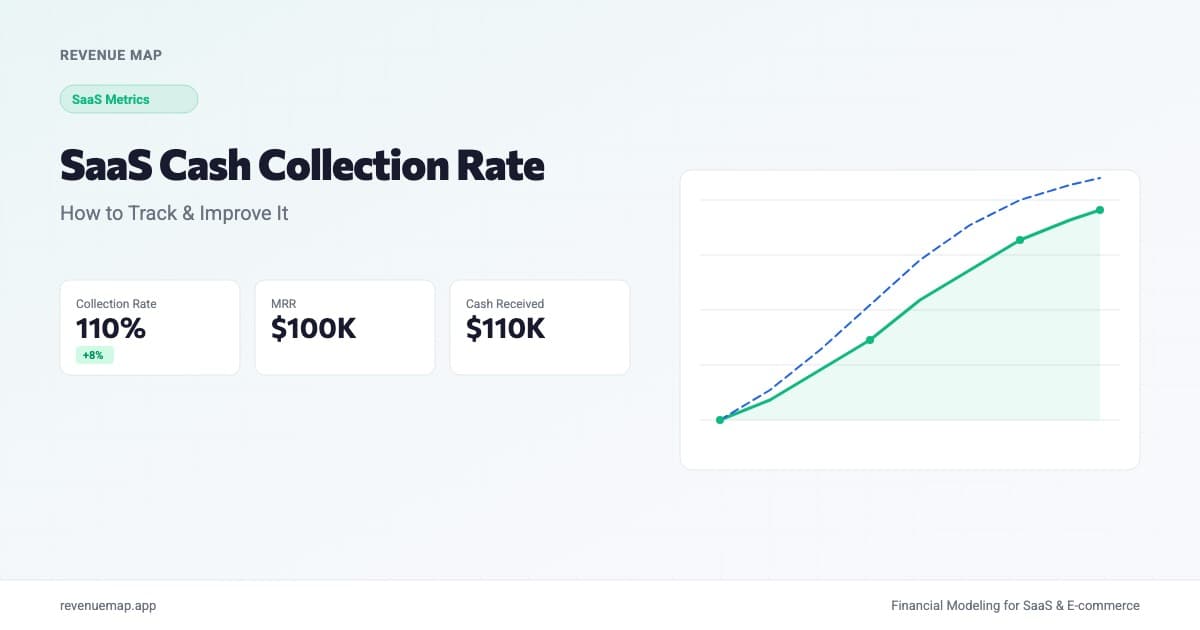
Cash collection rate measures the percentage of your invoiced MRR that actually arrives in your bank account. If your dashboard says $100K MRR but your bank received $88K, your cash collection rate is 88%, and your financial model is lying to you about runway. This is one of the most overlooked gaps in SaaS financial planning.
The topic resurfaced this week when SaaStr's Jason Lemkin argued that every SaaS company should collect at least 100% of MRR in cash each month, and ideally 110% or more. His point is blunt: if cash collected falls below 100% of MRR, you have a process failure in finance. And the consequences compound faster than most founders expect.
What Is Cash Collection Rate?
Cash collection rate is the ratio of actual cash received to the MRR you invoiced in the same period. It answers a simple question: are you getting paid for the revenue your metrics claim you earned?
Cash Collection Rate = Cash Received / Invoiced MRR × 100%
This is not the same as revenue recognition. Accrual accounting might recognize $100K of MRR on your P&L, but if $12K of that sits in accounts receivable (or worse, never arrives), your operating cash is only $88K. For early-stage companies funding operations from cash flow rather than a large war chest, that delta determines whether you make payroll in month 16 or month 13.
A collection rate above 100% is not only possible but desirable. It happens when customers prepay annual contracts. If a customer signs a $120K annual deal and pays upfront, you collect $120K in cash but recognize only $10K per month in MRR. That lump sum boosts your collection rate above 100% in the payment month and creates a cash buffer that strengthens your real runway.
Why Cash Collection Rate Matters for Your Financial Model
Most founders track MRR religiously but never reconcile it against cash received. Here's why that's dangerous.
Your runway model is wrong. Burn rate calculations use cash out minus cash in. If you substitute MRR for "cash in," you overestimate incoming cash every month. A 10% collection shortfall on $80K MRR means $8K less cash per month, which compounds to nearly $100K over a year. For a startup with $1.5M in the bank, that's the difference between 18 months of runway and roughly 15 months.
Investor metrics diverge from reality. Board decks that show growing MRR alongside a shrinking cash balance raise red flags. Investors who spot the divergence will ask about collection efficiency, and not having an answer erodes trust.
It exposes hidden churn. Failed payments are a form of involuntary churn that often goes untracked. A customer whose credit card declines three times and eventually churns shows up in your churn metrics weeks later, but the cash shortfall appeared immediately. Monitoring collection rate catches these signals earlier.
How to Calculate Your Cash Collection Rate
Step 1: Sum Your Invoiced MRR
Total all recurring invoices generated for the month. Include only subscription revenue. Exclude one-time fees, professional services, and usage overages unless they're billed on a predictable recurring basis.
Step 2: Sum Cash Received
Count the actual cash that hit your bank account from subscription invoices during the same period. If you use Stripe, this is your net payout (gross charges minus refunds and fees). For enterprise invoices on net terms, count the cash when it arrives, not when the invoice was sent.
Step 3: Divide and Compare
Cash Collection Rate = (Cash Received / Invoiced MRR) × 100%
A result of 100% means you collected exactly what you billed. Above 100% means prepayments pulled cash forward. Below 100% means some invoiced revenue remains uncollected.
Calculate Your Cash Collection Rate
Cash Collection Rate Calculator
See how much of your invoiced MRR you actually collect
Cash Collection Rate Benchmarks
The right target depends on your billing model and customer mix. Here's the honest breakdown:
| Customer Segment | Target Collection Rate | Typical Range | Red Flag |
|---|---|---|---|
| Self-serve / credit card billing | 100%+ | 95-102% | Below 93% |
| SMB with monthly invoicing | 100%+ | 92-100% | Below 90% |
| Mid-market (net-30 terms) | 95-100% (monthly) | 85-98% | Below 85% |
| Enterprise (net-60 terms) | 90-95% (monthly, but 100%+ quarterly) | 80-95% | Below 80% monthly for 2+ months |
The 110%+ target that SaaStr recommends becomes realistic when you push annual prepayments. If 30% of your customer base pays annually and you spread those collections across 12 months, you'll naturally land above 100% in aggregate. The key insight: annual contracts are not just a retention play, they're a cash flow accelerator.
Why SaaS Companies Fall Below 100%
The gap between invoiced MRR and cash collected usually stems from a few predictable failure modes.
Failed payments. Credit card declines are the most common cause. Cards expire, hit spending limits, or get flagged for fraud. Without automated retry logic and dunning email sequences, these failed charges quietly erode your cash position. Industry data suggests that 20-40% of all SaaS churn is involuntary, driven by payment failures rather than deliberate cancellations.
Net payment terms. Enterprise contracts on net-30 or net-60 create a structural lag between invoice and cash receipt. This isn't a problem by itself, but it becomes one when your model assumes MRR equals cash. If 40% of your MRR is on net-60 terms, roughly two months of that segment's revenue sits in AR at any given time.
Billing disputes and partial payments. Customers who dispute charges, request credits, or negotiate retroactive discounts reduce your effective collection. These adjustments often happen outside the billing system and don't show up in MRR dashboards until someone reconciles manually.
Delayed invoicing. If your finance team sends invoices late (or if automated invoicing misfires), the payment clock doesn't start until the customer receives the bill. A five-day delay on a net-30 invoice means payment arrives 35 days after the service period, not 30.
How to Improve Your Cash Collection Rate
Here's the thing: most collection problems are process problems, not customer problems. The fixes are operational, not strategic.
Automate payment retries. Configure your payment processor (Stripe, Braintree, etc.) to retry failed charges on an intelligent schedule. Stripe's Smart Retries alone recover a meaningful portion of failed payments without any customer-facing action.
Build a dunning sequence. When a payment fails, send an automated email sequence: a friendly reminder on day 1, a payment update request on day 3, and a service-impact warning on day 7. Most involuntary churn can be prevented with a three-email dunning flow.
Push annual prepayments. Offer a 10-15% discount for annual billing. Customers who prepay improve your cash collection rate, reduce churn (annual customers churn at roughly half the rate of monthly customers), and give you more predictable cash flow. The discount pays for itself through reduced payment processing costs and lower churn rates.
Shorten payment terms. If your enterprise contracts default to net-60, negotiate for net-30 or offer a 2% early-payment discount. Every 30 days you remove from payment terms directly accelerates cash collection.
Reconcile monthly. Compare your MRR dashboard to your actual bank deposits every month. This sounds basic, but many startups don't do it until a cash crisis forces the conversation. Build a simple reconciliation into your monthly close process: MRR invoiced, cash received, delta, and the reason for each line item in the gap.
Cash Collection Rate vs. Other Metrics
Cash collection rate sits between your MRR waterfall and your burn rate calculation. MRR tells you what you earned on paper, cash collection rate tells you what you actually received, and burn rate tells you what you spent. All three must be accurate for your runway projection to mean anything.
It also connects directly to net revenue retention. A company with 120% NRR but 85% cash collection is growing on paper while potentially struggling with cash flow. That tension is sustainable for a quarter or two (while AR accumulates), but if collections don't catch up, you'll need to raise earlier or cut faster than your growth metrics suggest.
Key Takeaways
- Cash collection rate measures what you actually receive, not what your dashboard says you earned. Calculate it monthly: cash received divided by invoiced MRR.
- Collect at least 100% of MRR each month. Below that threshold, your runway model is overstating your cash position. Target 110%+ by encouraging annual prepayments.
- Failed payments are the biggest silent killer. Automated retries and a simple dunning email sequence can recover 20-40% of otherwise-lost revenue.
- Reconcile MRR to cash monthly. The gap between invoiced revenue and collected cash should be a standing line item in every board deck and monthly close.
- Annual contracts serve double duty. They reduce churn and pull cash forward, improving both your retention metrics and your collection rate in the same move.
Cash collection rate belongs in every SaaS financial model right next to MRR, burn, and runway. If those numbers don't tie to your bank balance, the model is fiction. Start building a model that tracks real cash flow with Revenue Map, and see how collection efficiency changes your runway projection.
Related Articles
SaaS Revenue Per Employee: 2026 Benchmarks
How much ARR should each employee generate? See 2026 SaaS revenue per employee benchmarks by stage and growth rate, with formulas and a free calculator.
SaaS Gross Margin: How to Calculate and Benchmark It
Learn how to calculate SaaS gross margin, what counts as COGS, and 2026 benchmarks by company stage. Includes a free calculator.
Annual Contract Value: How to Calculate and Model ACV
Learn how to calculate annual contract value (ACV) for SaaS, see benchmarks by segment, and model ACV as contracts shift to shorter terms.