SaaS Pricing Strategy: How to Set, Test, and Scale Prices
A SaaS pricing strategy is your plan for capturing value from your product through pricing models, tiers, and packaging. The most common models are flat-rate, tiered, per-seat, and usage-based, and the right choice depends on your product's value metric and customer segments.
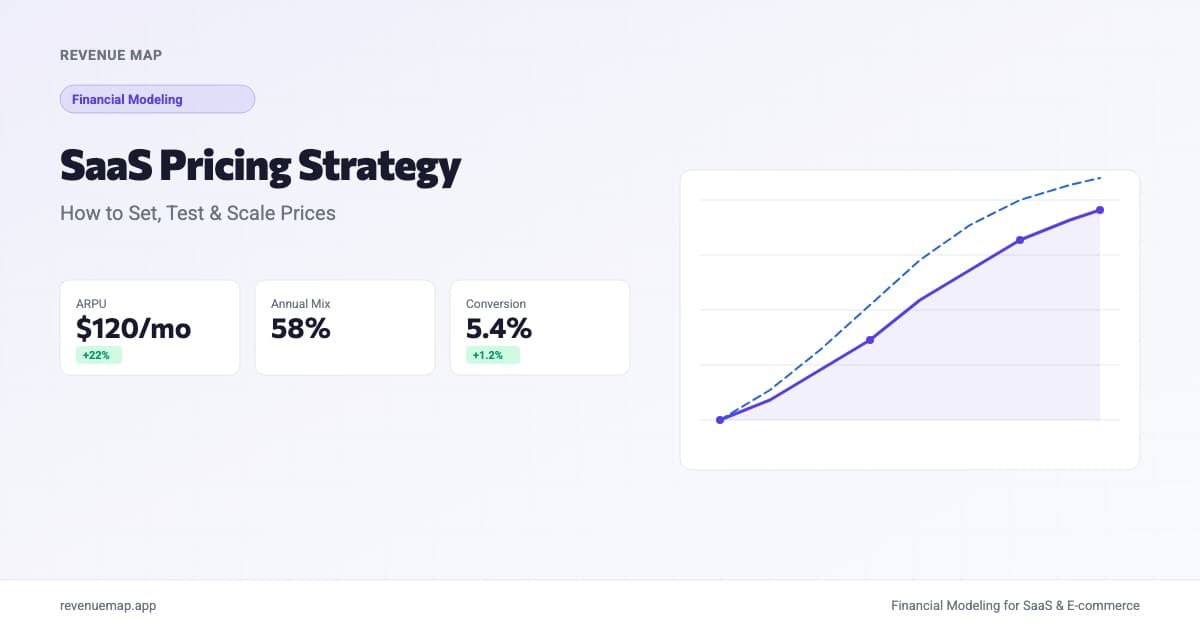
A SaaS pricing strategy is your plan for how you capture value from your product through pricing models, tier structures, and packaging decisions. The right strategy maximizes revenue per customer while keeping conversion friction low. Getting it wrong creates what SaaStr recently called a "pricing gap": a dead zone between tiers where prospects who want more than Basic but can't justify Enterprise simply walk away.
Most founders treat pricing as a one-time decision. Set the number at launch, maybe raise it once a year. But pricing is the single highest-leverage input in your financial model. A 10% increase in ARPU, if retention holds, compounds faster than a 10% increase in lead volume. This guide covers how to choose, structure, test, and scale your SaaS pricing.
What Is a SaaS Pricing Strategy?
A SaaS pricing strategy is the framework that determines what you charge, how you package features, and how pricing scales as customers grow. It encompasses your pricing model (flat-rate, tiered, per-seat, or usage-based), your value metric (the unit customers associate with the price), and your tier structure (how you segment customers into plans).
The strategy sits at the intersection of three forces: what customers will pay, what competitors charge, and what your unit economics require. Founders who anchor too heavily on competitor pricing end up in a race to the bottom. Those who focus only on willingness-to-pay may price above what their cost structure can support. The best strategies triangulate all three and revisit the balance as the product and market evolve.
Here's the thing: most early-stage SaaS companies underprice. They fear losing deals and default to low prices to accelerate adoption. That works until you try to raise a Series A and investors ask why your ARPU is half the industry benchmark. By then, your existing customer base expects the old price, and raising it feels like a minefield.
The Pricing Gap Problem (and How to Spot It)
SaaStr's recent analysis describes a pattern that many B2B startups unknowingly create: the pricing gap. It works like this. A company offers a Basic plan at $29/month and a Pro plan at $149/month. The five-fold jump creates a dead zone. Prospects who outgrow Basic but cannot internally justify a 5x increase in spend choose neither plan. They either stay on Basic and churn once they hit feature limits, or they leave for a competitor whose pricing meets them in the middle.
The gap is hard to detect from the inside because you only see the deals that close. The prospect who visited your pricing page, hesitated at the jump from $29 to $149, and never submitted a demo request is invisible to your analytics. You might think the problem is lead quality or product-market fit when it is actually a pricing architecture issue.
Three signals that you have a pricing gap:
- High Basic churn, low Pro adoption. If customers on your entry tier churn at significantly higher rates than Pro customers but few upgrade, they may be hitting a ceiling they cannot justify jumping past.
- Sales objections centered on price, not value. When prospects say "I see the value but can't get budget approval for that tier," the issue is the tier boundary, not the product.
- Competitors winning on a mid-tier plan you don't offer. If your competitor's $79 plan is pulling customers from your funnel, you have a gap in your lineup.
The fix is structural, not cosmetic. Adding a mid-tier plan (say $79/month with a curated set of Pro features) gives prospects a stepping stone. It also gives your sales team a natural expansion path: land on mid-tier, expand to Pro once the customer sees ROI. This is one reason why three-tier pricing has become the default in SaaS. The middle tier exists not primarily to be chosen, but to frame the others and fill the gap.
The Four Core SaaS Pricing Models
Each model aligns with a different value delivery pattern. The table below summarizes the tradeoffs.
| Model | How It Scales | Best For | Revenue Predictability | Expansion Potential |
|---|---|---|---|---|
| Flat-rate | Does not scale | Simple tools, early stage | High | Low |
| Tiered | Feature gating | Multi-segment products | High | Moderate |
| Per-seat | Headcount growth | Collaboration tools | High | Moderate |
| Usage-based | Consumption volume | APIs, infrastructure, data | Lower | High |
Flat-rate pricing charges everyone the same amount. It is simple to communicate and easy to model, but it leaves money on the table with high-value customers and cannot capture expansion revenue. Very few SaaS companies stay flat-rate past $1M ARR.
Tiered pricing segments customers by features and usage limits. The per-seat vs usage-based comparison covers two specific flavors in depth, but the broader tiered approach remains the most common structure. It works because different customers value different capabilities, and tiers let you price-discriminate without negotiating every deal.
Per-seat pricing charges based on the number of users. It is highly predictable and aligns cost with organizational adoption. The risk is that customers optimize around seat counts (shared logins, admin-only access) to manage costs.
Usage-based pricing charges based on consumption. As we covered in the usage-based pricing model guide, this approach generates strong net revenue retention because revenue grows automatically as customers use more. The tradeoff is harder revenue forecasting and customer anxiety about unpredictable bills.
Most mature SaaS companies end up with a hybrid. A base subscription provides predictable revenue, and usage-based or per-seat components capture expansion. This is where pricing strategy gets genuinely nuanced, and it is the part most worth modeling.
How to Choose Your Pricing Model
Start with your value metric: the unit of value that customers intuitively connect to what they pay. For a CRM, it might be contacts or seats. For an infrastructure tool, it might be API calls or compute time. For a design tool, it might be projects or exports.
A good value metric passes three tests:
- Easy to understand. The customer can predict their bill without a calculator.
- Scales with value. As the customer gets more value, they naturally consume more of the metric.
- Hard to game. Customers cannot easily reduce their metric count without reducing their actual usage.
Once you have a value metric, the model often selects itself. If the metric is headcount, per-seat makes sense. If it is consumption, usage-based pricing fits. If the value is hard to quantify in a single metric, tiered feature-gating works.
The other critical input is your CAC payback period. If payback is already long, you need a pricing structure that generates higher revenue per customer in the early months. That might mean higher base prices, annual billing incentives (offer a 10-20% discount for annual commitment), or onboarding fees that offset acquisition costs upfront.
Calculate the Revenue Impact of a Price Change
Price Change Revenue Impact
Model how a price change affects your monthly revenue
Want to model this over 36 months with scenarios? Try Revenue Map free →
The calculator illustrates a key tension in every price increase decision: higher prices mean more revenue per customer, but some customers will leave. The net impact depends on how many churn relative to the size of the increase. Most SaaS companies overestimate the churn a price increase will cause. The risk is usually smaller than founders fear, especially when the increase comes with clear, communicated value additions.
How to Test and Iterate on Pricing
Pricing changes do not need to be all-or-nothing events. Here is a practical sequence that limits risk.
1. Test on new customers first. Show the new pricing only to prospects who have never seen your old prices. Run it for 60-90 days and compare conversion rates and ARPU against the control. This is the safest test because existing customers are unaffected.
2. Grandfather existing customers (temporarily). When you roll out new pricing broadly, lock current customers into their existing rate for 6-12 months. This buys goodwill and gives you time to build the additional value that justifies the increase.
3. Lead with value, not price. The announcement should be about what's new in the product, not about the price going up. "We're launching three new features and restructuring plans to include them" lands very differently than "prices are increasing effective next month."
4. Track cohort economics separately. New-price cohorts will have different churn profiles and LTV curves than old-price cohorts. Mix them in your metrics and you will lose the signal. Keep them separate for at least two full churn cycles before blending.
Pricing Strategy Benchmarks by Stage
| Metric | Seed Stage | Series A | Series B+ |
|---|---|---|---|
| ARPU (SMB) | $30-80/mo | $60-150/mo | $100-300/mo |
| ARPU (Mid-Market) | $200-500/mo | $500-2,000/mo | $1,500-5,000/mo |
| Annual billing mix | 20-30% | 40-60% | 60-80% |
| Pricing page conversion | 2-5% | 3-7% | 5-10% |
| Price increase frequency | 1x/year | 1-2x/year | 1x/year |
Notice the ARPU progression. Companies that nail pricing strategy see ARPU roughly double between seed and Series A, then double again into growth stage. This is not because they keep raising prices on the same product. It is because they refine their packaging to capture more of the value they deliver, add tiers for higher-value segments, and build expansion mechanisms into the product.
Key Takeaways
- Your pricing strategy is the highest-leverage input in your financial model. A 10% ARPU increase with stable retention compounds faster than almost any other growth lever.
- Pricing gaps kill deals invisibly. If the jump between your tiers is too large, you are losing prospects you never see in your pipeline. Audit your tier boundaries.
- Choose your pricing model based on your value metric. Seats, consumption, features: the metric your customers intuitively associate with value should drive the structure.
- Test pricing changes on new customers first. Grandfather existing customers, lead with value, and track new-price cohorts separately to understand the true impact.
- Revisit pricing at least annually. Your product, market, and competitive landscape change. Your pricing should evolve with them.
Your pricing strategy feeds directly into every revenue projection in your financial model. Build your SaaS model in Revenue Map to see how pricing changes flow through MRR, churn, and runway projections in real time.
Related Articles
Per-Seat vs Usage-Based Pricing: How to Choose
Compare per-seat and usage-based pricing models for SaaS. See when each works, revenue benchmarks, and a framework to pick the right model for your startup.
Cash Flow Projection Template for Small Business
Build a 12-month cash flow projection your lender will trust. Includes formulas, a free calculator, and line-by-line examples for restaurants, coffee shops, and more.
SaaS Revenue Model Template for Startups
Build a SaaS revenue model from scratch with MRR components, pricing tier math, and expansion revenue. Includes a free calculator and benchmarks.