Franchise Startup Costs: Full 2026 Breakdown
Franchise startup costs typically range from $25,000 for a home-based or mobile franchise to $500,000 or more for a full restaurant or gym buildout. The franchise fee alone runs $20,000 to $50,000 for most brands, with buildout, equipment, and working capital making up the rest.
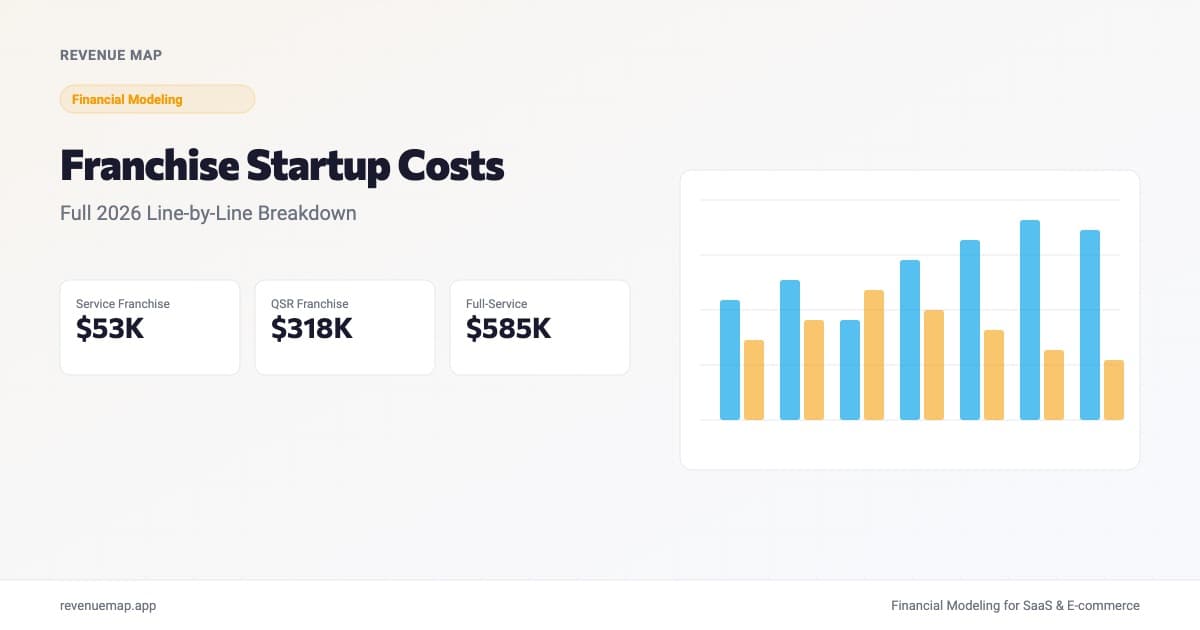
Franchise startup costs range from roughly $25,000 for a home-based service franchise to over $500,000 for a full-service restaurant or gym buildout. The franchise fee is just the entry ticket. Buildout, equipment, inventory, and working capital make up the bulk of the investment, and the total varies wildly by industry and brand.
Those numbers are not abstract. This week, a 7-unit Dave's Hot Chicken franchisee filed Chapter 11 bankruptcy, disputing $8.8 million in Bank Midwest debt and alleging that lender interference derailed a $30 million sale. At the same time, KFC is testing a redesigned restaurant prototype in a Dallas suburb with breakfast, boba tea, and a retail shop. One franchisee is fighting to survive; another brand is reimagining what a unit looks like. Here is a complete breakdown of franchise startup costs in 2026, what the Item 7 table in a Franchise Disclosure Document actually means, and how to put these numbers in front of a lender.
What Does It Cost to Open a Franchise?
Every franchisor publishes a Franchise Disclosure Document (FDD) with Item 7: Estimated Initial Investment. This table breaks down every cost category from the franchise fee to the first three months of operating capital. The ranges below reflect major franchise categories in 2026.
| Cost Category | Low-Investment Service | Quick-Service Restaurant | Full-Service Restaurant |
|---|---|---|---|
| Franchise fee | $15,000 | $35,000 | $45,000 |
| Leasehold improvements | $0 | $100,000 | $200,000 |
| Equipment and signage | $5,000 | $80,000 | $150,000 |
| Initial inventory | $2,000 | $8,000 | $15,000 |
| Technology and POS | $3,000 | $12,000 | $20,000 |
| Insurance (first year) | $3,000 | $8,000 | $15,000 |
| Training and travel | $5,000 | $10,000 | $15,000 |
| Marketing (grand opening) | $5,000 | $15,000 | $25,000 |
| Working capital (3-6 months) | $15,000 | $50,000 | $100,000 |
| Total | $53,000 | $318,000 | $585,000 |
These are midpoint estimates. Your actual numbers depend on the specific brand, your market, and how much buildout the space needs. A McDonald's franchise can require $1 million or more in total investment. Always start with the Item 7 table in the specific FDD for the brand you are evaluating.
The Five Cost Categories That Matter Most
1. Franchise Fee ($10,000 to $50,000)
The franchise fee is a one-time, non-refundable payment for the right to operate under the brand. It covers initial training, the operations manual, site selection assistance, and trademark rights. Most brands charge $25,000 to $45,000.
The franchise fee is the most visible cost but rarely the largest. The buildout is where the real money goes.
2. Leasehold Improvements and Buildout ($0 to $250,000)
For home-based or mobile franchises, this cost is zero. For brick-and-mortar concepts, it is usually the single biggest expense. Restaurant franchises require commercial kitchen infrastructure, ventilation, grease traps, and brand-specific finishes.
The range depends heavily on whether you are building out a raw shell or moving into a second-generation space. A QSR going into a former restaurant space might spend $60,000 to $100,000. The same concept in a raw retail shell could spend $150,000 to $200,000 because all the kitchen infrastructure has to be installed from scratch. If you have read our restaurant startup costs breakdown, the pattern is the same: the condition of the space is the biggest cost variable.
3. Equipment, Fixtures, and Signage ($5,000 to $150,000)
Franchisors typically specify exactly which equipment you must purchase, sometimes down to the brand and model. A QSR franchise might require a specific POS system ($8,000 to $15,000), proprietary kitchen equipment ($50,000 to $100,000), and brand-standard signage ($10,000 to $30,000).
Service franchises have much lower equipment costs: a cleaning franchise might need only a vehicle, supplies, and a scheduling tablet.
4. Working Capital ($15,000 to $100,000)
Working capital is the cash you need to cover operating expenses before the business sustains itself. Most franchisors require three to six months in the Item 7 estimate, but that is often a minimum. New locations typically need six to twelve months to reach consistent profitability.
Here is the thing: underfunded franchisees are the ones who end up in trouble. The Dave's Hot Chicken bankruptcy involved a franchisee that grew to seven units. Rapid expansion burns cash fast, and if the revenue ramp takes longer than projected, every new unit compounds the problem.
5. Ongoing Fees (Not Startup, But Budget for Them)
These are not startup costs, but they affect your cash flow from day one and should be in your financial projections:
- Royalty fee: 4% to 8% of gross revenue, paid weekly or monthly
- Advertising fund: 1% to 3% of gross revenue for national and regional marketing
- Technology fee: $100 to $500 per month for POS software, apps, and loyalty programs
- Required vendor markups: some franchisors require you to purchase supplies from approved vendors at prices that may be higher than market rate
On a franchise doing $50,000 per month in revenue, a 6% royalty plus a 2% ad fund takes $4,000 off the top before you cover rent, payroll, or food costs. The tradeoff is brand recognition, proven systems, and faster ramp-up.
Franchise Costs by Industry
Here is how startup costs compare across the most common franchise sectors:
| Franchise Type | Typical Total Investment | Franchise Fee | Break-Even Timeline |
|---|---|---|---|
| Cleaning / janitorial | $25,000 to $75,000 | $10,000 to $30,000 | 3 to 6 months |
| Tutoring / education | $50,000 to $150,000 | $20,000 to $40,000 | 6 to 12 months |
| Mobile food / kiosk | $75,000 to $200,000 | $15,000 to $35,000 | 6 to 12 months |
| Quick-service restaurant | $200,000 to $500,000 | $25,000 to $50,000 | 12 to 18 months |
| Fitness / gym | $250,000 to $600,000 | $30,000 to $50,000 | 12 to 24 months |
| Full-service restaurant | $350,000 to $750,000 | $35,000 to $50,000 | 12 to 24 months |
| Hotel / lodging | $1M to $10M+ | $40,000 to $75,000 | 3 to 5 years |
According to Small Business Trends, several up-and-coming fast food franchises are gaining traction in 2026, many with lower initial investments than legacy brands. That said, a lower initial investment from a newer brand comes with higher brand-awareness risk: you may spend more on local marketing to drive traffic that an established brand gets for free.
Hidden Costs That Catch First-Time Franchisees
The Item 7 table covers the obvious categories, but several costs are easy to underestimate:
Lease negotiation and legal fees ($5,000 to $15,000). You will need an attorney to review the franchise agreement and the lease. Franchise agreements are long, complex, and heavily weighted in the franchisor's favor. Skipping legal review to save $5,000 is a false economy.
Territory protection gaps. Some franchise agreements do not guarantee exclusive territories. A second location from the same brand opening nearby can split your revenue without reducing your fixed costs. Read the FDD's Item 12 carefully.
Required remodels ($100,000 to $300,000). Many franchise agreements include mandatory remodel schedules every 7 to 10 years. This is not a startup cost, but it is a capital expenditure you need in your long-term break-even analysis.
Transfer and renewal fees ($5,000 to $25,000). Selling your franchise typically triggers a transfer fee, and renewal at the end of your initial term (10 to 20 years) costs $10,000 to $25,000.
How to Finance Franchise Startup Costs
Most franchisees do not pay the full startup cost out of pocket. The three main options:
SBA 7(a) loans are the most popular route. The SBA maintains a Franchise Directory of pre-approved brands, which streamlines lending. Expect to put 10% to 20% down in equity injection, with the loan covering the rest over 7 to 10 years.
Conventional bank loans require stronger credit and more collateral but can close faster. Franchisor financing through in-house programs or preferred lenders is also available for some brands.
Whichever route you take, you will need a business plan with financial projections that a lender can evaluate. Lenders want projected revenue, a startup cost breakdown, 12-month cash flow forecasts, and a debt service coverage ratio above 1.25x. Use the FDD's Item 19 (Financial Performance Representations) as a starting point, then adjust for your local market.
Calculate Your Franchise Startup Costs
Franchise Startup Cost Calculator
Estimate total investment for a franchise opportunity
Want to model this over 36 months with scenarios? Try Revenue Map free →
What to Check Before You Sign
Before committing to a franchise, run through these diligence steps:
- Read the full FDD, not just Item 7. Items 19 (financial performance), 20 (outlet list), and 21 (financial statements) tell you how existing franchisees are actually performing.
- Call existing franchisees. Item 20 lists contact information for every current and recently closed franchisee. Ask about actual startup costs versus the Item 7 estimate, time to break even, and franchisor support quality.
- Model the worst case. Use the FDD's revenue data to build conservative projections. If the business does not work at 70% of the average unit volume, the investment carries real risk.
- Calculate your all-in gross margin after royalties. A 65% food-cost margin drops to 57% after a 6% royalty and 2% ad fund. That changes your break-even point significantly.
- Get a franchise attorney to review the agreement. Not a general business attorney. Franchise law is specialized, and the agreement is almost never negotiable except on territory and development schedule.
Key Takeaways
- Franchise startup costs range from $25,000 (home-based service) to $500,000 or more (full-service restaurant or gym), with the franchise fee making up a relatively small share of the total.
- Leasehold improvements and equipment are usually the two largest line items for brick-and-mortar franchises. The condition of the space you lease has the biggest impact on total cost.
- Budget for six to twelve months of working capital, not the three-month minimum some FDDs suggest. Underfunded franchisees are the ones who fail during the ramp-up.
- Ongoing royalties and advertising fees (5% to 10% of gross revenue) reduce your margins compared to an independent business. Factor them into projections from day one.
- SBA 7(a) loans are the most common financing vehicle. You will need 10% to 20% equity injection, a full business plan, and a debt service coverage ratio above 1.25x.
The numbers are knowable in advance. Every FDD lays out the cost structure. The question is whether projected revenue, after royalties and fees, supports the investment. Build your projections with Revenue Map to see if the math works before you sign.
Related Articles
Laundromat Startup Costs: Full 2026 Breakdown
Opening a laundromat costs $200K to $500K. Full line-by-line breakdown with real equipment prices, build-out costs, and financing options.
Coffee Shop Startup Costs: Full 2026 Breakdown
Opening a coffee shop costs $85,000 to $325,000. Full line-by-line cost breakdown with equipment, buildout, permits, and working capital.
Restaurant Startup Costs: Full 2026 Breakdown
How much does it cost to open a restaurant? Expect $175K to $750K depending on concept and location. Full line-by-line breakdown inside.