Startup Runway: How to Calculate and Extend It
Startup runway is the number of months a company can operate before running out of cash. Calculate it by dividing your current cash balance by your monthly net burn rate. Most investors expect startups to maintain at least 18 months of runway after a funding round.
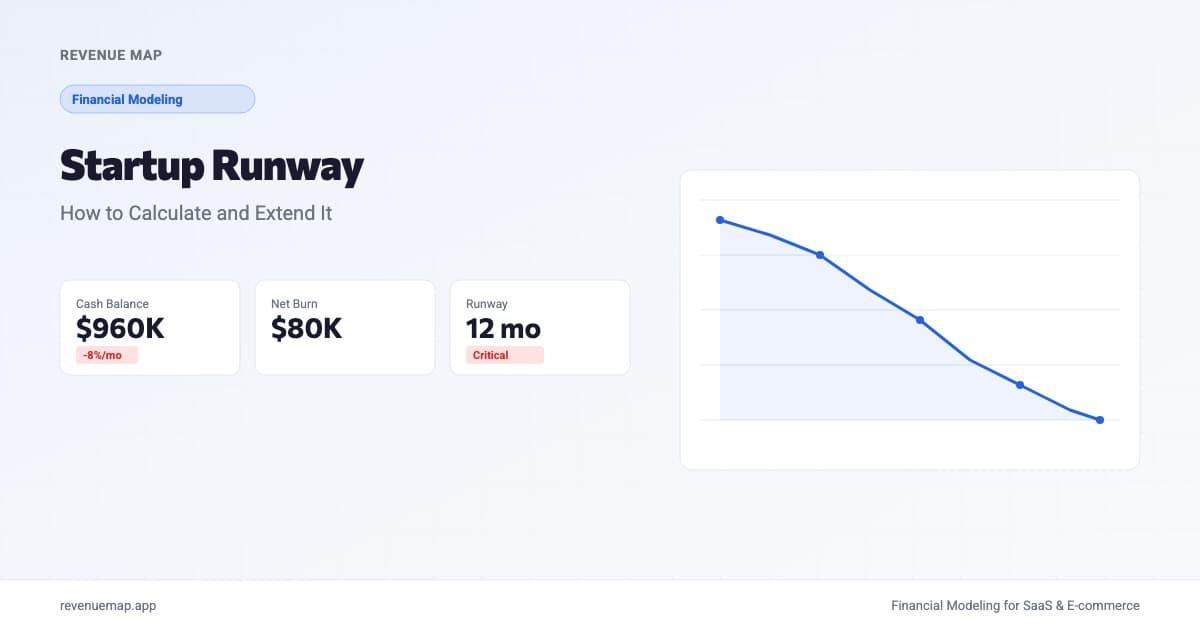
Startup runway is the number of months your company can keep operating before the cash runs out. You calculate it by dividing your current cash balance by your monthly net burn rate, and the result tells you exactly how much time you have to hit your next milestone, close your next round, or reach profitability. It is the most important number on your dashboard that isn't a revenue metric.
Runway matters more in 2026 than it has in years. According to SaaStr's analysis of the 2026 IPO market, total VC-backed IPO value through July reached $1.79 trillion, but strip out SpaceX and it becomes one of the weakest exit years on record. For SaaS companies specifically, the IPO window remains essentially closed. Meanwhile, the biggest fundraising rounds of the year, like Valar Atomics' $1 billion raise at a $6 billion valuation, are concentrating in deep-tech and infrastructure bets, not in typical software startups. If you're a SaaS or e-commerce founder, that means one thing: you probably can't count on fresh capital arriving on your timeline, so the runway you have today is the runway you need to plan around.
What Is Startup Runway?
Startup runway is the estimated number of months a company can continue operating at its current spend rate before exhausting its cash reserves. It translates a raw cash balance into a time horizon, which is what actually drives decisions about hiring, product launches, and fundraising timing.
The concept is straightforward, but founders routinely get it wrong in two ways. First, they calculate runway using gross burn (total expenses) instead of net burn (expenses minus revenue), which overstates the problem for companies generating meaningful revenue. Second, they treat it as a static snapshot instead of a moving target. Your runway changes every month as both spending and revenue shift. A startup that had 20 months of runway in January might have 14 by June if costs crept upward while revenue stayed flat.
Here's the thing: investors care about runway more than most founders realize. When a VC asks "how much runway do you have?" during a pitch, they're really asking two questions. How disciplined is this team with capital? And will they run out of money during my diligence process? The wrong answer to either question kills the deal.
How to Calculate Your Runway
The formula is simple:
Runway (months) = Cash Balance / Monthly Net Burn Rate
Where:
- Cash Balance is your current bank balance plus any liquid investments you can access within 30 days
- Monthly Net Burn Rate is total monthly expenses minus total monthly revenue (cash basis, not accrued)
Worked example: Your startup has $960,000 in the bank. Monthly expenses total $105,000 (payroll $68,000, cloud infra $14,000, marketing $12,000, office and tools $11,000). You generate $25,000 in monthly revenue.
Net Burn Rate = $105,000 - $25,000 = $80,000/month
Runway = $960,000 / $80,000 = 12 months
Twelve months sounds manageable until you realize that fundraising typically takes 3 to 6 months. If you wait until month 6 to start raising, you'll be pitching with only 6 months of cash left, and experienced investors can smell desperation in a cap table.
Important nuances. Use actual cash flows, not accounting revenue. Accrued revenue that hasn't collected doesn't pay salaries. If you bill annually, smooth the cash inflow across months for a more accurate runway estimate, or better yet, calculate both a "cash runway" and a "revenue runway" to see both perspectives. Also exclude one-time items (a big contract payment, a tax refund) unless they'll recur, or you'll overstate your position.
For a deeper breakdown of the spending side, see our guide to startup burn rate, which covers gross vs. net burn, stage benchmarks, and strategies for reducing it.
Calculate Your Startup Runway
Startup Runway Calculator
Enter your cash balance and monthly financials to calculate runway
How Much Runway Should You Have?
There's no universal right answer, but the benchmarks below reflect what we've seen across hundreds of financial models and what investors typically expect at each stage.
| Stage | Target Runway After Funding | When to Start Raising | Typical Net Burn |
|---|---|---|---|
| Pre-seed | 18-24 months | 12 months remaining | $15K-$40K/mo |
| Seed | 18-24 months | 9-12 months remaining | $40K-$100K/mo |
| Series A | 18-24 months | 9-12 months remaining | $100K-$250K/mo |
| Series B+ | 24-30 months | 12-15 months remaining | $250K-$600K/mo |
A few patterns worth calling out. The "start raising" column is consistently 9 to 12 months before your cash runs out. That accounts for 3 to 6 months of active fundraising plus a buffer for term-sheet negotiation and closing. Founders who start raising with only 6 months left often accept worse terms because they can't afford to walk away.
The gap between target runway and "start raising" is your execution window: the months where you need to hit the milestones that make the next round possible. If your seed round gives you 20 months and you plan to start raising at month 11, you have 11 months to prove enough traction for a Series A. That's the frame you should use when building your financial projections.
One caveat: these benchmarks assume U.S. market conditions. Startups with distributed teams in lower-cost regions can stretch the same cash 40 to 60% further, which is one reason we've seen more founders build remote-first companies in the current funding climate.
Why 2026's Capital Concentration Matters for Your Runway
The SaaStr data paints a stark picture. Through July 2026, VC-backed IPO volume looked historic on paper. But the headline number is almost entirely driven by a single exit. Remove it, and the remaining IPO market is one of the thinnest in a decade. SaaS companies in particular have effectively zero path to public markets right now.
At the same time, the largest rounds are going to a narrow set of companies in capital-intensive sectors like nuclear energy, defense tech, and AI infrastructure. These aren't the kinds of raises that signal a healthy fundraising environment for the average seed or Series A startup. They signal the opposite: capital is concentrating, not distributing.
What does this mean practically?
Your next round will take longer than you think. When capital concentrates, VCs get pickier with smaller checks. Budget 6 months for fundraising, not 3.
Your metrics need to be cleaner. In a loose market, growth rate covers a lot of sins. In a tight market, investors scrutinize unit economics, gross margins, and capital efficiency. A strong CAC payback period can be the difference between a term sheet and a polite pass.
Bridge rounds are less available. When the market was flush, founders could always raise a bridge to buy time. Today, bridges are harder to close and signal weakness. Plan as if your current cash is all you'll have for the next 18 months.
How to Extend Runway Without Cutting Growth
Collect Cash Faster
The gap between when you earn revenue and when you collect it is hidden runway drain. If you offer monthly billing, consider shifting customers to annual plans with a discount. A 15% annual discount costs less than the financing equivalent of waiting 12 months for the same cash. Even moving from net-60 to net-30 payment terms adds measurable weeks of runway. Track your cash collection efficiency as a standalone metric.
Audit Vendor Spend Monthly
SaaS tool sprawl is the most underrated runway risk. The average startup accumulates 3 to 5 subscriptions that nobody actively uses. Set a monthly calendar reminder to review every recurring charge. Any tool that hasn't been accessed by at least two team members in the past 30 days should be canceled or downgraded. Cloud infrastructure is the second area: right-size instances, delete unused resources, and apply startup credits from AWS Activate, GCP for Startups, or Azure Founders Hub.
Rethink Hiring Sequencing
Payroll is 60 to 70% of most startups' burn. Before every hire, ask: does this role accelerate revenue within 6 months? If the answer is "maybe," defer the hire and explore contractors or part-time specialists instead. The difference between hiring one engineer now versus waiting three months is roughly $45,000 to $75,000 in loaded costs, which could be an extra month of runway.
Model Scenarios, Not a Single Plan
Your SaaS financial model should include at least three scenarios: base case, conservative, and downside. Run each one through the runway calculation. If your downside scenario shows fewer than 12 months of runway, you need to start adjusting now, not when the downside materializes. The founders who survive tight markets are the ones who made cuts at 15 months of runway, not at 6.
Key Takeaways
- Runway = Cash Balance / Monthly Net Burn Rate, and it tells you how many months you have before the money runs out
- Target 18 to 24 months of runway after every funding round, and begin fundraising when you have at least 9 to 12 months remaining
- 2026's capital concentration means longer fundraising cycles, plan for 6 months of active raising, not 3, and treat your current cash as if no new capital is coming
- Collect cash faster, audit vendors monthly, and defer non-critical hires to extend runway without sacrificing growth
- Model three scenarios (base, conservative, downside) and track how each one affects your runway, the downside case should still show 12 or more months
Runway touches every other metric in your financial model. Reducing burn rate extends the denominator. Growing MRR shrinks net burn from the other side. Track it weekly, not monthly, because a single large customer churning or an unnoticed cloud cost spike can shave months off your timeline between board meetings. Build your model in Revenue Map and see exactly how long your cash lasts across multiple scenarios.
Related Articles
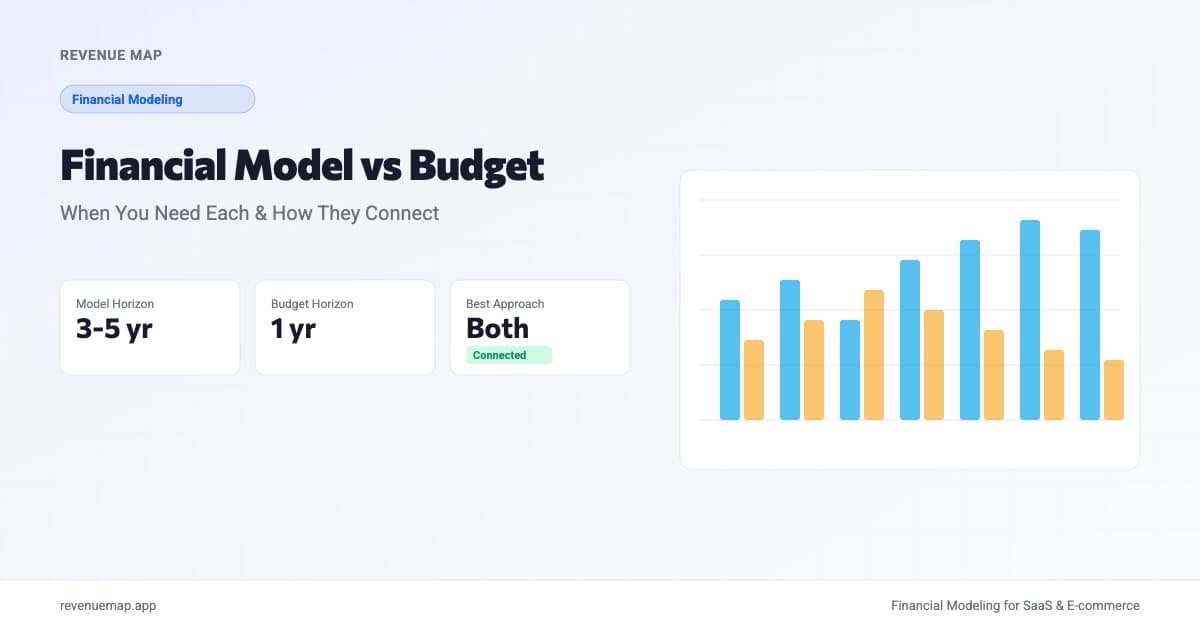
Financial Model vs Budget: When You Need Each
A financial model projects scenarios over 3-5 years. A budget allocates spending for 12 months. Here is when to use each and how to connect them.
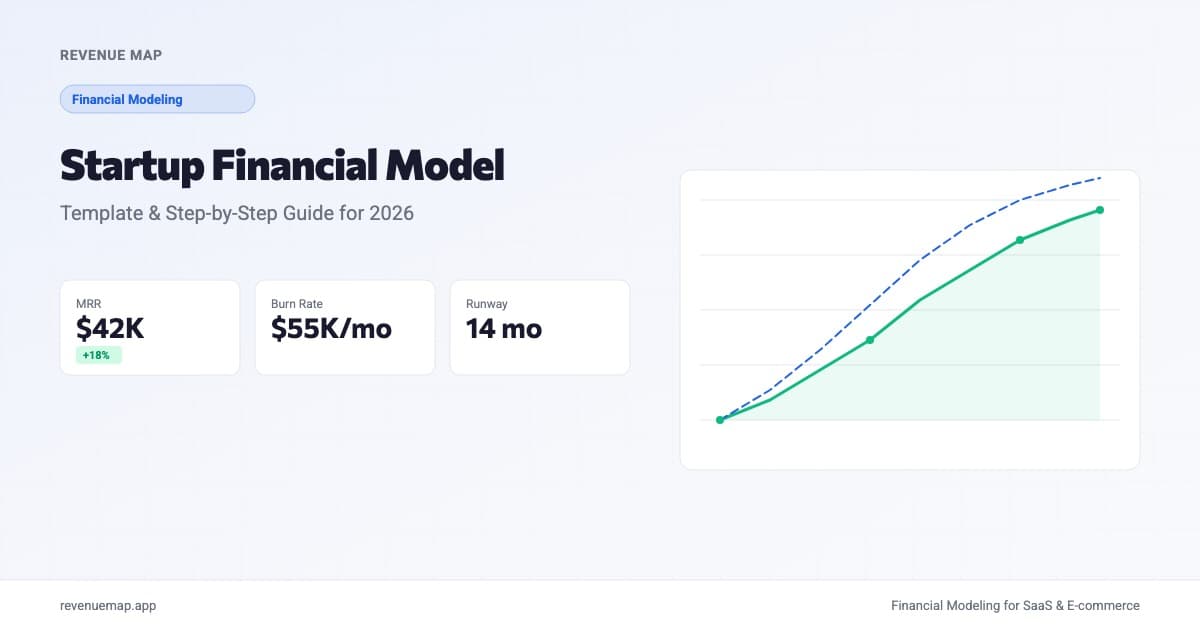
Startup Financial Model Template (2026 Guide)
Build a startup financial model from scratch with this step-by-step template. Covers revenue, costs, runway, and the metrics investors expect.
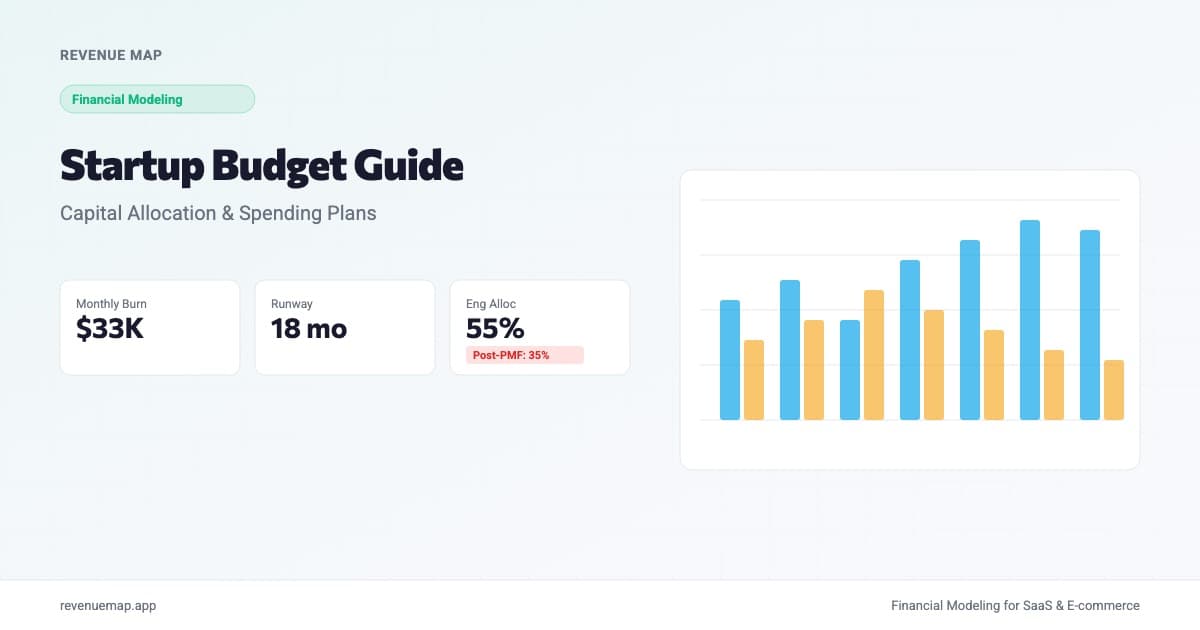
How to Create a Startup Budget in 2026
Step-by-step guide to building a startup budget with allocation frameworks, benchmarks, and a free calculator. Includes what VCs look for.