Startup Costs: How to Calculate and Budget
Startup costs are the one-time and recurring expenses needed to launch a business. Most tech startups spend between $15,000 and $75,000 before generating any revenue. Calculate total startup costs by adding incorporation fees, product development, marketing, and at least 6 months of operating expenses.
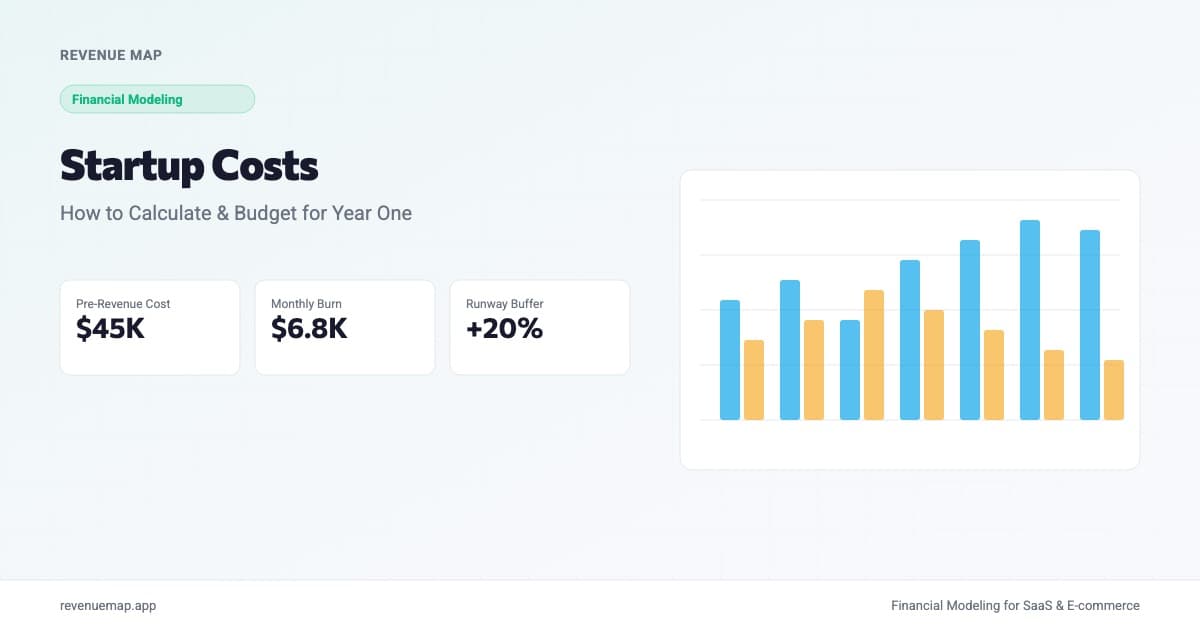
Startup costs are the one-time and recurring expenses you need to cover before your business generates its first dollar of revenue. For most tech startups, that number falls somewhere between $15,000 and $75,000, though it varies wildly based on your business model, team size, and whether you're bootstrapping or raising capital. Getting this number wrong doesn't just mess up your spreadsheet. It shortens your runway, forces premature fundraising, and in the worst case, kills the company before it finds product-market fit.
The cost picture gets more complicated when you factor in expenses that don't show up on a bank statement. According to a recent SaaStr analysis, a startup that appeared to deliver a clean 3.8x return on its acquisition price actually returned only 1.6x to investors after accounting for dilution across funding rounds. That gap between the headline number and the real economic outcome is something most first-time founders don't model until it's too late. Whether you're raising or bootstrapping, understanding your true startup costs is the foundation of every financial decision that follows.
What Are Startup Costs?
Startup costs are all the expenses a business incurs before it begins normal operations and generates revenue. They include both one-time expenditures (incorporating the company, buying equipment, building the MVP) and the recurring monthly expenses you'll burn through while the product is still pre-revenue.
The IRS draws a formal line between "startup costs" and "operating expenses," but for financial modeling purposes, what matters is the total cash you need from day zero to the point where revenue starts covering your bills. That total is your pre-revenue budget, and it feeds directly into your burn rate and runway calculations.
Startup costs typically fall into five categories:
- Legal and incorporation: entity formation, operating agreements, trademarks, initial contracts
- Product development: engineering salaries or contractor costs, design, cloud infrastructure, domain names
- Marketing and launch: website, initial ad spend, content creation, PR
- Operations: accounting software, insurance, office or coworking space, SaaS tools
- Working capital: the cash buffer you need to survive until revenue ramps
That last category is the one founders forget most often. You need enough cash to cover not just the build, but the months (sometimes many months) of operating expenses before customers start paying.
How Much Does It Cost to Start a Startup?
The honest answer: it depends on your model. A solo founder shipping a SaaS product from a home office has a fundamentally different cost structure than an e-commerce brand that needs to order inventory. Here are realistic ranges based on what we've seen across hundreds of financial models.
| Business Type | Typical Pre-Revenue Cost | Largest Expense Category | Time to First Revenue |
|---|---|---|---|
| SaaS (solo founder, MVP) | $5,000 to $15,000 | Cloud hosting and tools | 3 to 6 months |
| SaaS (small team, 2 to 4 people) | $30,000 to $75,000 | Salaries / contractor costs | 4 to 9 months |
| E-commerce (dropshipping) | $2,000 to $10,000 | Marketing and ads | 1 to 3 months |
| E-commerce (own inventory) | $20,000 to $100,000 | Inventory purchase | 2 to 6 months |
| Marketplace | $25,000 to $80,000 | Engineering (both sides) | 6 to 12 months |
| Service / agency | $3,000 to $15,000 | Marketing and sales | 1 to 3 months |
These numbers assume founders aren't paying themselves market-rate salaries during the pre-revenue phase. Once you add founder compensation, even a lean SaaS startup can burn $10,000 to $20,000 per month.
One trend worth watching: AI tools have meaningfully compressed the cost of building an MVP. The TechCrunch Startups report from July 2026 highlighted how AI-powered development tools are enabling founders to ship products faster and cheaper than ever before. That said, lower build costs often just shift spending to customer acquisition, which remains stubbornly expensive for most startups.
How to Calculate Your Total Startup Costs
Here's a step-by-step process for estimating your pre-launch budget. The goal is a single number: how much cash do you need before revenue covers your monthly expenses?
Step 1: List One-Time Costs
These are expenses you pay once during setup:
- LLC or C-Corp filing fees ($50 to $500 depending on state)
- Legal fees for operating agreement, IP assignment, founder agreements ($1,000 to $5,000)
- Domain name and branding ($100 to $2,000)
- Equipment (laptops, monitors, peripherals) ($500 to $3,000 per person)
- Initial inventory or prototype costs (varies by model)
- Website design and development ($0 if DIY, $2,000 to $10,000 if outsourced)
Step 2: Estimate Monthly Operating Costs
These recur every month regardless of revenue:
- Cloud hosting (AWS, Vercel, etc.): $50 to $500
- SaaS tool stack (email, analytics, project management): $100 to $500
- Accounting and bookkeeping: $200 to $1,000
- Insurance (general liability, E&O): $100 to $300
- Marketing spend: $500 to $5,000
- Contractor or freelancer costs: $0 to $10,000
- Coworking or office space: $0 to $2,000
Step 3: Estimate Months to Revenue
Be conservative. Most founders underestimate this by 50% or more. If you think you'll have paying customers in three months, model for six.
Step 4: Apply the Formula
Total Startup Cost = One-Time Costs + (Monthly Operating Costs x Months to Revenue)
Worked example: CloudSync (B2B SaaS, 2 founders)
One-time costs: $4,200 (Delaware C-Corp $400, legal $2,500, equipment $1,000, domain/branding $300)
Monthly operating costs: $6,800 (cloud hosting $200, tools $350, accounting $400, marketing $2,500, part-time designer $3,000, insurance $150, coworking $200)
Estimated months to first revenue: 6
Total startup cost: $4,200 + ($6,800 x 6) = $45,000
That's the minimum cash the founders need before revenue starts. We'd recommend adding a 20% buffer for unexpected expenses, bringing the target to roughly $54,000.
Estimate Your Startup Costs
Startup Cost Calculator
Estimate total pre-revenue costs for your startup
What Hidden Costs Do Founders Miss?
The line items above are the predictable part. The expenses that actually catch founders off guard are the ones that don't fit neatly into a budget spreadsheet.
Equity dilution is a real cost. If you raise a seed round, you're trading 15% to 25% of your company for capital. That's not free money. The SaaStr analysis we referenced earlier showed a company selling for 3.8x its entry valuation, but investors only receiving 1.6x in actual returns after accounting for dilution across multiple rounds. For founders, the dilution math is even steeper. Every round compresses your ownership, and if the exit isn't massive, you can work for years and walk away with less than you'd have earned as an employee at a larger company. Model this before you raise.
Customer acquisition cost scales faster than you think. Your first 50 customers might come from your network, Product Hunt, or organic search. Customers 51 through 500 almost always cost more per head. Budget for a CAC payback period of 6 to 18 months, and make sure your startup cost estimate includes enough marketing runway to reach sustainable acquisition volume.
Compliance and regulatory costs appear without warning. SOC 2 audits ($10,000 to $50,000), GDPR compliance tooling, payment processor reserves, state sales tax registration, these expenses tend to show up right when you're closing your first enterprise deals, precisely the moment when your cash is tightest.
Hiring is more expensive than the salary. Recruiting, onboarding, benefits, equipment, and the productivity ramp-up period can add 25% to 40% on top of base compensation. If your startup costs model assumes you'll hire two engineers at $120,000 each, the real annual cost is closer to $160,000 per person.
How Do Startup Costs Differ from Ongoing Operating Expenses?
Startup costs are the expenses incurred before the business begins normal operations. Operating expenses are the recurring costs of running the business once it's live. The distinction matters for two reasons.
First, your financial projections need to separate the two. Investors want to see how much it costs to get the business off the ground (startup costs) versus how much it costs to keep it running (operating expenses). Mixing them together makes your burn rate look artificially high in early months and artificially low later.
Second, the accounting and tax treatment is different. In the U.S., up to $5,000 of startup costs can be deducted in year one, with the rest amortized over 15 years. Operating expenses are fully deductible in the year they're incurred.
For modeling purposes, we recommend creating a separate "launch budget" tab in your financial model template that tracks one-time startup costs independently from your monthly P&L.
Common Budgeting Mistakes
Confusing "MVP cost" with "startup cost." The cost to build the product is just one component. You also need cash for legal, marketing, operations, and the months of runway before revenue kicks in. An MVP that costs $8,000 to build might sit inside a $45,000 total startup budget.
Ignoring the time-to-revenue gap. Even after launch, most startups take 3 to 9 months to reach meaningful revenue. Your budget needs to cover this gap. Calculate it as part of your runway analysis.
Planning for best-case scenarios. If your model says you'll break even in month four, plan your budget for month eight. Things take longer than expected. Features slip. Sales cycles stretch. The founders who survive are the ones who modeled the pessimistic case and had the cash to ride it out. A solid break-even analysis will help you find the realistic timeline.
Not tracking actuals against the budget. A startup cost estimate is only useful if you compare it to real spending every month. Set up a simple tracker from day one. When actual costs drift from estimates (and they will), adjust the plan rather than ignoring the gap.
Key Takeaways
- Total startup costs include one-time expenses plus monthly operating costs multiplied by the months until revenue covers your burn. Most tech startups need $15,000 to $75,000 pre-revenue.
- The biggest underestimated costs are equity dilution, customer acquisition ramp-up, compliance requirements, and the gap between launch and meaningful revenue.
- Always add a 20% buffer to your estimate and model the pessimistic timeline, not the best case.
- Separate startup costs from ongoing operating expenses in your financial model. Investors expect this distinction, and it makes your projections more credible.
- Track actuals against your budget monthly from day one. The plan will be wrong; what matters is how quickly you catch and respond to the drift.
Ready to build a startup budget that actually holds up? Create your financial model with Revenue Map and see exactly how your startup costs feed into burn rate, runway, and break-even projections.
Related Articles
How to Create a Startup Budget in 2026
Step-by-step guide to building a startup budget with allocation frameworks, benchmarks, and a free calculator. Includes what VCs look for.
Startup Burn Rate: How to Calculate, Benchmark, and Cut It
Learn how to calculate gross and net burn rate, compare to stage-specific benchmarks, and apply proven strategies to extend your startup's runway.
Car Wash Business Plan: Costs and Projections
Build the financial section of your car wash business plan with real startup costs, revenue projections, and the numbers lenders require.