Three-Statement Financial Model Template
A three-statement financial model links your income statement, balance sheet, and cash flow statement into a single integrated spreadsheet. It lets you see how any business decision, from pricing changes to new hires, cascades across revenue, assets, and cash.
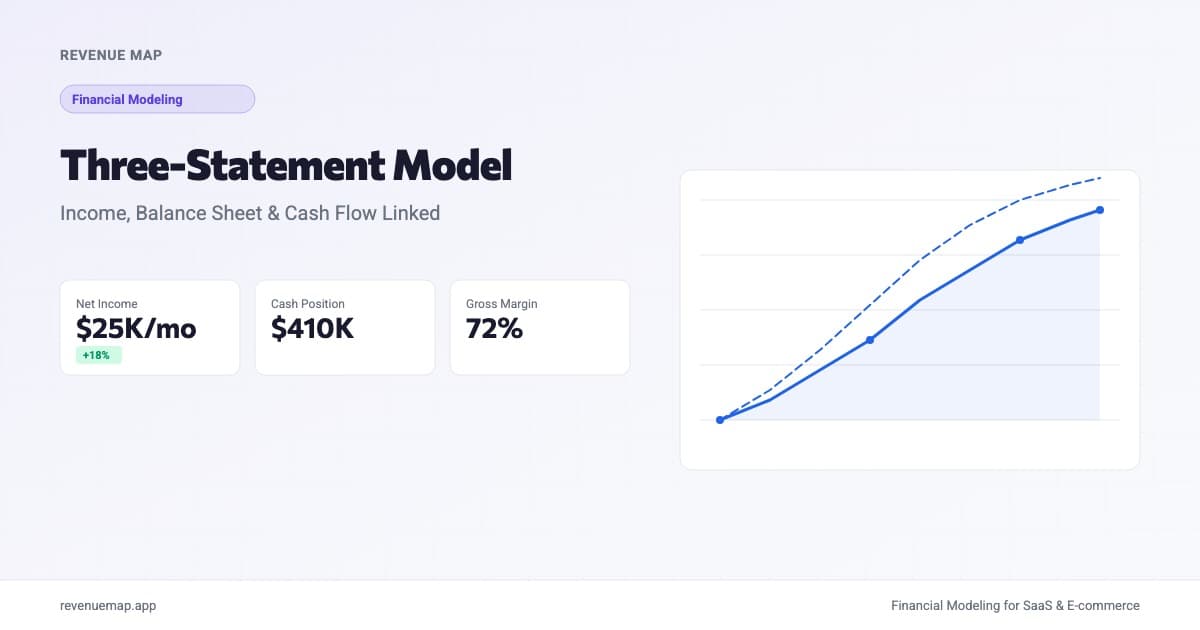
A three-statement financial model is an integrated spreadsheet that links your income statement, balance sheet, and cash flow statement into a single connected system. When you change a revenue assumption or add a hire, the impact flows automatically through all three statements, showing you not just whether the business is profitable on paper but whether it will have cash in the bank. If you are building startup financial projections, the three-statement model is the format that investors expect and the one that actually catches cash-flow problems before they become emergencies.
Why does this matter right now? Consider the decision Atlassian just made with Loom. According to SaaStr's analysis, Atlassian eliminated Loom's free creator seats shortly after acquiring the company. That single pricing decision cascades across all three financial statements: the income statement sees higher ARPU but potentially lower user growth, the balance sheet shifts as deferred revenue and receivables change, and the cash flow statement reflects a completely different collection pattern. A founder staring at a P&L alone would miss half the picture.
What Is a Three-Statement Financial Model?
A three-statement financial model is a set of three linked financial statements that together describe the complete financial position of a business. The three statements are:
- Income Statement (P&L): revenue minus expenses over a period, ending in net income
- Balance Sheet: what the company owns (assets), owes (liabilities), and the residual equity at a specific point in time
- Cash Flow Statement: a reconciliation of net income to actual cash movement, broken into operating, investing, and financing activities
The critical word is "linked." In a properly built three-statement model, you do not enter numbers independently into each statement. Net income from the P&L feeds directly into the balance sheet and cash flow statement. Working capital changes on the balance sheet appear as adjustments in operating cash flow. Debt repayments affect both the balance sheet and financing cash flow. Change one input and the entire model updates.
This is the standard framework used in investment banking, private equity, and increasingly in startup finance. If you have been working with a standalone SaaS financial model or a simple P&L, the three-statement model is the next level of rigor.
Why a P&L Alone Is Not Enough
Here is the problem founders run into: a P&L can show profitability while your bank account is draining. The income statement uses accrual accounting, recording revenue when earned and expenses when incurred, regardless of when cash changes hands.
A SaaS company billing annual contracts upfront illustrates this. The income statement recognizes one-twelfth of each contract per month, but the cash arrived on day one. The P&L says "$50K MRR." The bank account says "$600K just landed." Those are very different signals for planning.
The reverse is equally dangerous. A company with 90-day payment terms might show strong revenue growth on the P&L while burning through cash waiting for customers to pay.
| What it tells you | Income Statement | Balance Sheet | Cash Flow Statement |
|---|---|---|---|
| Revenue and profit | Yes | No | Indirectly |
| What you own and owe | No | Yes | No |
| Actual cash position | No | Yes (cash line) | Yes |
| Can you make payroll next month? | No | Partially | Yes |
| Impact of a pricing change | Partially | Partially | Yes (when combined) |
How the Three Statements Connect
The linkages between statements are what make the model powerful. Here is how they work:
Net income connects to everything. Net income from the bottom of the P&L flows into two places: retained earnings on the balance sheet (increasing equity) and the top line of the cash flow statement (the starting point for operating cash flow).
Working capital bridges profit and cash. When a customer owes you money, accounts receivable goes up on the balance sheet. That increase reduces operating cash flow on the cash flow statement, even though the P&L already recorded the revenue. The formula:
Operating Cash Flow = Net Income + Non-Cash Charges + Changes in Working Capital
The balance sheet must balance. Assets always equal liabilities plus equity. This acts as an automatic error check. If your model does not balance, something is linked incorrectly.
Ending cash ties back. The ending cash balance on the cash flow statement must equal the cash line on the balance sheet. This is the final integrity check that confirms the entire model is internally consistent.
How to Build a Three-Statement Model: Step by Step
Step 1: Start with the Income Statement
Build the P&L first because net income drives everything else. For a startup, the key line items are:
- Revenue: broken down by stream (subscriptions, services, one-time sales). If you are modeling SaaS, use MRR components: new, expansion, contraction, and churned. A demo conversion rate of 10 to 20% is a useful benchmark for pipeline-driven revenue assumptions, according to SaaStr.
- Cost of Goods Sold (COGS): hosting, infrastructure, payment processing, customer support directly tied to delivery
- Operating Expenses: salaries, marketing, rent, software, legal
- Net Income: revenue minus all costs and taxes
Your gross margin line (revenue minus COGS) is worth isolating because it determines how much each additional dollar of revenue contributes to covering fixed costs.
Step 2: Build the Balance Sheet
The balance sheet has three sections:
Assets (what you own):
- Cash and cash equivalents
- Accounts receivable (revenue earned but not yet collected)
- Prepaid expenses (rent, insurance paid in advance)
- Property and equipment (minus depreciation)
Liabilities (what you owe):
- Accounts payable (bills not yet paid)
- Deferred revenue (cash collected for services not yet delivered)
- Debt (loans, credit lines)
- Accrued expenses (salaries, taxes owed but not yet paid)
Equity:
- Paid-in capital (investment raised)
- Retained earnings (cumulative net income minus dividends)
For most startups, the key items to get right are cash, accounts receivable, deferred revenue (if you bill in advance), and equity from fundraising rounds. Skip the complexity you do not have yet.
Step 3: Create the Cash Flow Statement
The cash flow statement has three sections:
Operating activities: start with net income, add back non-cash expenses (depreciation, stock-based compensation), then adjust for working capital changes. If accounts receivable increased, subtract that amount because you recorded revenue but did not collect cash.
Investing activities: purchases of equipment, capitalized software development costs. For most early-stage startups, this section is small.
Financing activities: equity raised, debt borrowed or repaid, dividends paid.
Ending Cash = Beginning Cash + Operating CF + Investing CF + Financing CF
This ending cash number must match the cash line on your balance sheet. If it does not, trace the discrepancy. The most common culprit is a working capital item that you forgot to link.
Step 4: Link and Validate
Once all three statements exist, connect them:
- Net income from the P&L feeds into retained earnings (balance sheet) and the top of the cash flow statement
- Depreciation from the P&L adds back to operating cash flow and reduces asset values on the balance sheet
- Working capital changes (AR, AP, deferred revenue) from the balance sheet appear in operating cash flow
- Ending cash from the cash flow statement equals the cash line on the balance sheet
Run a balance check: assets minus liabilities minus equity should equal zero. If it does not, you have a linkage error.
Calculate Your Net Income
Net Income Calculator
Estimate monthly net income from revenue and cost structure
Three-Statement Model Benchmarks for Startups
These benchmarks give you a sanity check as you build out your model. If your numbers fall far outside these ranges, revisit your assumptions.
| Metric | Pre-Revenue | Seed to Series A | Series B+ |
|---|---|---|---|
| Gross Margin (SaaS) | N/A | 60 to 75% | 70 to 85% |
| Operating Cash Flow | Negative | Negative to break-even | Positive or near |
| AR Days (collection period) | 0 to 15 days | 15 to 45 days | 30 to 60 days |
| Cash as % of Assets | 80 to 95% | 50 to 80% | 30 to 60% |
| Deferred Revenue Ratio | Low | Growing | Significant |
| Burn Rate | $15K to $40K/mo | $50K to $200K/mo | $200K to $1M+/mo |
One thing worth noting: early-stage startups often have very simple balance sheets where cash is 80% or more of total assets. That simplicity is an advantage. It means your cash flow statement and balance sheet will be straightforward to build. Do not add complexity that does not exist yet.
Common Mistakes to Avoid
-
Building statements in isolation. If your P&L, balance sheet, and cash flow statement have no cell linkages between them, you have three documents, not a model. The linkages are the entire point.
-
Ignoring working capital. If your customers pay in 45 days, your cash flow lags your P&L by six weeks. Model accounts receivable and payable explicitly.
-
Forgetting deferred revenue. SaaS companies billing annually collect cash before they earn the revenue. That cash sits on the balance sheet as a liability and only converts to P&L revenue over 12 months. Miss this and your cash flow statement will be wrong.
-
Not balancing the balance sheet. Assets must equal liabilities plus equity. An unbalanced model gives you incorrect cash projections, which defeats the purpose.
-
Over-engineering for your stage. A pre-seed startup does not need 15 balance sheet line items. Start with cash, AR, AP, equity, and retained earnings. Add complexity as the business warrants it. A burn rate check or break-even analysis can live in simpler formats until you need integrated financials for fundraising or strategic decisions.
Key Takeaways
- A three-statement financial model links your income statement, balance sheet, and cash flow statement so that every business decision is reflected across all three.
- Net income is the primary connector: it flows from the P&L into retained earnings on the balance sheet and is the starting point for the cash flow statement.
- Working capital adjustments bridge the gap between accounting profit and actual cash, which is where most founders get surprised.
- Start simple. Early-stage startups need fewer than ten balance sheet line items. Add complexity only as the business grows.
- Always validate that your balance sheet balances and that ending cash matches across statements. If it does not, trace the broken link before trusting any output.
A financial model that only shows revenue and expenses is half the picture. The three-statement model is how you see whether your startup will actually have cash to operate next quarter, not just profit on paper. Build your integrated financial model with Revenue Map and connect your projections to the metrics that matter.
Related Articles
Creating Financial Models in Excel for Startups
Step-by-step guide to building a startup financial model in Excel. Covers revenue, expenses, cash flow, and scenario analysis with formulas and examples.
Budget vs Forecast vs Projection for Startups
Budgets, forecasts, and projections serve different purposes. Learn when to use each and how they connect in your startup financial plan.
Financial Modeling Software for Startups (2026)
Compare the best financial modeling software for startups, from spreadsheets to AI-native tools. Features, pricing, and when to upgrade from Excel.