Salon Startup Costs: Full 2026 Breakdown
Hair salon startup costs range from $40,000 for a solo suite rental to $340,000 for a premium multi-chair location. Buildout and leasehold improvements are the largest single expense, followed by working capital. Most independent salons land between $100,000 and $250,000 all in.
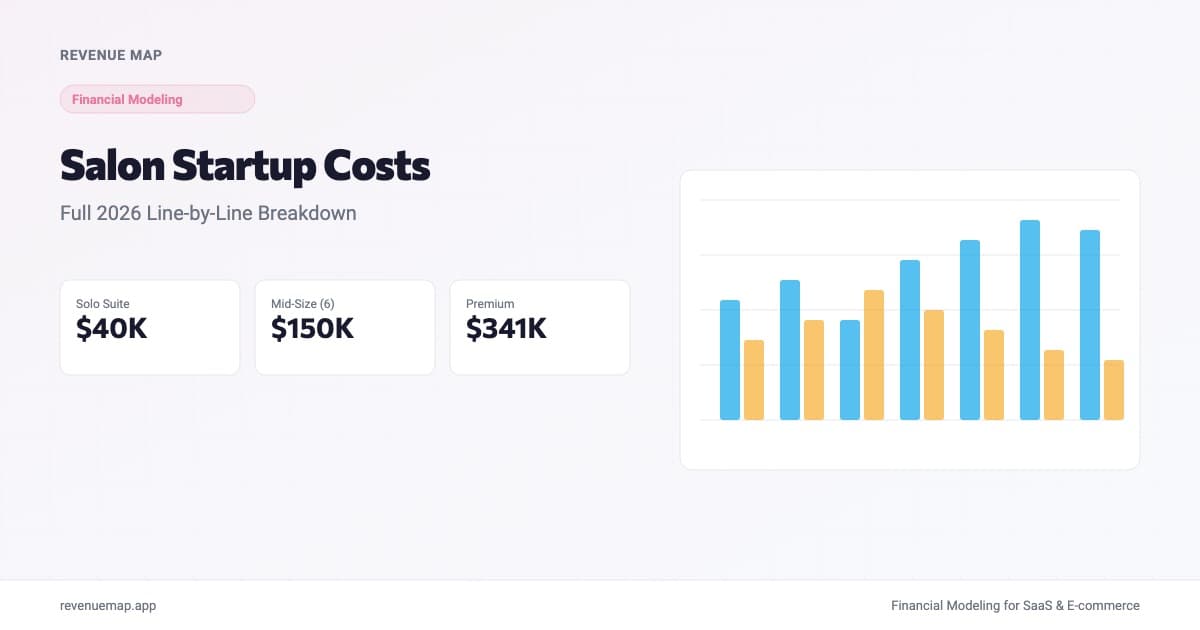
Hair salon startup costs range from about $40,000 for a solo suite rental to $340,000 for a premium multi-chair location with custom finishes and full spa services. Buildout and working capital account for most of the total, with equipment, permits, and marketing filling in the rest. Most independent salons land between $100,000 and $250,000.
Understanding where overhead eats your budget matters more than the headline number. Small Business Trends recently broke down why overhead expenditures catch small business owners off guard, and salons are a perfect case study: rent, utilities, insurance, and product costs run whether the chairs are full or empty. Getting those fixed costs right before you sign a lease is the difference between a salon that builds equity and one that bleeds cash from month one.
Here is a full breakdown of salon startup costs in 2026, organized by format, with the line items lenders and landlords actually ask about.
What Does It Cost to Open a Salon?
The total depends on three things: the format (solo suite vs. small independent vs. full-service), the condition of the space (turnkey former salon vs. raw retail shell), and the market (rent in Dallas looks nothing like rent in Brooklyn).
Here is a realistic range across four common formats:
| Category | Solo Suite | Small (2-3 Chairs) | Mid-Size (6 Chairs) | Premium Full-Service |
|---|---|---|---|---|
| Leasehold improvements and buildout | $0 | $10,000 | $45,000 | $120,000 |
| Styling stations, chairs, mirrors | $1,500 | $4,000 | $15,000 | $36,000 |
| Shampoo bowls and plumbing | $0 | $2,000 | $8,000 | $18,000 |
| Equipment (dryers, tools, color processing) | $2,000 | $3,500 | $10,000 | $25,000 |
| Retail product inventory | $500 | $2,000 | $8,000 | $20,000 |
| POS system and booking software | $500 | $1,500 | $4,000 | $8,000 |
| Permits, licenses, cosmetology compliance | $500 | $1,500 | $4,000 | $10,000 |
| Insurance (first year) | $800 | $2,000 | $5,000 | $9,000 |
| Marketing, signage, website | $1,200 | $3,000 | $6,000 | $15,000 |
| Working capital (6 months) | $33,000 | $20,000 | $45,000 | $80,000 |
| Total | $40,000 | $49,500 | $150,000 | $341,000 |
The solo suite figure is higher than it looks at first because the working capital line includes six months of suite rent ($200 to $600 per week). You skip the buildout, but you still need cash reserves to survive while building a client book.
The Five Biggest Cost Categories
1. Buildout and Leasehold Improvements ($0 to $120,000)
The buildout is the single most variable line item and often the largest. Converting a raw retail space into a functioning salon requires plumbing for shampoo bowls (minimum two, ideally one per two styling stations), upgraded electrical capacity for dryers and color processing equipment, ventilation for chemical products, and flooring that can handle water and foot traffic all day.
A turnkey space that previously housed a salon is the fastest way to cut this cost. The plumbing, electrical, and ventilation are already in place. You might spend $5,000 to $15,000 on cosmetic updates: paint, branding, new mirrors, lighting. That saves $30,000 to $80,000 compared to a raw-shell conversion.
Landlord tenant improvement (TI) allowances can cover a significant portion of the buildout. A landlord who wants a salon tenant (long leases, predictable hours, low noise complaints) may offer $10 to $25 per square foot. On a 1,200-square-foot space, that is $12,000 to $30,000 toward the build. Negotiate for it before you sign. The worst answer you get is no.
2. Working Capital ($20,000 to $80,000)
Working capital is the line item that separates salons that survive the ramp from salons that close in month three. New salons rarely fill chairs immediately. Stylists need time to build client books through referrals, social media, and walk-ins. During those first few months, rent, insurance, loan payments, and software subscriptions still come due.
Budget at least six months of fixed operating expenses: rent, insurance, loan payments, utilities, and software. For a mid-size salon with $5,500 in monthly rent and $3,000 in other fixed costs, that means roughly $45,000 to $55,000 in cash reserves before you open.
The commission model helps here. A commission-based salon pays stylists 35% to 50% of the revenue they actually generate, so your labor cost drops on slow days instead of running as a fixed payroll obligation. That variable cost structure means your burn rate falls when revenue falls, extending your cash runway.
3. Equipment and Styling Stations ($3,500 to $89,000)
Equipment breaks into three tiers. Styling stations (hydraulic chairs, mirrors, storage cabinets) run $1,000 to $6,000 per station. Shampoo bowls with plumbing connections cost $800 to $3,000 each installed. Processing equipment, hood dryers, flat irons, and color tools add $2,000 to $25,000 depending on how many services you offer.
Buying used commercial-grade stations from salon liquidations saves 30% to 50%. Brands like Belvedere, Takara Belmont, and Collins hold up for decades. Check equipment resellers and closing-salon sales before paying retail. The exception: shampoo bowls and plumbing fixtures should be new, because water damage to a freshly built-out space costs far more than you saved.
4. Product Inventory ($500 to $20,000)
Salon products split into back-bar consumables (color, developer, shampoo, treatments) and retail inventory sold to clients. Back-bar cost per service runs $3 to $12, with color services at the high end. Budget $500 to $3,000 for initial back-bar stock.
Retail is optional but profitable: selling take-home products adds revenue without adding chair time, and margins run 40% to 50%. Start conservatively with $3,000 to $5,000 and restock based on what actually sells. Dead inventory ties up cash.
5. Permits, Insurance, and Compliance ($1,300 to $19,000)
Every state requires a cosmetology establishment license ($200 to $1,500), and most require annual health department inspections. Insurance is non-negotiable: general liability ($1,000 to $3,000/year), professional liability ($500 to $1,500), and property insurance ($500 to $2,000) are the baseline. Workers' comp is required if you hire employees rather than independent contractors.
Check your state cosmetology board requirements before signing a lease. Minimum square footage per station, ventilation standards, and ADA compliance can force design changes that add $5,000 to $15,000 if discovered after the buildout starts.
Hidden Costs That Catch First-Time Salon Owners
Beyond the table above, these expenses surprise new operators:
- Utility deposits and ongoing costs. Salons use more water and electricity than typical retail. Expect deposits of $500 to $2,000 and monthly bills of $400 to $1,200.
- Towels and laundry. A six-chair salon goes through 50 to 100 towels per day. Commercial laundry runs $300 to $800/month, or invest $2,000 to $4,000 in your own washer/dryer units.
- Credit card processing fees. Processing fees of 2.5% to 3.5% on $50,000/month in revenue cost $1,250 to $1,750 monthly.
- Continuing education. Most states require CE hours for license renewal. Budget $500 to $1,500 per stylist per year.
How to Finance Salon Startup Costs
Most salon owners use a combination of personal savings, an SBA loan, and sometimes equipment financing. Here is how the typical capital stack looks:
Total Startup Cost = Owner Equity (10-30%) + SBA 7(a) Loan (50-70%) + Equipment Financing (10-20%)
SBA 7(a) loans offer terms up to 10 years for equipment and 25 years for real estate. Lenders require a business plan with financial projections, a startup cost breakdown, and a DSCR of at least 1.25x. Our guide on writing a business plan for a business loan covers what lenders scrutinize. Equipment financing covers styling stations and shampoo bowls separately at 6% to 12% interest over 3 to 7 years.
Calculate Your Salon Startup Costs
Hair Salon Budget Calculator
Estimate your total startup investment by salon format
Want to model this over 36 months with scenarios? Try Revenue Map free →
What Revenue Do You Need to Cover These Costs?
A salon's revenue is driven by stylists, clients per day, and average service ticket. Understanding your gross margin by service type helps determine how quickly you recoup your investment. The core formula:
Monthly Revenue = Stylists x Clients per Day x Avg Ticket x Days Open
A mid-size salon with $150,000 in startup costs, financed at 60% via an SBA loan, needs roughly $8,000 to $10,000 per month in operating profit to service the debt. At a $70 average ticket with six stylists seeing five clients per day, that is achievable by month four or five. For the full revenue model and 12-month cash flow, see the salon business plan guide. Run the numbers with the startup cost calculator or build a full projection with the salon and barbershop model.
How to Reduce Salon Startup Costs
- Take over a turnkey salon space. A former salon already has plumbing, electrical, and ventilation. Savings: $30,000 to $80,000 on leasehold improvements.
- Buy used styling stations. Commercial hydraulic chairs from brands like Belvedere or Collins last decades. Used units sell for 30% to 50% below retail.
- Negotiate a TI allowance. Landlords value salon tenants for their long lease terms and consistent foot traffic. A $15 to $25 per square foot allowance on a 1,200-square-foot space covers $18,000 to $30,000 of your buildout.
- Start with fewer chairs. Open with four stations and add two more as revenue justifies it. You save on equipment and reduce the square footage you need.
- Skip retail inventory at launch. Back-bar products are essential, but retail shelves can wait. Add retail in month three based on real demand.
- Use a pre-opening campaign. A founding-client promotion can generate $5,000 to $15,000 in prepaid appointments before opening, reducing the working capital you need.
Key Takeaways
- Hair salon startup costs range from $40,000 (solo suite) to $340,000 (premium multi-chair), with most independent salons landing between $100,000 and $250,000.
- Buildout and working capital are the two largest line items. Taking over a turnkey space and negotiating a tenant improvement allowance are the highest-leverage savings.
- Commission-based labor is the structural advantage of salons: your biggest cost scales with revenue, which keeps the burn rate low during the ramp-up.
- Budget at least six months of working capital. The commission model helps, but rent, insurance, and utilities still arrive on schedule whether the chairs are full or not.
- SBA 7(a) loans plus equipment financing cover 70% to 90% of startup costs for qualified borrowers. Start with a solid business plan and break-even analysis.
- Ready to put real numbers behind your salon budget? Build your projection free in two minutes.
Related Articles
Bakery Startup Costs: Full 2026 Breakdown
Opening a bakery costs $20,000 to $324,000. Line-by-line breakdown by format with equipment, buildout, permits, and working capital.
Gym Startup Costs: Full 2026 Breakdown
Gym startup costs range from $50K for a personal training studio to $500K for a full-service facility. Full line-by-line breakdown with real numbers.
Car Wash Startup Costs: Full 2026 Breakdown
Opening a car wash costs $70,000 to $500,000 depending on format. Full cost breakdown for mobile, hand wash, self-service, and tunnel operations.