Micro SaaS Ideas: 10 Profitable Niches for 2026
Micro SaaS is a small, focused software product built by a solo founder or tiny team, targeting a specific niche. Profitable micro SaaS ideas for 2026 include AI API cost trackers, niche CRM tools, SEO monitoring dashboards, and vertical workflow automations.
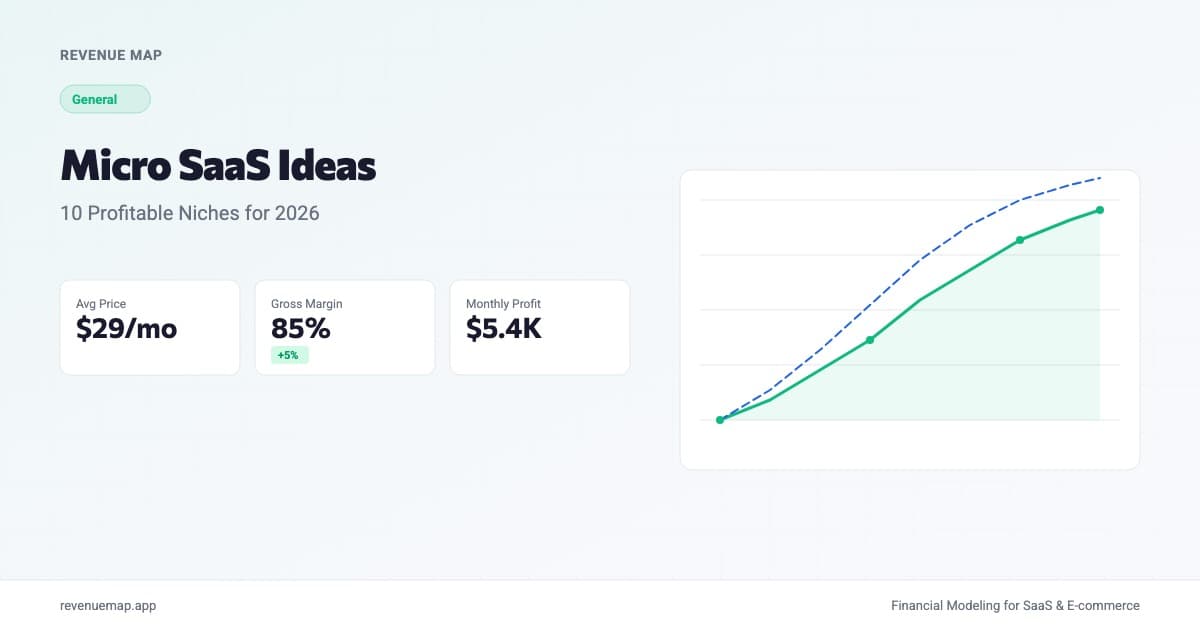
Micro SaaS ideas are small, focused software products that solve one specific problem for a narrow audience. They are typically built by solo founders or tiny teams, and the best ones generate $5,000 to $50,000+ in monthly recurring revenue with minimal overhead. Unlike venture-backed startups that need to grow at all costs, micro SaaS businesses can reach profitability in months, not years.
The proof that this model works at every scale arrived this week. According to TechCrunch, Stripe is reportedly acquiring OpenRouter for over $7 billion. OpenRouter started as a focused API routing tool, essentially a single-purpose interface for sending requests to different AI models. It was the textbook micro SaaS: one niche, one pain point, one clean product. The difference between a $5K/month lifestyle business and a $7B acquisition is distribution and timing, not complexity.
What Is Micro SaaS?
Micro SaaS is a software-as-a-service business that intentionally stays small in scope. Instead of building an all-in-one platform, you pick one workflow, one pain point, or one audience and solve it better than anyone else.
The defining characteristics:
- Narrow niche: serves one type of user (freelance designers, Shopify store owners, DevOps teams)
- Solo or tiny team: one to three people, no investors required
- Low overhead: hosting costs under $200/month, no office, no sales team
- Recurring revenue: monthly or annual subscriptions, typically $9 to $99/month per seat
- Fast to launch: MVP in weeks, not months
Here's the thing: the rise of AI coding assistants has dramatically compressed build timelines. What used to take a contract developer three months can now ship in two to four weeks if you are technical. That shift makes 2026 the best year yet to launch a micro SaaS.
10 Micro SaaS Ideas Worth Building in 2026
Each idea below includes a target price range and the audience it serves. The table summarizes the economics at a glance, and we go deeper on the standout opportunities below.
| Idea | Target Audience | Price Range | Est. TAM (niche) | Key Metric |
|---|---|---|---|---|
| AI API cost tracker | Dev teams using LLMs | $29-79/mo | Medium | Cost/request |
| Niche CRM for agencies | Creative and marketing agencies | $19-49/mo | Medium | Pipeline velocity |
| SEO content decay monitor | Content marketers | $19-39/mo | Medium | Pages declining |
| Subscription analytics dashboard | Stripe-connected SaaS founders | $29-99/mo | Large | MRR, churn |
| Client onboarding checklist tool | Professional services firms | $15-39/mo | Medium | Completion rate |
| Invoice follow-up automator | Freelancers and consultants | $9-29/mo | Large | Collection rate |
| Changelog and release notes tool | SaaS product teams | $29-59/mo | Medium | Engagement rate |
| Status page generator | Small SaaS companies | $9-29/mo | Large | Uptime % |
| Proposal and SOW builder | Agencies and consultants | $19-49/mo | Medium | Win rate |
| Waitlist and referral page builder | Pre-launch startups | $19-39/mo | Medium | Referral conversion |
1. AI API Cost Tracker
The standout opportunity on this list. Every company integrating AI models faces the same problem: API costs are unpredictable and hard to track across providers. A dashboard that connects to OpenAI, Anthropic, and Google APIs, then surfaces cost-per-request, budget alerts, and usage trends by team, solves a genuine headache.
Why it works financially: development teams are already spending $500 to $50,000+ per month on AI APIs, so a $29-79/month monitoring tool is an easy sell. Low churn rate once integrated (switching costs are high), and the infrastructure to build this is just API polling plus a database.
2. Subscription Analytics Dashboard
Founders running SaaS products on Stripe need to see MRR, churn, and LTV without building a custom dashboard. Baremetrics and ChartMogul serve this market, but at $100+/month. A focused tool at $29-49/month that covers the essentials (MRR waterfall, cohort churn, ARPU trends) has room.
3. SEO Content Decay Monitor
Content teams publish hundreds of blog posts, then lose track of which ones are declining in rankings. A tool that connects to Google Search Console, flags posts losing impressions week over week, and suggests refresh priorities would save content managers hours of manual checking. Pair it with AI-generated rewrite suggestions and you have a sticky product.
4. Proposal and SOW Builder
Agencies and consultants spend hours writing proposals from scratch for every project. A template-driven tool that lets you assemble scope-of-work documents, attach pricing tables, and track client signatures handles a workflow that most people still manage in Google Docs. The saas pricing strategy here is straightforward: charge per seat or per workspace.
How to Evaluate a Micro SaaS Idea
Not every niche is worth building for. Before you write a line of code, run the idea through these five filters:
1. Willingness to pay. Does your target user already spend money on software? Developers and marketers do. Hobbyists and students rarely do. Check whether competing tools exist at price points above $15/month. Competition is validation.
2. Low churn potential. The best micro SaaS products embed into a workflow. If your tool becomes part of someone's daily routine (monitoring dashboards, CRM pipelines, invoicing), monthly churn stays below 3-5%. Tools used occasionally churn at 10%+ and the math collapses.
3. Cheap to run. Calculate your infrastructure cost per customer. If hosting and API costs per user exceed 30% of revenue, your gross margins will erode as you scale. The ideal micro SaaS costs under $2/month per customer to serve.
4. Narrow enough to own. Can you be the obvious best option for this specific use case? If the niche is broad ("project management"), you are competing with Asana and Monday. If the niche is tight ("project management for landscape architecture firms"), you can win.
5. No regulatory moat. Avoid niches that require compliance certifications, data residency guarantees, or industry-specific legal review. Those add months to launch timelines and ongoing costs that eat into micro SaaS margins.
Here is the formula for estimating monthly profit on a micro SaaS:
Monthly Profit = (Customers x Price) - (Fixed Costs + Variable Costs per Customer x Customers)
For a typical micro SaaS with 200 customers at $29/month, $150 in fixed hosting, and $1.50 per customer in variable costs:
Monthly Profit = (200 x $29) - ($150 + $1.50 x 200)
               = $5,800 - $450
               = $5,350/month
That is $64,200 per year in profit from a product you run solo. Scale to 500 customers and you are above $150K annually.
Calculate Your Micro SaaS Profitability
Micro SaaS Profit Calculator
Estimate monthly profit based on customers, pricing, and costs
Micro SaaS Benchmarks: What Good Looks Like
Before you build your financial model, here are the benchmarks that separate sustainable micro SaaS products from ones that stall out.
| Metric | Strong | Acceptable | Warning Sign |
|---|---|---|---|
| Monthly churn | Below 3% | 3-5% | Above 7% |
| Gross margin | Above 85% | 70-85% | Below 60% |
| CAC payback | Under 2 months | 2-4 months | Above 6 months |
| Infrastructure cost/user | Below $1 | $1-3 | Above $5 |
| Time to $1K MRR | Under 3 months | 3-6 months | Above 12 months |
The "time to $1K MRR" benchmark matters more than it looks. If your product cannot reach $1,000 in monthly recurring revenue within six months, either the market is too small, the pricing is too low, or the pain is not acute enough. That is the signal to pivot or abandon.
How to Model the Financials Before You Build
The smart move is to build the spreadsheet before the product. A simple startup financial model for a micro SaaS needs just four inputs:
- Customer acquisition rate (new customers per month, from organic SEO, communities, or Product Hunt launches)
- ARPU (average revenue per user per month)
- Monthly churn rate (percentage of customers who cancel)
- Cost per customer (hosting, APIs, support time valued at your hourly rate)
Plot these over 12 months. If the model shows profitability by month 4-6 with conservative assumptions, the idea passes the financial filter. If it needs 500+ customers to break even, your pricing is probably too low. Check the break-even analysis guide for the full framework.
For micro SaaS specifically, startup costs should stay under $500/month total. That keeps your burn rate minimal and means you can self-fund the project without outside capital.
Key Takeaways
- Micro SaaS products solve one narrow problem for a specific audience, targeting $5K-50K+ in monthly recurring revenue with minimal team and overhead.
- The best ideas for 2026 sit at the intersection of AI tooling and existing professional workflows, like API cost tracking, content monitoring, and intelligent proposal builders.
- Evaluate ideas on five dimensions before building: willingness to pay, churn potential, infrastructure cost, niche specificity, and regulatory complexity.
- Model the financials first. If you cannot reach profitability with 100-300 customers at your target price, the niche is probably too small or the pricing too low.
- Start with a focused MVP and expand only after you hit $1K MRR. Complexity kills micro SaaS products faster than competition does.
Browse more SaaS B2B ideas or explore AI/ML startup concepts if you want a broader list to riff on. When you are ready to validate the numbers, build your financial model with Revenue Map and see whether the unit economics hold up in minutes, not weeks.
Related Articles
Cash Flow Projection Template for Small Business
Build a 12-month cash flow projection your lender will trust. Includes formulas, a free calculator, and line-by-line examples for restaurants, coffee shops, and more.
SaaS Revenue Model Template for Startups
Build a SaaS revenue model from scratch with MRR components, pricing tier math, and expansion revenue. Includes a free calculator and benchmarks.
Budget vs Forecast vs Projection for Startups
Budgets, forecasts, and projections serve different purposes. Learn when to use each and how they connect in your startup financial plan.